Content Pillars for Instagram: Pick Four and Ratio Them

Content pillars for Instagram are three to five recurring topics, and every post you publish has to fit one of them. Each ties to a problem your buyer has and something you can prove you know. Pick four, give each a job, set a rough ratio between them, and review them after a month. Everything else is decoration. If you can't say which pillar a post belongs to before you write it, you're posting on impulse, and your feed reads that way.
Below: the five-pillar question, a worked example of one pillar, what the 5-3-1 and 5-5-5 rules actually are, and how to decide which pillar to cut.
What are the five content pillars?
There is no official set of five. Anyone who hands you a fixed list is selling a template. What most lists share is five jobs a feed needs to do. A workable version for a business account:
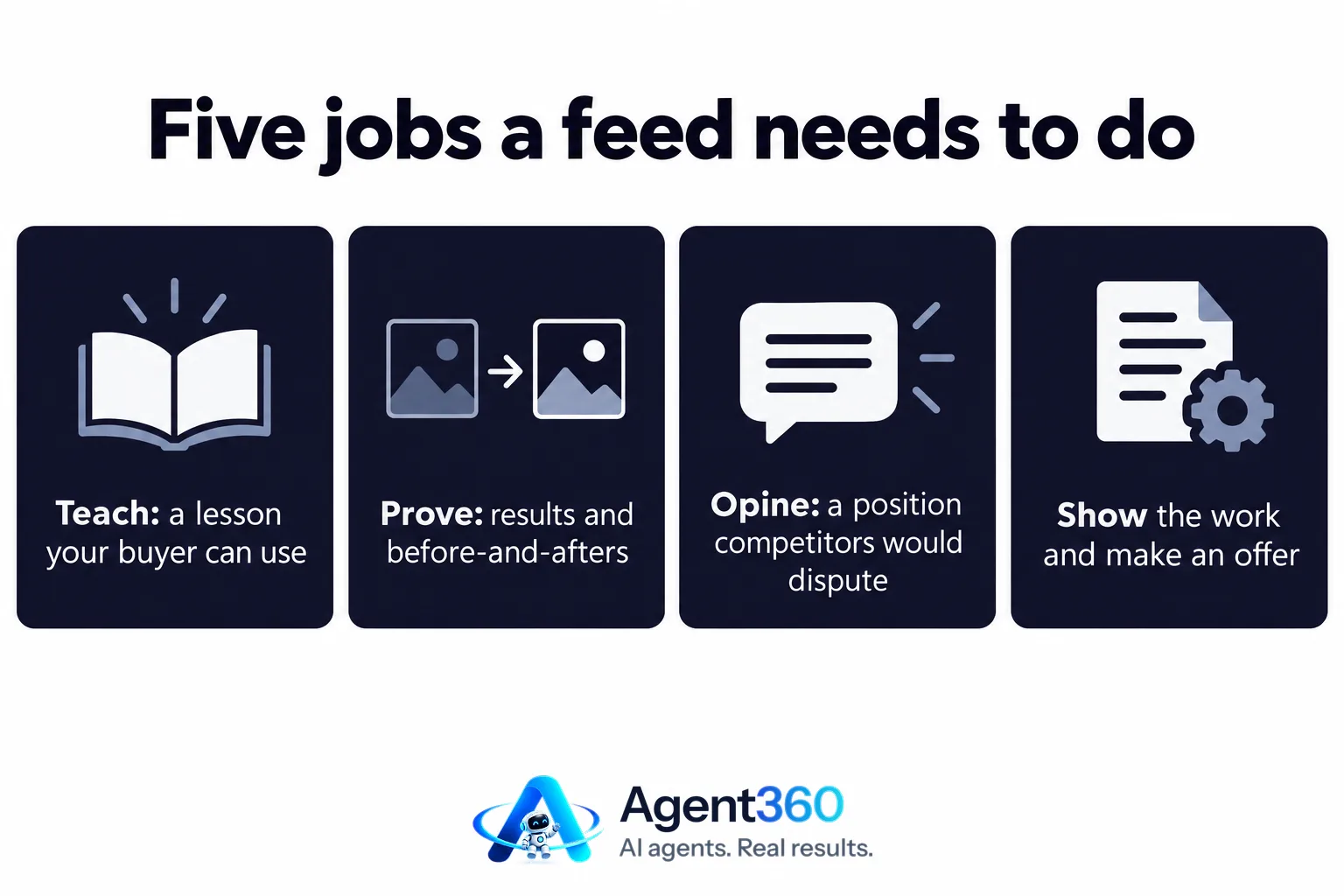
- Teach: a specific lesson your buyer can use today.
- Prove: results, before-and-afters, customer situations, numbers you can verify.
- Opine: a position you hold that some of your competitors would disagree with.
- Show the work: how the product, service or team actually operates.
- Offer: what you sell, who it is for, how to start.
Here is where we disagree with the usual advice. Five is a ceiling, not a target. Every extra pillar divides your posting volume. A brand posting a few times a week across five pillars shows each topic only now and then, which is too rarely for anyone to link you with it. Four pillars, repeated, build recognition faster than five. We make the same argument for every platform in Content Pillars for Social Media: Pick 4, Not 12.
Merge before you add. Opinion and teaching often collapse into one pillar, such as “what most people get wrong about X”. Showing the work and proof often merge too.
Can you give me an example of a content pillar?
Take a hypothetical bookkeeping firm that serves independent restaurants. One pillar could be cash-flow mistakes restaurant owners make. It passes three tests, and every pillar should:

- It starts from the buyer's problem. An owner who is profitable on paper but short on cash at payroll will stop scrolling for this.
- You can prove it. A bookkeeper has real material: how invoices pile up, how food costs drift, what a clean weekly report looks like.
- It produces many posts without repeating itself. One pillar should hold at least a dozen distinct ideas.
Under that single pillar, the posts might be:
- A picture post: the one weekly number to check before ordering stock.
- A Reel: a thirty-second walk through why a busy Saturday can still leave you short.
- A caption-led post: the owner assumption you think is wrong and why.
- A before-and-after of a messy reconciliation turned into a one-page report.
The topic is narrow and the formats vary. That's the whole mechanic.
A pillar is a subject, not a format. “Reels” is not a pillar, and neither is “Tips”. “Quotes” isn't one either, unless quotes are your product.
What is the 5-3-1 rule on Instagram?
It's community shorthand, not an Instagram rule, and the definition shifts depending on who is explaining it. Some versions are about posting mix: five posts that help, three that are about you, one that sells. Others are about daily engagement habits. If a source doesn't say which it means, treat the numbers as an example, not a law.
The idea underneath is sound. A feed needs a ratio, and the ratio should lean toward usefulness. Pillars give you something to apply it to. A sensible adaptation:
- Most posts come from your teach and opinion pillars.
- A smaller share comes from proof and showing the work.
- A small, deliberate share is the offer.
Where exactly to cut it depends on your audience and sales cycle, and nobody can give you a verified number. We cover the mix problem in more detail in Value vs pitch: post only pitches and the feed stops showing them, never pitch and nobody knows what you sell.
What is the 5 5 5 rule for Instagram?
Same caveat. It's informal, and versions circulate with different meanings. Some read it as five of each of three content types in a period, others as a structure for a weekly routine. Nobody at Instagram published it, so don't build a strategy on the exact figures.
The useful part is the habit it forces: decide the shape of your week in advance. Our version of that habit, which is ours and not a standard, is to assign each planned post to a pillar and a format before writing a word, then check the plan for gaps. If four of your five posts this week sit in the same pillar, the plan has a problem, whatever number you call it.
Cut the pillar that earns nothing after 30 days
Pillars are hypotheses. After a month of posting, compare the pillars, not individual posts. Single-post comparisons mislead because one reel can travel for reasons that have nothing to do with topic.
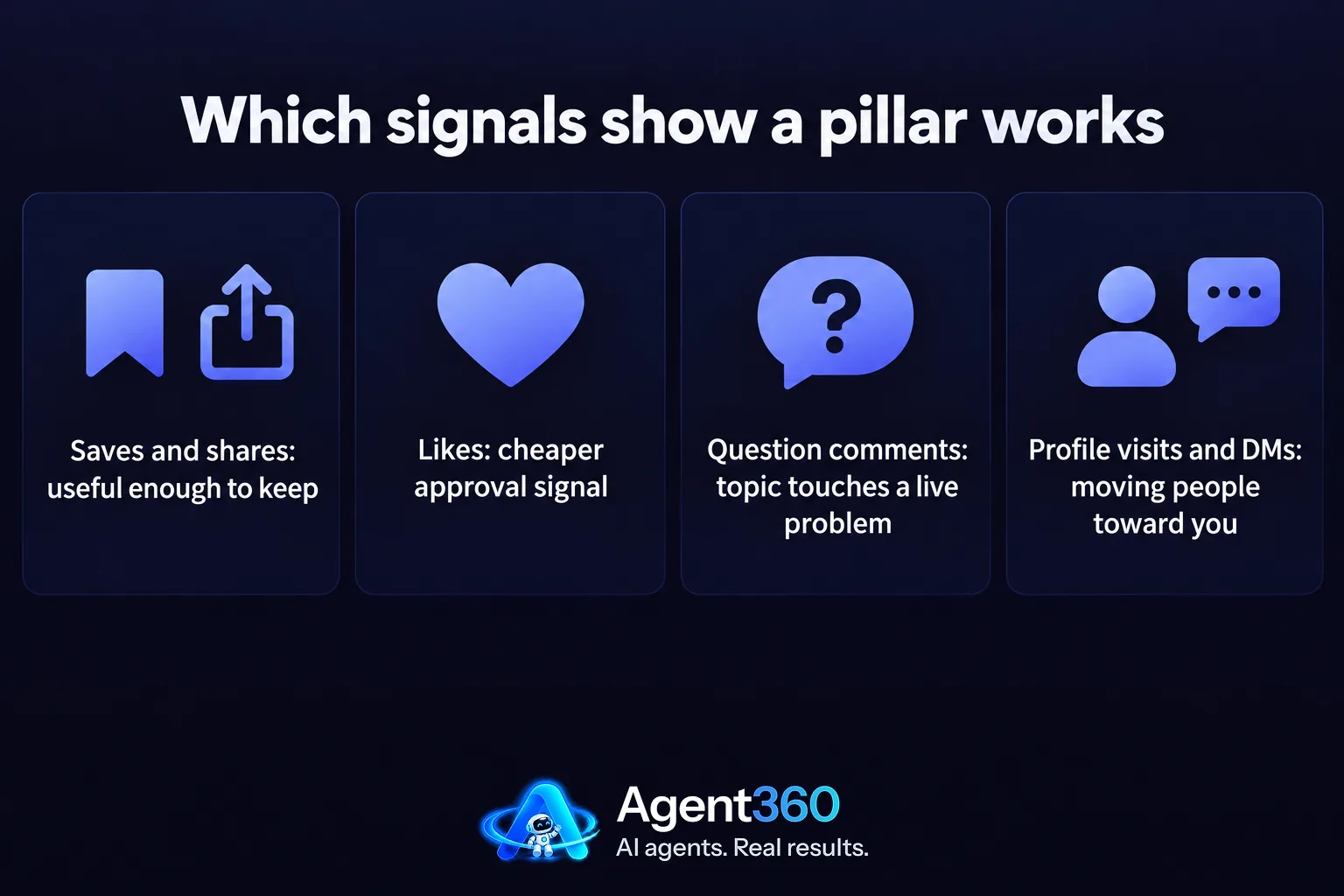
Look for signals that suggest intent rather than approval:
- Saves and shares usually mean someone found it useful enough to keep or send on. Likes are cheaper.
- Comments that ask a question tell you the topic touches a live problem.
- Profile visits and DMs after a pillar's posts suggest it is moving people toward you.
A pillar that earns none of these across several posts is either the wrong topic or the wrong angle. Rewrite the angle once. If it still earns nothing, drop it and promote your next-best idea. Most accounts keep a pillar out of loyalty to the original plan, which is a poor reason. Your analytics view should show these numbers per post, and the Analyst Agent pulls them across 30 or 90 days so you can group them by pillar.
Match the pillar to the format, not the other way round
Reels tend to reach people who don't follow you yet, so they suit your teach and opinion pillars, which introduce what you know. Feed pictures sit on your profile when someone checks you out, so proof and offer posts belong there. That's a tendency, not a rule. Still, it's a better starting assumption than posting whatever format you made fastest.
Timing matters less than this planning does. If you're still weighing when to post, The Best Time to Post on Instagram Is Not a Clock makes that case.
Where BrandAgent fits
Once your four pillars are set, the job is producing enough on-brand posts to fill them. BrandAgent for Instagram writes captions for each idea, draws a 4:5 picture in your colours from your Brand Kit, makes Reels from your videos and clips, and publishes to your Business or Creator account. You approve every post. It doesn't make carousels or Stories today, so plan those yourself. Plans start at $97 a month, month to month, and you begin with a 15-minute call.
Questions people still ask
How many content pillars do I need on Instagram?
Three to five, and four is the practical sweet spot for most business accounts. Fewer than three leaves the feed repetitive. More than five spreads a modest posting schedule too thin for any topic to stick in a follower's mind.
How often should each pillar appear?
Weight them by job. Teaching and opinion pillars should appear most often because they earn attention, and the offer pillar least often. The exact split is your call. Adjust it after 30 days using saves, shares and profile visits rather than a rule from a post, this one included.
Do content pillars work if I have a small audience?
Yes, and they matter more. With few followers you can't afford wasted posts. A tight set of pillars tells a new visitor what the account is about within a few seconds of looking at the grid, and that's when they decide whether to follow.
More articles
- Managing Social Media for Multiple Clients Without Chaos
- How Startups Should Pick an Instagram Scheduling Tool
- LinkedIn Personal Profile vs Company Page: Post From the Person
- How to Schedule Posts for a Retail Sales Event
- The Social Media Scheduler Test Most Businesses Skip
- Generating Instagram Posts With AI: What Actually Works
- AI Social Media Posts: What Actually Works
- AI Social Media Content Generator for Instagram, Explained
