The Best Time to Post on Instagram Is Not a Clock
Forget the chart. The one telling you 7pm is magic is averaging hundreds of accounts that share nothing with yours. Instagram's own engineers have said, more than once, that the feed ranks by relevance and recency to the one follower opening the app right now — not by a clock that applies to everyone. A post published at 6am can beat one posted at the supposedly perfect 7pm slot, because the follower who matters is the one scrolling at 6am. The aggregate doesn't exist for them.
That doesn't mean timing is irrelevant — it means you're asking the wrong question. Not “when should I post,” but “when is my audience actually open, and what does Instagram do with a post the moment it lands.”
Instagram checks early engagement before it checks the clock
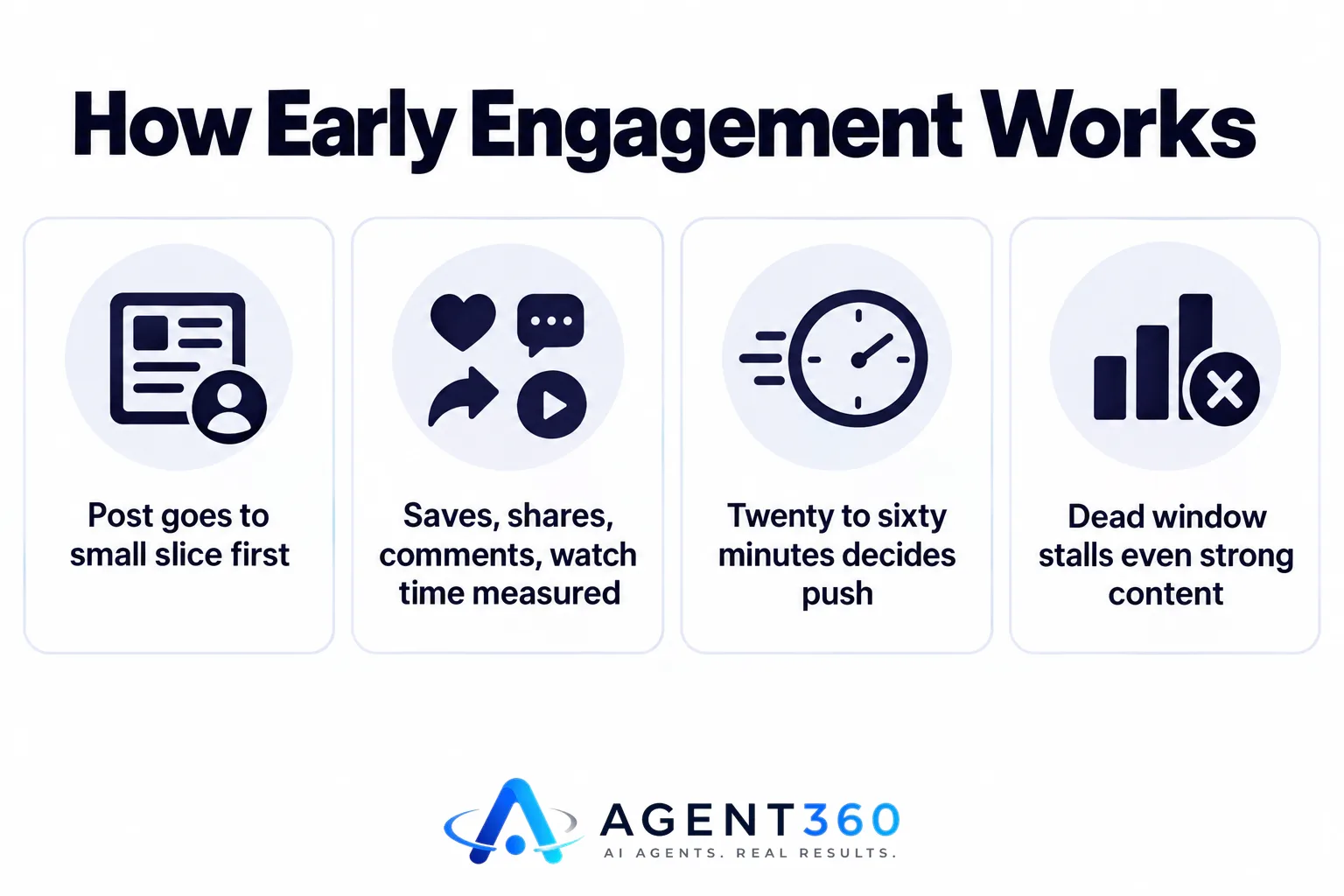
Here's the mechanism. A new post goes first to a small slice of followers and recent engagers. What that slice does in the next twenty to sixty minutes — saves, shares, comments, watch time — decides whether the post gets pushed to anyone else. Publish into a dead window, when almost nobody who follows you is awake, and even strong content can stall. Not because it's weak. Because there's no early signal for the algorithm to act on.
So the fix isn't a universal hour. It's finding the one- or two-hour window where your followers are reliably awake, and saving that window for your best post of the week — not whatever filler you had lying around.
Pull your own data instead of trusting a published chart
Every generic “best time” chart blends account sizes, industries and regions you have nothing to do with. Your own account already has the real answer, sitting in Instagram's native insights or whatever analytics tool tracks post-level performance over time. Pull your last twenty or thirty posts — not three. Log the posting hour against the reach at 24 hours and look for a pattern. Not one standout post; that's usually noise. Look for a repeated band of two or three hours where reach is consistently higher than the rest. That band belongs to your account alone, and it shifts as your followers change — which is why a test you ran two years ago tells you nothing today.

And if you post on more than one platform, don't assume the window transfers. A LinkedIn audience checking the feed on a work break behaves nothing like an Instagram audience scrolling before bed, so Instagram's publishing patterns need their own test, separate from whatever works on LinkedIn.
Consistency beats precision, and most accounts chase the wrong one
A time that's three hours off but happens every single week will usually beat a technically perfect slot that only shows up twice a month. Instagram's ranking rewards accounts it can predict. Show up reliably and you build a backlog of engagement signal that compounds; post sporadically and that signal resets every time. So if the choice is between chasing the exact optimal hour or picking a reasonable one and holding it for eight straight weeks — hold the hour. Inconsistency will cost you more than imprecision ever will.
This is where most small teams quietly fall apart. The plan looks fine on paper, week three gets busy, the Tuesday post slides to Thursday, and then it just disappears for two weeks. A shared content calendar that shows what's scheduled next to what actually went out catches that slide before it becomes the new normal.
Reels, feed posts and Stories don't share a clock
Reels travel well past your follower list through Instagram's recommendation system, so the “your followers are online” logic barely applies — a Reel posted at 2am can still perform if it earns watch-through, because it's competing in a much bigger pool than your own audience. Feed photos lean harder on your followers' active hours, since they mostly reach people who already follow you. Stories vanish after 24 hours no matter when you post them, so the only timing question that matters is whether they land somewhere inside your audience's daily check-in window — not which hour within it.
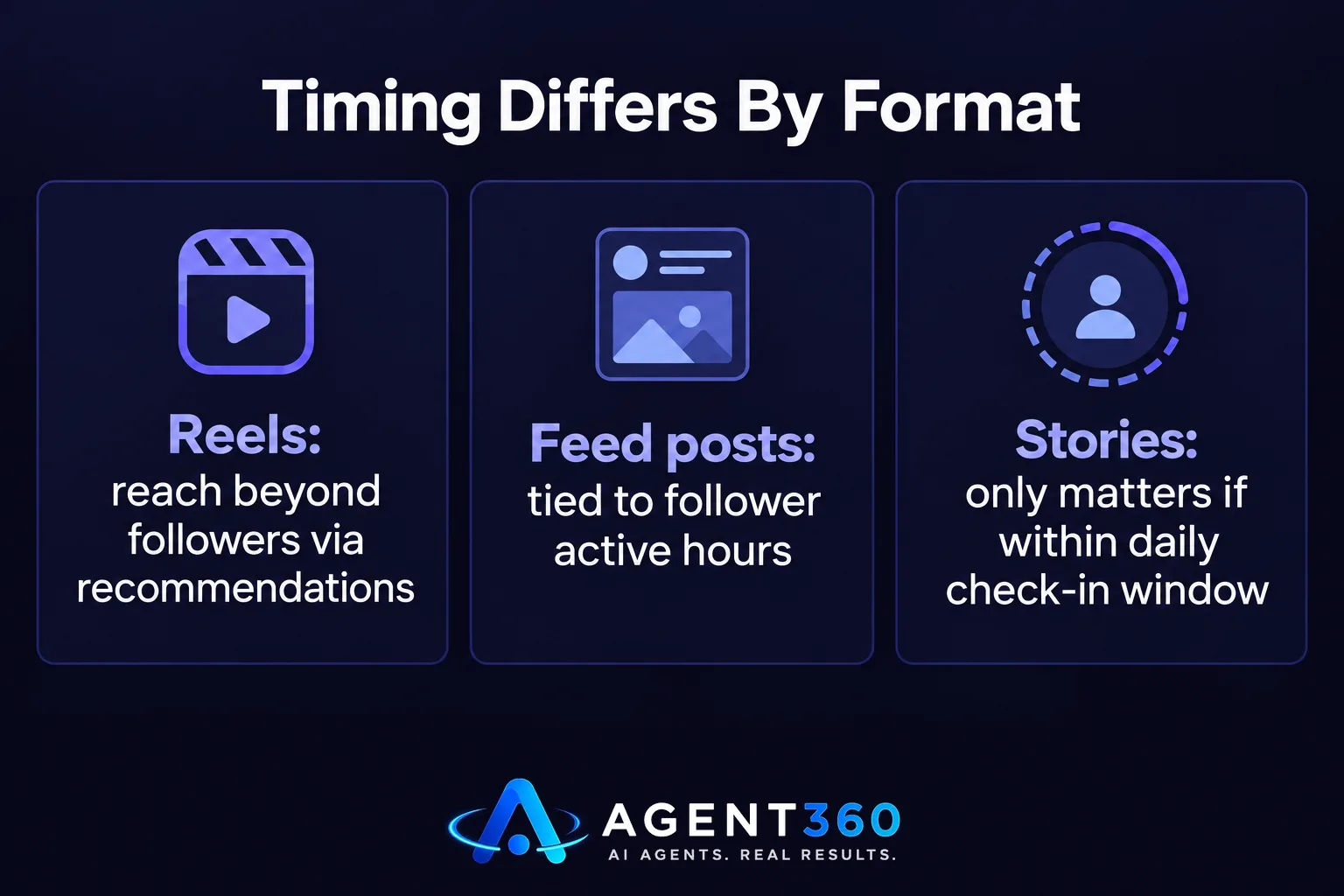
Treat these as three different scheduling problems, not one. A single posting time for all three formats is a convenience for you — it isn't a strategy for the algorithm.
Don't let timing distract from the bigger lever
Posting time can move reach by a noticeable margin. Whether the post is worth watching moves it by a lot more. An account posting genuinely useful content at a mediocre hour will out-reach an account posting weak content at the “perfect” one, because engagement rate in that first hour is the stronger signal. If you're spending more time arguing about posting hour than about the actual mix of posts — the split between value and pitch content, or whether every post looks like the last ten — you're optimizing the smaller lever.
Where this gets genuinely hard is doing it across four platforms with four audiences, four formats and four different windows — while also writing the posts themselves. BrandAgent schedules each platform's posts to the time you set, puts the calendar next to your actual meetings so gaps show up before they happen, and pulls reach and engagement for every post so you can read your own timing pattern instead of guessing from someone else's chart.
Questions
Does Instagram publish an official best time to post? No. Instagram has never published one universal optimal time, and its own representatives have said reach depends more on relevance and early engagement than on the clock.
How many posts do I need before I can trust my own timing data? Anything under fifteen to twenty posts is too noisy to read. Look for a band that repeats across most of them, not one outlier post that happened to pop.
Should Reels and feed posts go out at the same time? No. Reels reach people who've never followed you, through recommendations — feed posts don't have that luxury, so they stay tied to when your actual followers are awake.
More articles
- AI Social Media Content Generator for Instagram, Explained
- What a Real AI Agent Content Idea Workflow Looks Like
- Which Social Platforms Deserve Your Time, Not Your Guilt
- Why Social Media Content Creation Burns Teams Out by Week Six
- A Social Media Approval Workflow That Doesn't Stall
- How to Batch Social Media Content Creation Without Losing a Day
- How to Measure Social Media ROI Without Guessing
- The Social Media Scheduling Tool Checklist Small Businesses Skip
