How to Write a LinkedIn Post That Actually Gets Engagement
Most LinkedIn posts die in the first nine words. Not the body — the opening. The feed shows a line and a half before the “see more” cut, and if that line doesn’t make a claim, ask a real question, or contradict something the reader believes, they’re gone before they reach your point. Engagement isn’t a hidden setting. It’s a hook, a shape, and what you do in the hour after you hit publish.
Can you give me some examples of creative social media posts? Skip ahead if that’s the question you came with — the formula list is below. Mechanics first, if you want them.
Open with the claim, not the context
The instinct is to set the scene: “Last week I was thinking about...”. That sentence spends your one visible line on nothing. Replace it with the actual point — a number, a verdict, a disagreement. “Most onboarding emails get deleted unread” gets a reaction. “I wanted to share some thoughts on onboarding emails” gets scrolled past. Test: if you can delete your first sentence and the post loses nothing, delete it.
Short lines matter more here than almost anywhere else, because LinkedIn renders text in a narrow column on mobile. A sentence that would run as one line on a blog should often break into three here, each short enough to read in a glance. This isn’t decoration. It’s what makes a thumb pause instead of flick.
What is the 4-1-1 rule on LinkedIn?
The 4-1-1 rule started on Twitter, not LinkedIn: for every six posts, share four pieces of other people’s content, one piece of your own that isn’t promotional, and one direct pitch. People repeat it like it’s LinkedIn law. It mostly isn’t. LinkedIn’s feed rewards original, specific posts far more than curated shares, and a ratio built for retweets doesn’t map onto a platform where the algorithm is reading dwell time and comment depth on your own words.
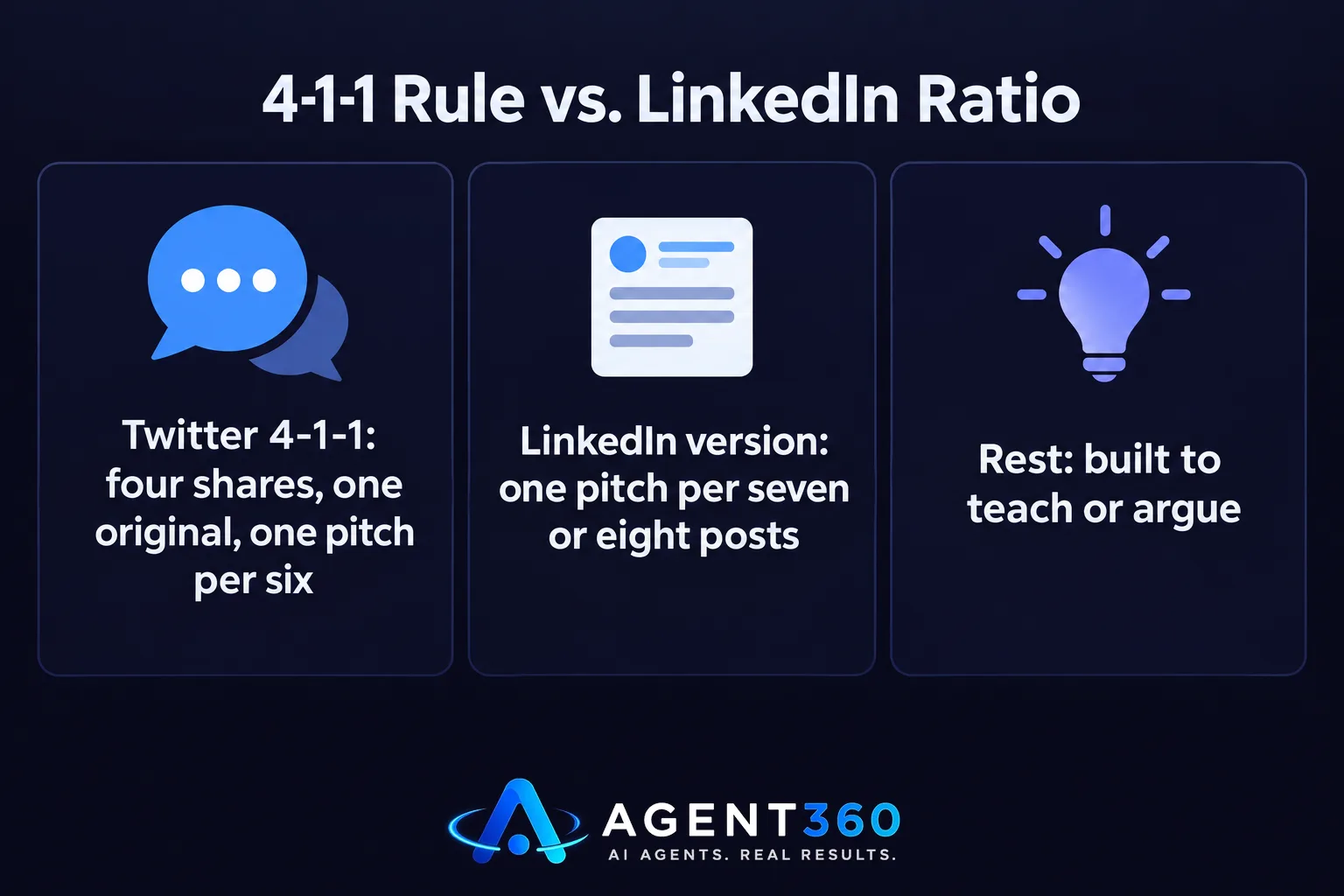
Keep the spirit, not the arithmetic. Most of what you post should teach or argue something; only a small share should ask for anything. A simpler working ratio for LinkedIn runs closer to one pitch in every seven or eight posts, with everything else built to be useful or opinionated on its own terms. The reasoning behind that mix, and what happens to reach when you get it wrong in either direction, is laid out in value vs pitch.
How to create a catchy LinkedIn post?
Catchy, on LinkedIn, almost always means specific. “Here’s what I learned about hiring” is not catchy. “We stopped asking for cover letters and applicant quality went up” is — because it’s a claim a reader can agree or disagree with before they’ve finished the sentence. Four things show up in nearly every post that gets replies:
- A first line that is a claim, a number, or a flat contradiction of common advice — never a throat-clear.
- One specific detail in the body: a threshold, a name, a timeframe, a mistake. Vague posts get vague reactions, which is to say none.
- A structure the eye can skim — short paragraphs, occasional line breaks, no wall of text past line four.
- An ending that asks something a stranger can actually answer in a sentence, not “thoughts?”.
That last point is where most posts lose their own momentum. “Thoughts?” asks for effort with no prompt. “What’s the one onboarding step you’d cut first?” hands the reader a sentence to fill in. The ten post formulas built for LinkedIn each handle this ending differently, but every one of them earns the comment instead of begging for it.
Three shapes worth stealing
If you want creative examples rather than rules, these are reliable shapes, not gimmicks:
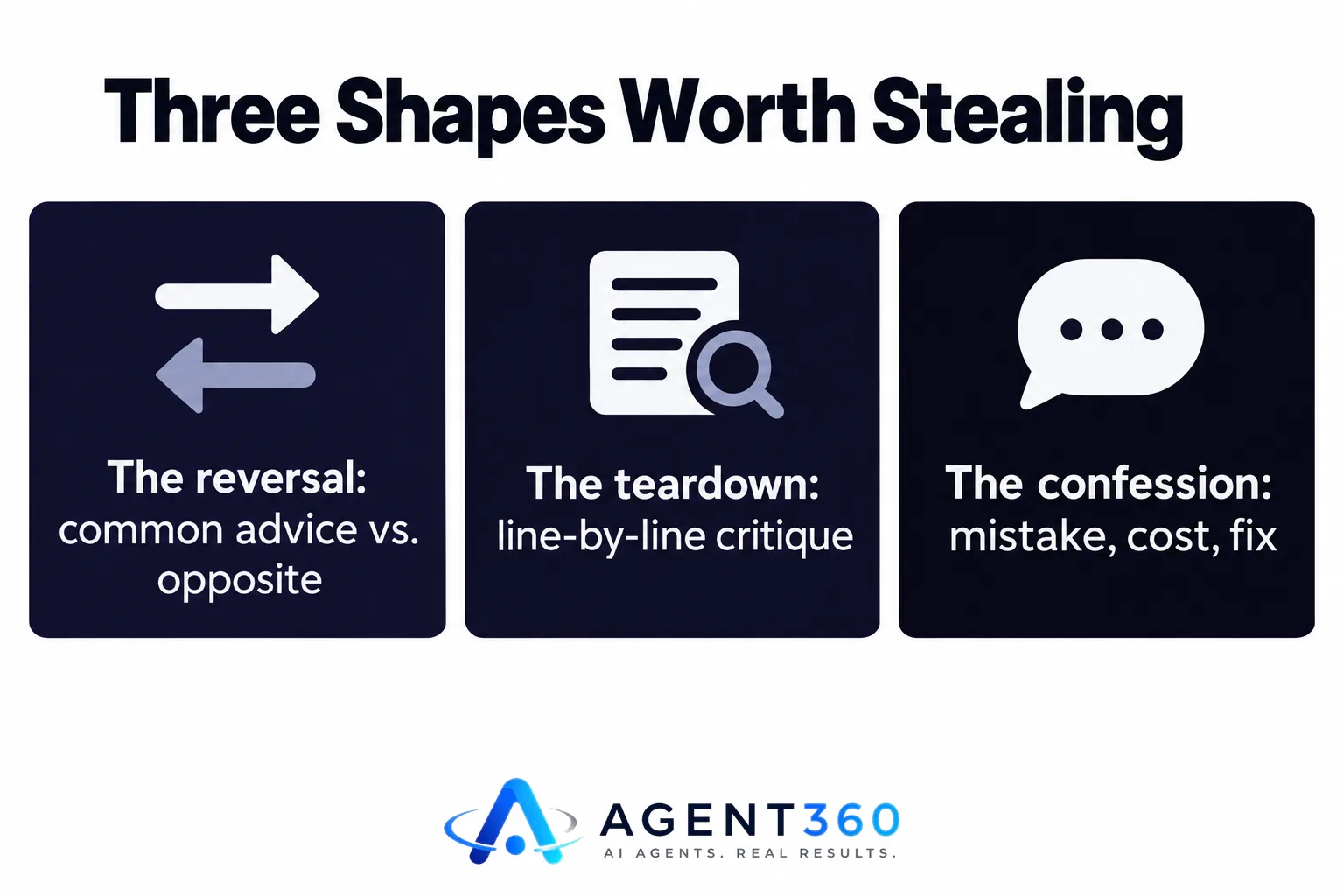
- The reversal: state the common advice in line one, then spend the post explaining why you do the opposite and what it cost or saved you.
- The teardown: take a public example — a job posting, a landing page, an email — and walk through what works and what doesn’t, line by line.
- The confession: name a specific mistake, what it actually cost (a client, a week, a hire), and the one change that fixed it. Vulnerability without a specific cost reads as performance; a number makes it real.
Each of these works on LinkedIn because they give the reader a position to push back on — and disagreement in the comments is worth more to reach than a pile of likes.
The comment is the real conversion event
A like costs a reader nothing and tells the feed almost nothing. A comment is a small act of attention, and the feed treats it that way, showing the post to more of the commenter’s network and holding it in front of more of yours. Posts that ask a real question in the last line, and get a reply from the author within the first hour, tend to keep getting shown. Posts that go quiet after the author walks away tend to stop. If you only have ten minutes after publishing, spend them replying to the first three comments. Not drafting the next post.

Is boosting your post on LinkedIn worth it?
Rarely, and almost never as a first move. Boosting pays to put a post in front of more feeds, but it does nothing to fix a weak hook or a flat ending. It just shows the same weak post to more people who scroll past it at the same rate. The posts worth boosting are the ones already earning comments on their own — paid reach extends a signal that’s proven, rather than propping one up that isn’t. Most teams get a better return from publishing consistently, on the schedule where their audience is actually online and tracked with a calendar rather than a memory, than from spending the same budget on one boosted post.
Where the volume comes from once you have a working shape
Knowing the shape is one problem. Writing it in your own voice three times a week, for months, is another. The Writer Agent inside BrandAgent drafts from the same ten formulas referenced above, scores each draft against LinkedIn’s own rules before it reaches you, and rewrites anything that scores weak — you only ever see the version that passed. It's available from $97 a month, and you still approve every post before it publishes.
Questions worth answering directly
How to create a catchy LinkedIn post? Open with a specific claim or number instead of context, keep paragraphs short enough to skim, include one concrete detail the reader can picture, and end with a question a stranger could actually answer.
What is the 4-1-1 rule on LinkedIn? It’s a borrowed Twitter ratio — four shared posts, one original post, one pitch in every six — that doesn’t map cleanly onto LinkedIn’s feed. The useful version keeps pitches rare, closer to one in seven or eight posts, with the rest built to teach or argue something on its own.
Can you give me some examples of creative social media posts? The reversal (state common advice, then argue the opposite), the teardown (critique a real example line by line), and the confession (a specific mistake with a specific cost and the fix) all reliably outperform generic “thoughts on X” posts.
Is boosting your post on LinkedIn worth it? Only once a post is already earning comments on its own — boosting just hands a weak post to more people who scroll past it the same way.
More articles
- How AI Talking Head Videos Actually Get Made
- Social Media Posts That Get Leads (Not Just Likes)
- The B2B Social Media Strategy That Actually Moves Deals
- How to Build a Personal Brand on LinkedIn (That Sticks)
- The Real Alternatives to a Social Media Agency
- Done-For-You Social Media Management: What It Costs
- Social Media Marketing on Autopilot: The Ratios That Work
- Repurpose Content for Social Media: The Rules That Work
