AI Can Create Your Social Content. Here's The Catch

AI can already write your post, design the picture, cut the video, and publish the whole thing. That part is settled. What it still can't do on its own is tell whether the draft actually sounds like you, or whether it's the same forty words every other account posted this week. That judgment call is the real job now, and it's the one most tools quietly skip.
Can AI create content for social media?
For the mechanical parts, yes, reliably. Large language models draft post copy per platform, image models generate on-brand pictures, and video tools slice long recordings into vertical clips with captions burned in. None of that is experimental anymore. It's sitting in dozens of tools at a range of price points, waiting for you to type a prompt.
Where it breaks down is consistency without context. A model with no information about your business defaults to generic marketing language, because that's the statistical average of everything it was trained on. Feed it your actual voice, your colours, your real sentences, and the output changes. That's the gap between a tool that writes content and one that writes yours — and it's why a defined brand kit matters more than which model sits underneath.
The three jobs people lump into one
Search for an “AI content creator” and you'll find three different products wearing the same label: a chat assistant that drafts text when you ask, a scheduler that posts what you hand it on a timer, and a system that does both plus the design and video work in between. They solve different problems, and mixing them up is how people end up disappointed.
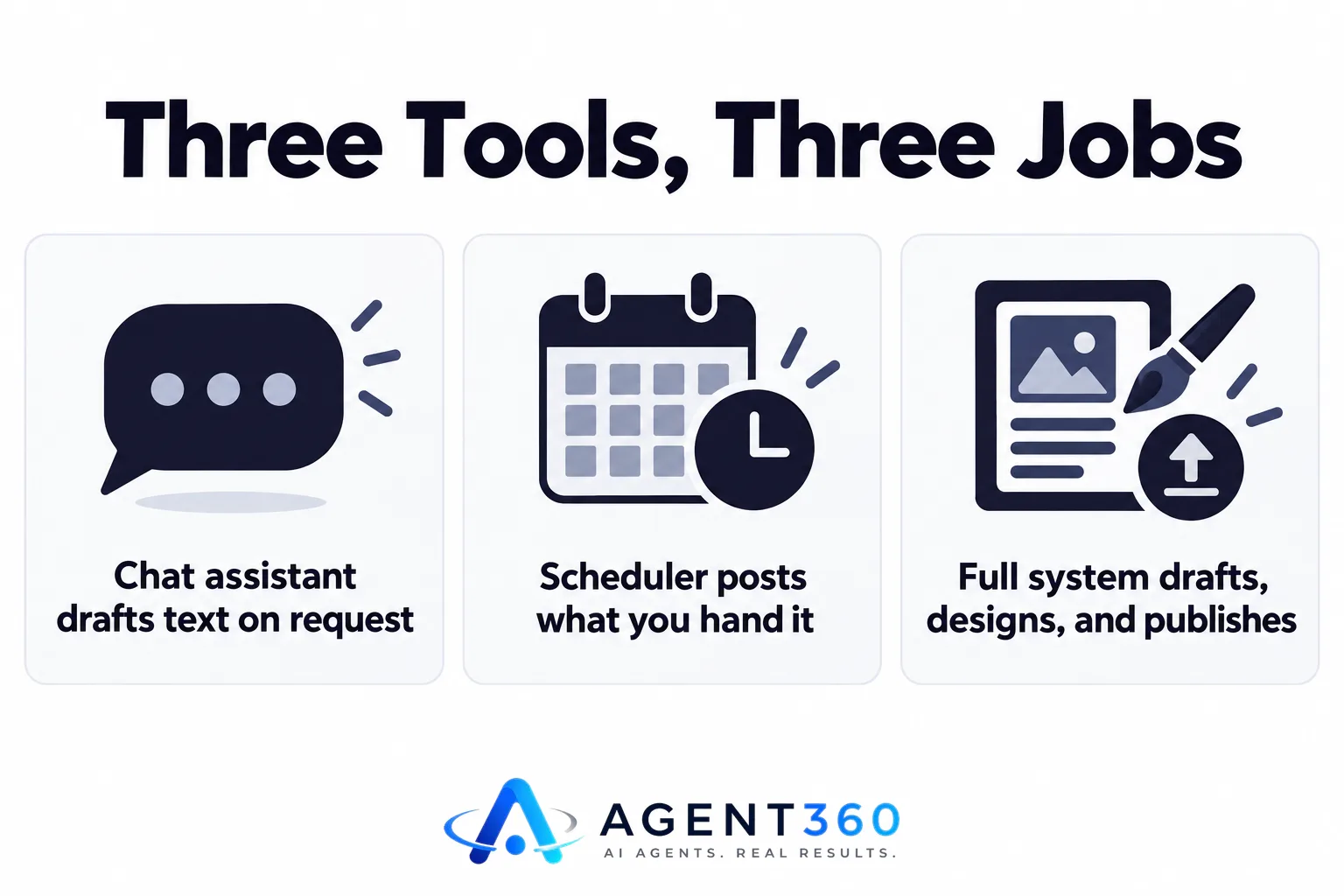
A chat assistant is fast for a single draft, but it has no memory of your last fifty posts, no platform-specific rules, and no way to publish — you're still copying and pasting into four different apps. A scheduler solves the publishing problem but assumes the content already exists. Neither closes the gap by itself. The fuller breakdown is in how a dedicated system compares to a chat tool and how it compares to a scheduler.
BrandAgent sits in the third category: it drafts a version of each idea for LinkedIn, Instagram, YouTube and X, draws a matching picture, cuts the video, and publishes on the schedule you set — but nothing goes out until you approve it. Plans start at $97 a month with no contract, which matters if you want to test whether this fits how your team actually works before committing to anything bigger; see current plans.
What is the 30% rule for AI?
There's no official standard here, but the number people land on informally makes a decent gut check: if more than three out of every ten AI drafts need a full rewrite rather than a light edit, the system doesn't know your voice yet. The problem isn't the model. It's the context it was given. Below that threshold, you're editing. Above it, you're rewriting — and rewriting ten drafts a week is slower than just writing three yourself.
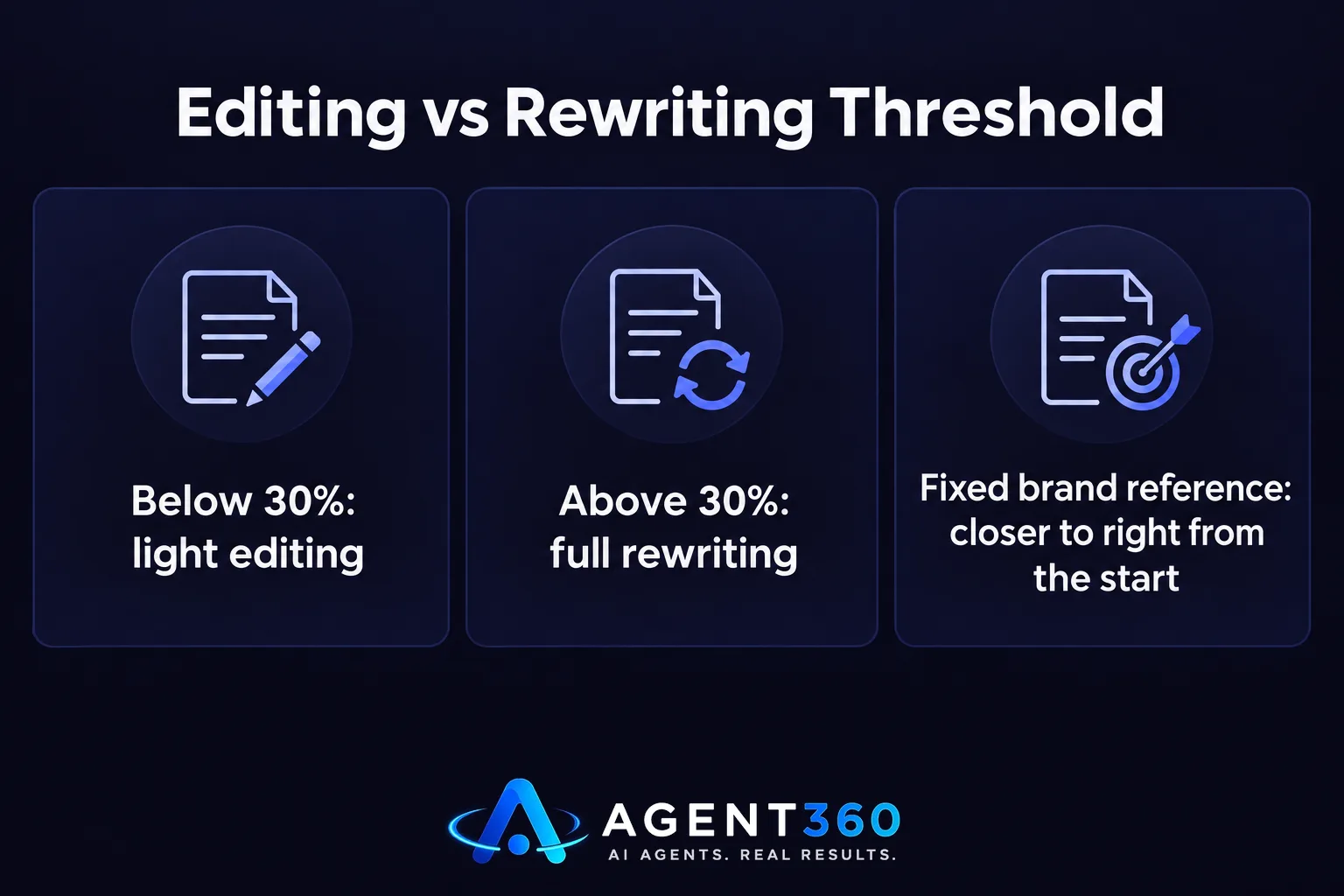
The fix isn't a sharper prompt every time. It's giving the system a fixed reference — your actual sentences, your actual positioning, your actual claims — so every draft starts closer to right. That's the whole argument for a brand kit over a blank prompt box: you set the context once instead of re-explaining your company in every single chat.
Is AI finally good enough to run without you?
No. Be suspicious of anyone who tells you otherwise. The writing and design have gotten good enough that the bottleneck moved from production to judgment — someone still has to read each draft and decide if it's accurate, on-brand, and worth putting your name on. That review step is small, usually a minute or two per post. Skip it, and you end up with an AI-generated claim about your own product that isn't true, published under your own name.
The posts that actually get engagement aren't pure value or pure pitch either — they're a mix, and getting that ratio wrong in either direction quietly kills reach. All value, no offer, and nobody learns what you sell. All pitch, and the algorithm and the audience both tune out. There's a practical split worth following in value vs pitch.
Where this actually saves time
The honest time savings isn't in the first draft. A competent person can write one LinkedIn post in fifteen minutes with no tool at all. It's in the repetition: taking one idea and turning it into a LinkedIn version, an Instagram caption with its own image, a short vertical cut, and an X post, four times a week, without starting from a blank page each time. A defined set of repeatable post formulas and a system that drafts in your voice changes how many weeks you can keep a calendar full — not how good any single post is.

Frequently asked questions
What is the 30% rule for AI?
It's not an official rule — it's a practical threshold some marketers use: if more than roughly three in ten AI drafts need a full rewrite rather than a light edit, the tool doesn't have enough context about your brand yet, and the fix is better input, not more editing.
Do I still need to approve every post?
Yes, and any system that skips this step is a risk, not a feature. A short review pass — checking tone, accuracy, and whether the claim is actually true — takes a minute or two per post and is the difference between content that sounds like you and content that sounds like everyone else.
Can AI create content for social media without any input from me?
It can generate something, but without your actual voice, positioning and examples, it generates the generic average of its training data. The input that matters most isn't a longer prompt — it's a fixed reference, like a brand kit, that every draft starts from.
More articles
- How Often to Post on LinkedIn: The Rules That Actually Matter
- Social Media Content for Small Business: The Rules That Work
- Brand Voice AI: What It Means and What It Can’t Fake
- What an AI Short Video Maker Needs to Actually Work
- The Honest Guide to AI Video Generators for Social Media
- LinkedIn Ghostwriting: What It Really Costs and How It Works
- An AI Content Calendar Only Works With Rules Behind It
- Social Media Scheduling Tools Won't Fix Your Empty Calendar
