What Is the Best All-in-One Marketing Service for a Local Business?
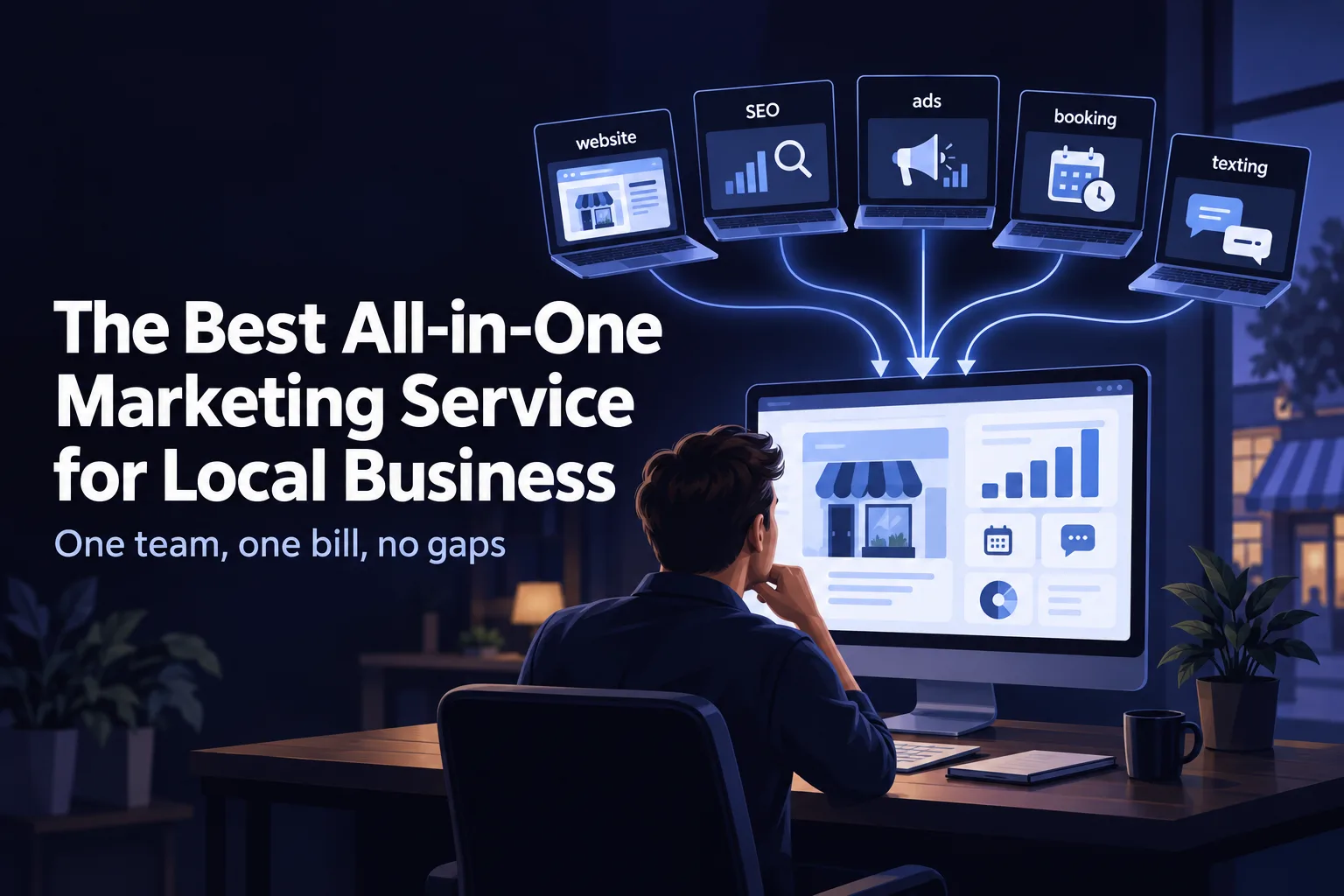
Here's the test that actually matters: does it replace the most separate vendors with a single bill, a single login and a single person who answers when something breaks — without making you accept worse work on any one piece? That's it. Not the logo, not the sales deck, not the feature count on a pricing page. The question is whether your website, your SEO, your ads, your booking page and your lead follow-up stop being five relationships and become one.
Most owners searching for this already know why. They're paying a web designer, a separate SEO person, an ad freelancer, a booking app and a texting tool, and none of them talk to each other. A lead comes in through the ad guy's campaign, lands on a site the designer built two years ago, and nobody follows up because the booking app doesn't text. “All-in-one” is supposed to fix that. Plenty of companies claim to. Here's how to tell which ones actually do.
The best one replaces five vendors, not five job titles
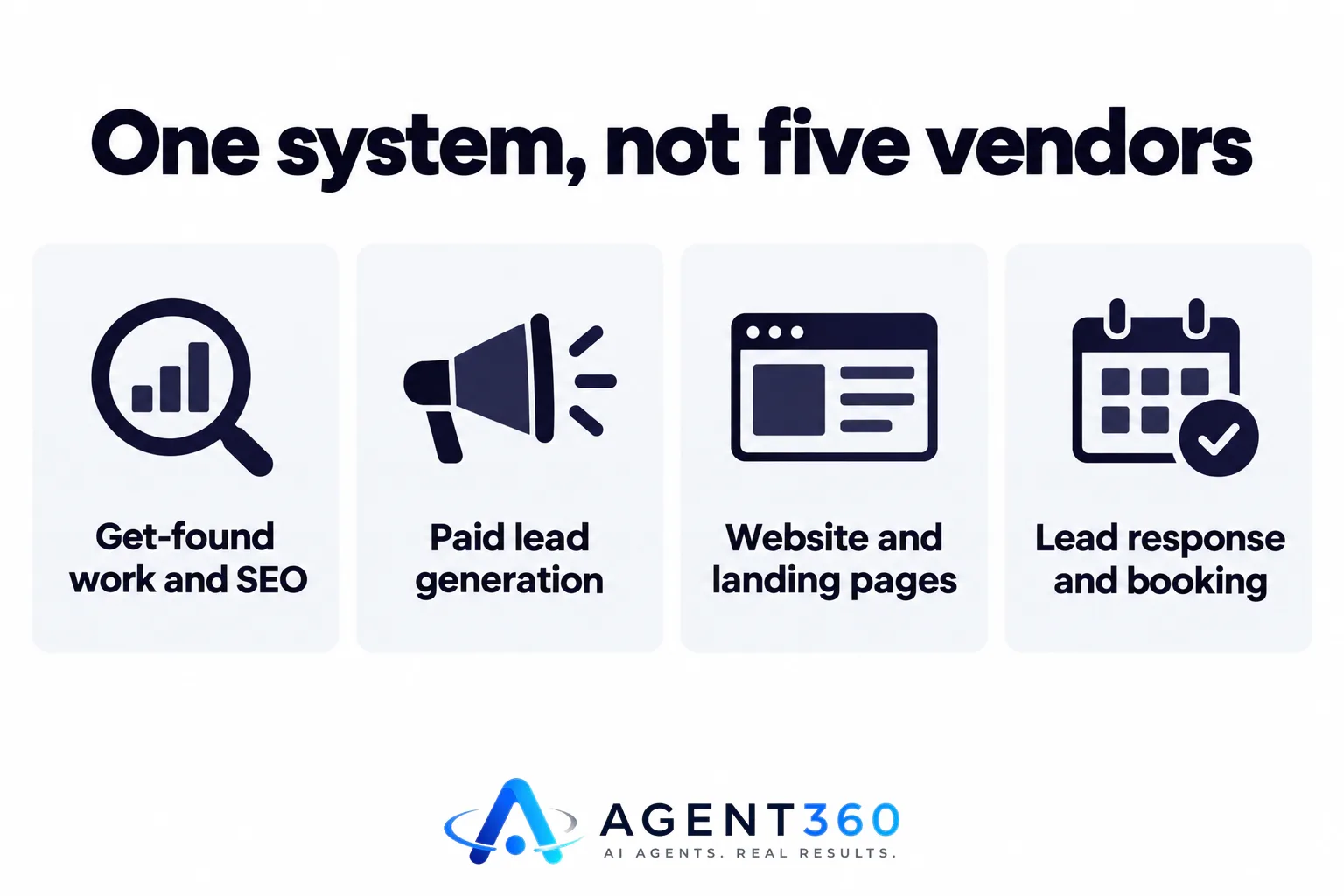
A lot of “all-in-one” platforms are really a website builder with an SEO add-on and an ads add-on bolted on separately — three teams, three handoffs, one invoice. That's not the same thing as one team running all of it from a single plan. Ask directly: is my website, my SEO and AI search visibility, my ad management, my booking system and my CRM run by the same account team, or am I still getting routed between departments? If the answer is departments, you've bought a bundle, not a system. A real all-in-one setup, like the one Booked runs on, puts get-found work, paid lead generation, the website and landing pages, and lead response and booking under one plan with one dashboard, so nothing falls into the gap between two vendors who don't share data.
Ask what happens to a lead between 6pm and 9am
This is the fastest way to separate a marketing service from a marketing-and-operations service. A lot of “all-in-one” platforms stop at generating the lead. They'll build you a nice site, run your ads, and then the lead sits in an inbox until your front desk opens. For a local business, that gap is where the booking gets lost — the customer has already called the next name on the list by the time anyone replies. The service worth paying for answers that question with a system, not a promise: instant text and email replies the moment a form comes in, and ideally a phone system that picks up after hours instead of routing the call to voicemail. If a platform can't tell you exactly what happens to a lead at 11pm on a Saturday, assume the answer is nothing.

AEO and GEO are not optional add-ons anymore
Search behavior has split. People still type into Google, but they also ask ChatGPT “who's a good plumber near me” and get a short list with no ads and no map pack — just whichever business the model has decided to trust. Traditional SEO doesn't automatically win you a spot on that list. Being the best all-in-one service in 2025 means treating Answer Engine Optimization and Generative Engine Optimization as part of the core service, not a future upsell, because the businesses showing up in AI answers today are building that reputation now, before more competitors realize it matters. For the longer version of how that selection actually works, see how ChatGPT picks which local business to recommend.
Check whether the booking system is actually yours
Some all-in-one platforms are, underneath, a marketing layer glued onto someone else's booking or payment system. That means your deposits, your client list and your cancellation policy live on a third party's terms, not yours. Ask three questions before signing anything: who holds the customer data if I cancel, does the deposit money land in my own payment account or theirs, and can I export my client list on day one if I need to. A service built around your own domain and your own Stripe account answers all three without hesitation. One built on a marketplace model usually can't.
Price per vendor replaced, not price per month
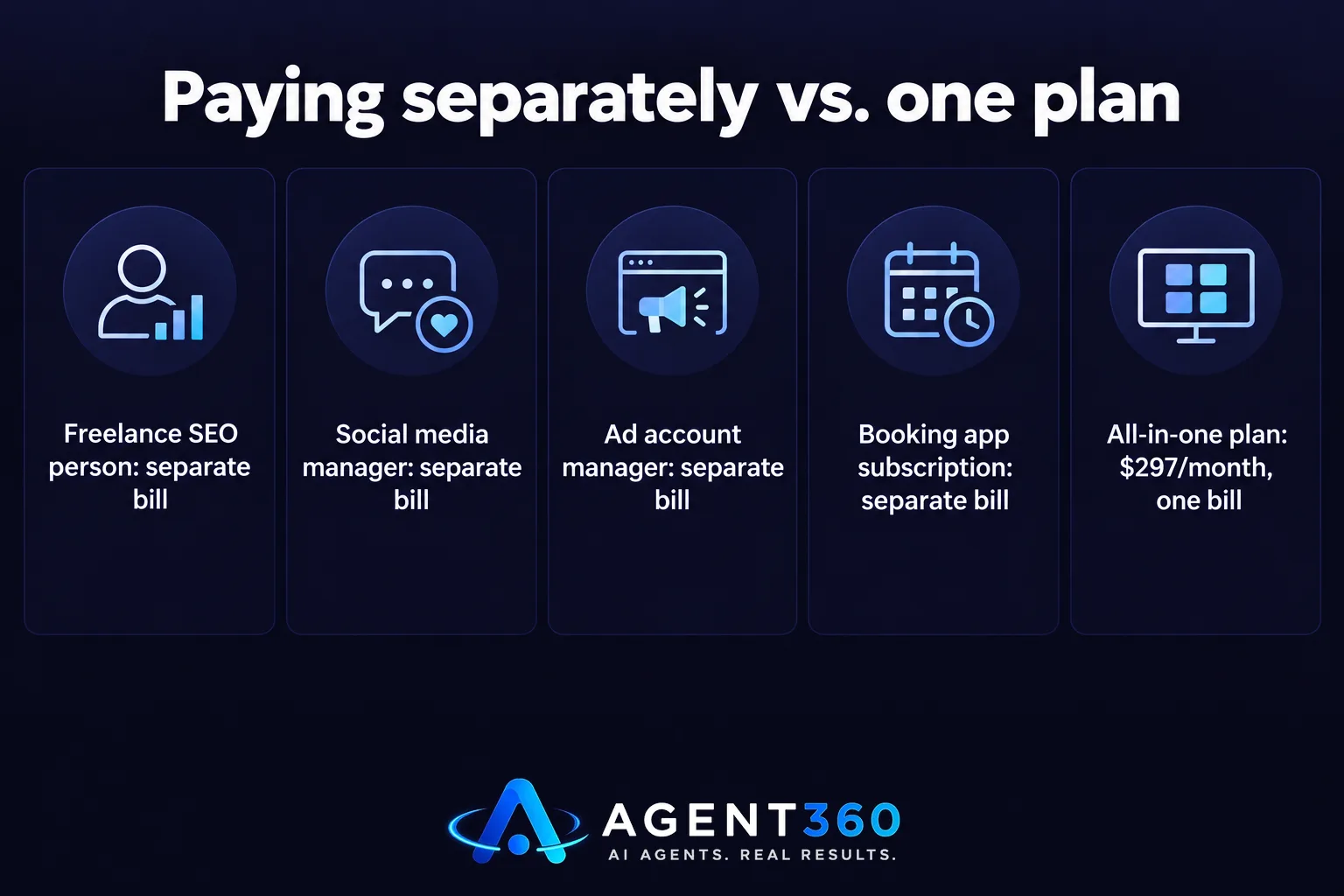
A $297 monthly plan looks expensive next to a $20 website builder until you count what you were actually paying before: a freelance SEO person, a social media manager, an ad account manager, a booking app subscription, a separate texting tool for follow-up. Priced individually, that stack routinely runs well past what a single all-in-one plan costs — and that's before you count the hours spent managing five different people. The fair comparison isn't the cheapest single tool. It's the total cost of running the same functions separately, laid out in more detail in all-in-one marketing agency vs. separate vendors.
Where Booked fits
Booked runs the website, SEO, AEO and GEO, paid ads on Google and Meta, lead response, booking with deposits, and review and rebooking follow-up from one plan, starting at $297 a month with no setup fee and no contract. Plans scale by ad spend managed, content volume and features like 24/7 AI phone answering, not by splitting the work across separate tools — see the breakdown on the pricing page.
What is a best all-in-one platform for marketing?
There's no single platform that's best for every business. The right one depends on whether you need one location or several, how much ad spend you're managing, and whether phone calls or online forms drive most of your bookings. The useful question isn't which platform has the most features — it's which one runs your website, search visibility, ads, lead response and booking as one connected system instead of five separate tools you have to manage yourself.
Frequently asked questions
Is an all-in-one marketing service better than hiring specialists separately?
It depends on how much time you have to manage the handoffs. Specialists can each be excellent individually, but someone still has to connect the ad campaign to the landing page to the booking system to the follow-up text, and that coordination job either falls on you or on the all-in-one team. For a business with no in-house marketing manager, one accountable team usually wins.
How much should a local business expect to pay for all-in-one marketing?
Entry-level plans for a single location typically start under $300 a month plus ad spend paid directly to Google or Meta. Higher tiers add more ad budget management, more content, and features like 24/7 phone answering, usually landing between $400 and $600 a month before ad spend.
Can I switch from separate vendors to an all-in-one service without losing my website or reviews?
A properly run switch keeps your domain in your name and migrates your existing reviews and customer list rather than starting over. Ask any provider directly whether you keep your domain and data if you ever cancel. The answer should come back fast, and it should be yes.
More articles
- Booked vs Thryv: A Fair, Side-by-Side Comparison
- How ChatGPT Picks Which Local Business to Recommend
- Done-for-You Website and Marketing: What You Still Do
- Small Business Website and SEO Package: What Should Be Included
- All-in-One Marketing Agency vs. Separate Vendors: Who Wins?
- How Much Should a Small Business Spend on Marketing?
- Website and Marketing Packages: What a Fair Price Looks Like
- All-in-One Marketing for Small Business
