Apollo vs Smartlead: Which One Actually Books Meetings?
Apollo vs Smartlead comes down to one question: are you missing leads, or are you missing sends? Apollo is a prospecting database with a built-in sender bolted on. Smartlead is a sending platform built for deliverability and volume, with no database of its own. Picking between them means picking which half of your outbound is actually broken.
Founders running their own outbound and sales teams filling pipeline both hit this choice the same way: the list runs dry, or the inbox stops landing. The fix is different for each, and the two tools are not really substitutes for one another.
Key Takeaways
- Apollo solves a leads problem; Smartlead solves a sending-at-scale problem, not the same job.
- Smartlead's strength is managing many mailboxes and warming them, which matters once you outgrow a single domain.
- Apollo's contact data needs verification before a send, since bounce rates directly hurt domain reputation.
- Many teams end up running both: Apollo for data, Smartlead for delivery, see how the two stack up feature by feature.
- Neither tool books the meeting for you; that step still needs a cadence, a calendar link, and a human watching replies.
Table of Contents
What's the core difference between Apollo and Smartlead?
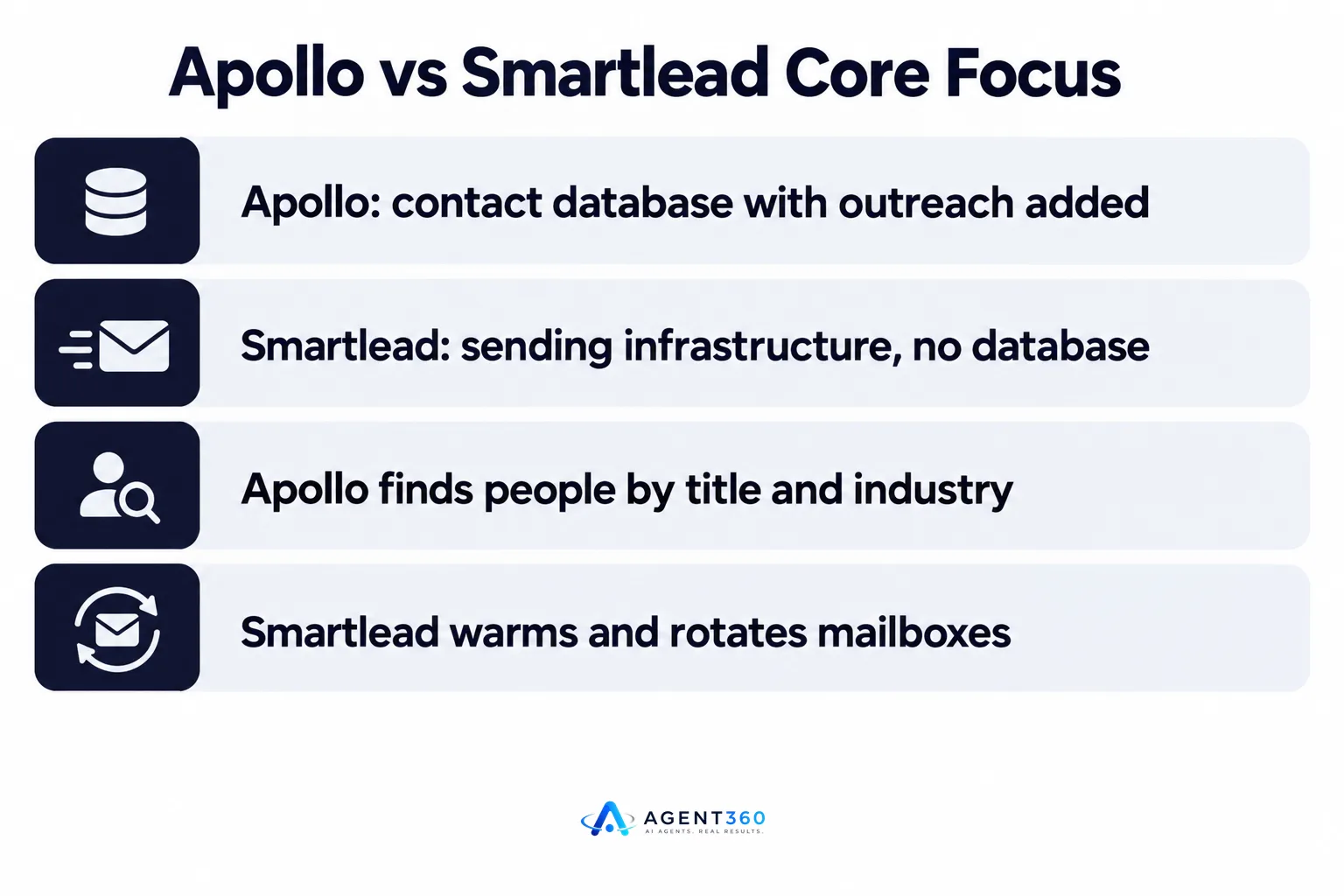
Apollo is built around a contact database with outreach features added on; Smartlead is built around sending infrastructure with no database at all. Apollo's pitch starts with “find the right person” — search by title, industry, headcount, technology used — then email or call from inside the same tool. Smartlead starts from the opposite end: you bring your own list, and it focuses on getting that list delivered, warmed, and rotated across mailboxes without tripping spam filters.
Does Apollo do cold email well?
Apollo can send cold email, but sending is not its core engineering focus. Teams that lean hard on Apollo for high-volume sending tend to hit deliverability limits sooner than teams using a sender built for that one job.
Does Smartlead find leads for you?
No. Smartlead has no prospecting database. You need a separate source for contacts — Apollo, a scraped list, or another data provider — before Smartlead has anything to send.
Which one is better for finding leads?
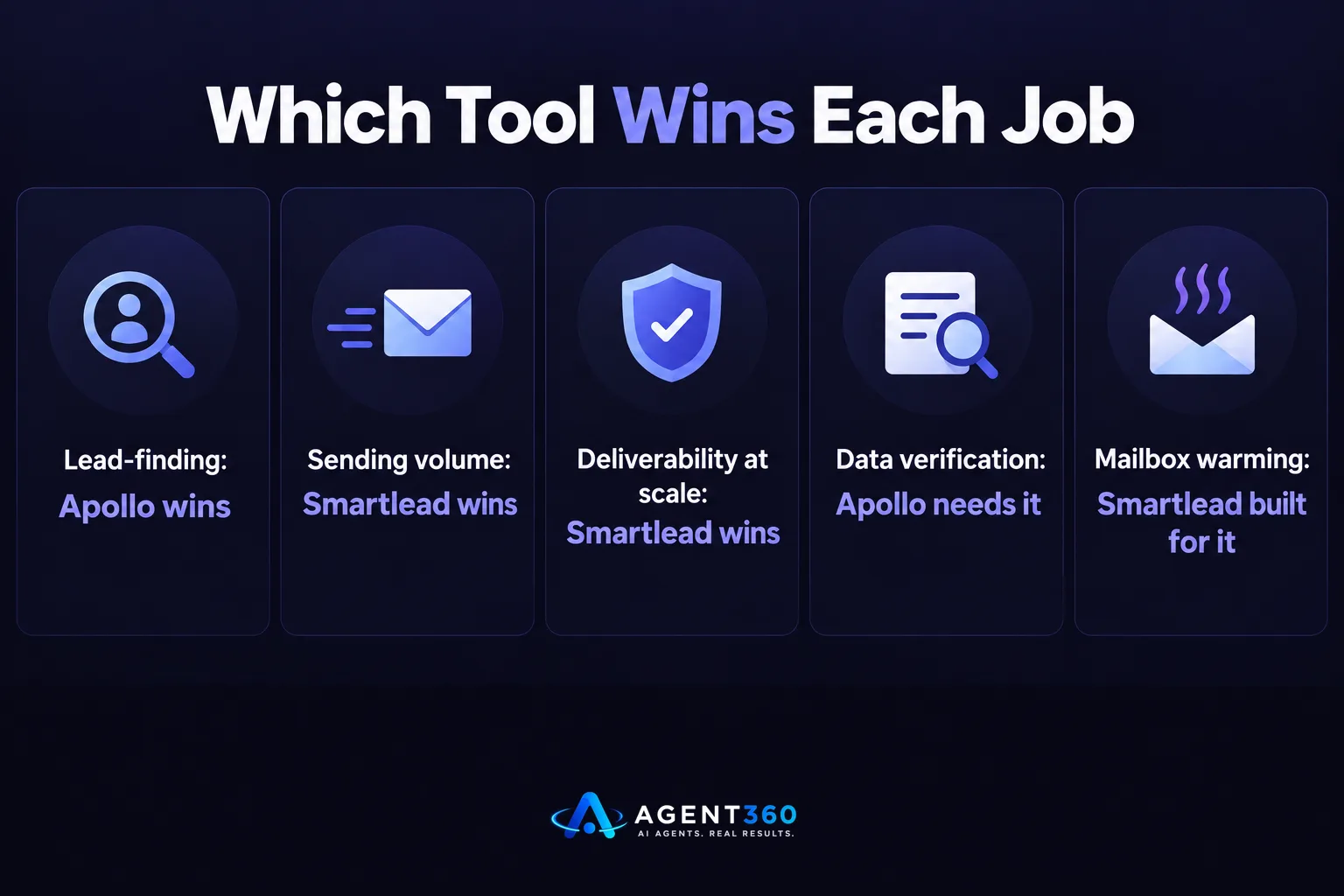
Apollo wins on lead-finding because that's its core product, not an add-on. Its filters — title, seniority, company size, technology stack, recent funding — let you build a list without leaving the tool. Smartlead has nothing comparable; it assumes you already solved that problem elsewhere.
How accurate is Apollo's contact data?
Apollo sources and verifies emails at scale, but any database of this size carries stale records — people change jobs, emails bounce. Verifying a list before a send protects your sender reputation regardless of where the list came from.
Which one is better for sending volume and deliverability?
Smartlead is built for scale: managing dozens of mailboxes, rotating sends, and warming domains so volume doesn't tank deliverability. That's the specific problem it was designed to solve. Apollo can send from a connected inbox, but it isn't designed around mailbox rotation or domain warming the way a dedicated sender is.
How many inboxes do I actually need?
The honest answer: it depends on your target send volume and what each provider currently allows per inbox, and those caps shift over time and aren't always published. Instead of chasing a fixed number, size your inbox count to the volume you want to send weekly — a breakdown of how sending volume maps to inbox and domain needs is a better starting point than any single rule of thumb.
Do I need both, or can one replace the other?
Most outbound setups end up using something like Apollo for data and something like Smartlead for sending, because neither tool fully replaces the other. Using Apollo alone for sending means hitting deliverability ceilings faster. Using Smartlead alone means running dry on leads with no built-in way to refill the pipeline.
- Audit where outbound actually breaks. If reply rates are fine but the list runs out, the problem is leads, not sending.
- Separate the two jobs on purpose. Treat prospecting and sending as different systems, even if one tool claims to do both.
- Verify data before every send. A stale list sent through a strong sender still bounces and still damages domain reputation.
- Track replies somewhere that isn't your inbox. A spreadsheet or a lightweight CRM stops good leads from getting buried once volume goes up.
Which tool fits a founder running outbound solo?
A founder running outbound alone usually needs the leads problem solved more than the sending-volume problem, at least at first. Early on, the list is the bottleneck — there's no backlog of prospects to burn through. Sending infrastructure becomes the bottleneck later, once the list is solid and volume needs to scale past what one or two inboxes can carry.

What if I don't want to manage two separate tools?
That's the tradeoff of stitching Apollo and Smartlead together — more setup, more subscriptions, more places for a lead to fall through. A platform that handles prospecting, sending, and booking in one place removes that stitching work, which matters most for a founder who doesn't have time to babysit two dashboards.
Simplify Prospecting and Sending Into One System
Running Apollo for data and Smartlead for delivery works, but it means managing two tools, two logins, and two places where a lead can slip through the cracks. Agent360 combines AI prospecting that finds buyers and flags buying signals with multi-channel outreach across LinkedIn, email, and phone — so the list and the send live in the same system.
Meetings book directly onto your calendar, and CRM tools track the pipeline without a spreadsheet on the side. For a founder or a lean sales team weighing Apollo vs Smartlead, the question worth asking first is whether two tools are solving a problem one system could handle.
See how the full outbound workflow fits together before deciding how many tools you actually need.
Frequently Asked Questions
Is Apollo or Smartlead better for cold email deliverability?
Smartlead is built specifically around deliverability at scale — mailbox rotation, warming, and sending infrastructure are its core focus. Apollo can send email but wasn't engineered primarily around deliverability at volume.
Can I use Apollo data inside Smartlead?
Yes, exporting a list from Apollo and importing it into Smartlead is a common workflow, since Smartlead has no prospecting feature of its own. Verify the list before importing to avoid a wasted send.
Which tool is cheaper?
Pricing on both platforms changes and isn't something to quote from memory — check each provider's current pricing page before comparing, since list size, seats, and send volume all factor into the final cost.
Do either of these tools book meetings for me?
No. Both handle sending or data, not meeting booking. Getting a reply into a calendar slot still requires a cadence, a calendar link, and someone watching for replies.
What's the risk of running high volume through Apollo alone?
Pushing high send volume through a tool not built around mailbox rotation and warming raises the risk of domain reputation damage, which can suppress delivery across every mailbox tied to that domain, not just the one that triggered it.
More articles
- Smartlead vs Lemlist: Which Cold Email Tool Fits You?
- Apollo vs ZoomInfo: Which Fits Your B2B Sales Team?
- Instantly vs Smartlead: Which Cold Email Tool Wins?
- Cold Email Software Comparison: What Actually Matters
- LinkedIn Outreach Limits: What They Are and How to Stay Under Them
- Agent 360: Who It's For, What It Costs and How It Works
- What Is Agent360? Outbound, Meetings and CRM Explained
- Renting LinkedIn Accounts for Outreach: Worth the Risk?
