Looking for an Aimfox Alternative? Check This First
An Aimfox alternative is any outbound tool that picks up where single-channel LinkedIn automation stops working for you. Aimfox automates connection requests and LinkedIn messages. It does not call prospects, send email sequences, or give you a pipeline view. If your team needs more than LinkedIn to book meetings, you need a tool built for more than LinkedIn.
This matters because LinkedIn is rarely enough on its own. A prospect who ignores three connection requests might answer a phone call or reply to an email the same week. Tools that only touch one channel leave that reply on the table.
Key Takeaways
- Aimfox automates LinkedIn only, so a stalled LinkedIn thread has nowhere else to go.
- A real alternative adds email and phone so one quiet channel does not stall the whole deal.
- Check whether the tool books meetings directly on your calendar, not just logs a reply.
- Compare Aimfox against HeyReach and other LinkedIn-only tools before you compare them against a multi-channel option.
- Ask how the tool handles CRM tracking, since a spreadsheet next to your outreach tool is its own failure point.
Table of Contents
What does Aimfox do, and why are teams looking for an alternative?
Aimfox automates LinkedIn connection requests and messaging, and teams outgrow it when a deal needs more than one channel. It sends invites, follows up on LinkedIn, and tracks replies inside that one platform. For a founder or a small sales team running outbound without SDRs, that single-channel limit becomes the thing that caps pipeline growth.
What happens when a LinkedIn-only tool is all you have?
A prospect accepts the connection, reads the first message, and goes quiet. With a LinkedIn-only tool, the sequence ends there unless someone manually finds an email address or picks up the phone. That manual step is exactly the work founders start automating outbound to avoid.
Is LinkedIn automation itself risky, separate from the channel limit?
Any automation tool that sends high volumes of connection requests or messages from one account risks LinkedIn's own restrictions, which the platform does not publish as a fixed number. Reviewing current guidance on LinkedIn outreach limits before scaling volume on any tool, including Aimfox, is worth doing regardless of which tool you choose.
What should a B2B outbound tool include beyond LinkedIn automation?
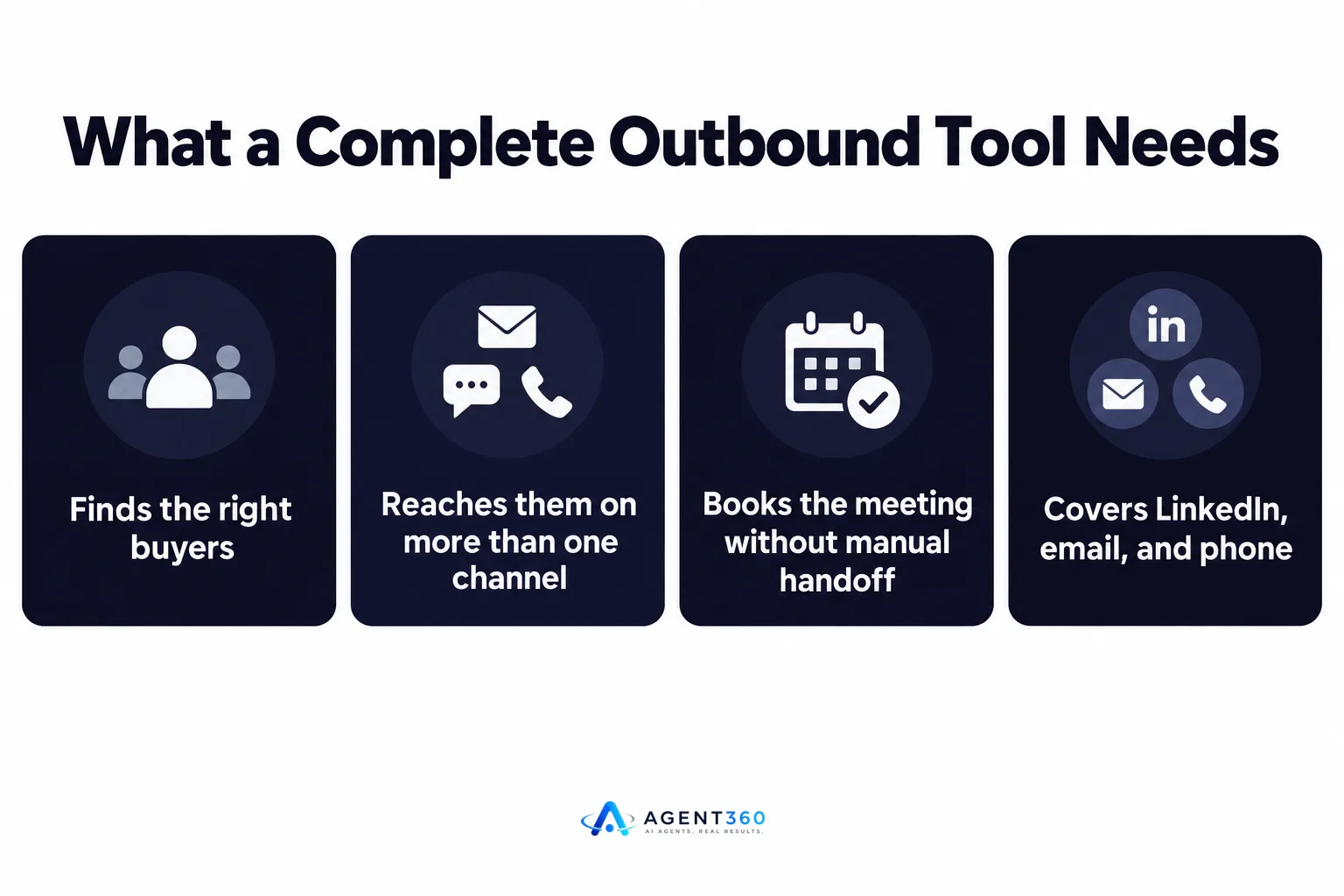
A complete outbound tool finds the right buyers, reaches them on more than one channel, and books the meeting without a manual handoff. That is the gap between an automation tool and a system that actually fills a calendar.
Why does channel coverage matter more than send volume?
More messages on one channel does not replace a second channel. A prospect who never checks LinkedIn messages will never reply no matter how well the sequence is written. Covering LinkedIn, email, and phone in one outreach flow means a quiet channel does not end the conversation.
Why does meeting booking belong inside the tool, not after it?
A reply is not a meeting. If the tool stops at “prospect said yes” and a human has to chase calendar availability by email, meetings slip through the cracks between reply and booking. A tool that books directly on your calendar removes that gap entirely.
How do you evaluate a multi-channel alternative to Aimfox?
Test the alternative against the same list of prospects Aimfox is already working, and compare replies, meetings booked, and time spent per week. A side-by-side test on real prospects tells you more than any feature list.
- List what Aimfox is not solving. Write down every manual step your team does after a LinkedIn reply, including finding emails or dialing numbers.
- Check channel coverage. Confirm the alternative reaches prospects by LinkedIn, email, and phone from one sequence, not three separate tools.
- Confirm meeting booking is built in. Ask whether the tool books on your calendar automatically or just flags a reply for someone to follow up on.
- Look at the CRM view. A pipeline that lives in a spreadsheet next to your outreach tool breaks down once deal count grows.
- Run a short pilot. Move one segment of your list to the new tool for two weeks before moving everything.
What is a fair side-by-side comparison between tools like this?
Compare the full path from prospect found to meeting booked, not just messages sent. A tool that sends more LinkedIn invites but books fewer meetings is not an upgrade, it is more noise on one channel.
Ready to Move Beyond LinkedIn-Only Outreach?
Agent360 finds ideal buyers and surfaces buying signals through AI prospecting, then reaches them across LinkedIn, email, and phone from one sequence. Meetings land directly on your calendar, and CRM tools keep the pipeline visible without a separate spreadsheet. The AI handles the volume; a human backs up the parts that need judgment.

If LinkedIn-only automation has taken your team as far as it can, the next step is covering the channels that LinkedIn-only tools can't reach.
See how it works before you decide what replaces Aimfox.
Frequently Asked Questions
Is Aimfox safe to use for LinkedIn outreach?
Any tool automating LinkedIn activity carries some platform risk, since LinkedIn does not publish fixed daily limits for connection requests or messages. Reviewing current guidance before scaling volume applies to Aimfox and to any LinkedIn automation tool.
What is the main limitation of Aimfox compared to a multi-channel tool?
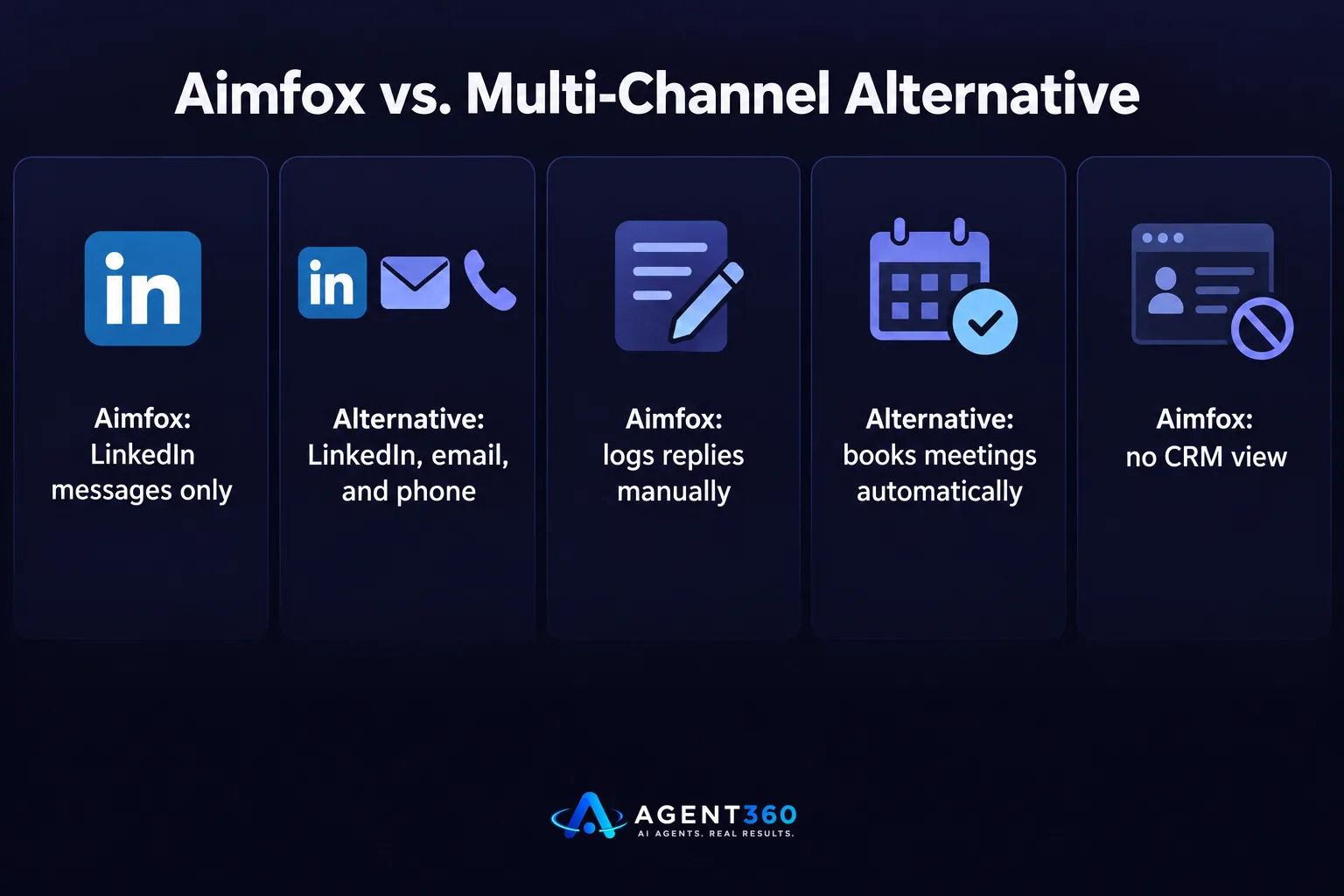
Aimfox only operates on LinkedIn. It does not send email, make calls, or book meetings on a calendar, so a prospect who goes quiet on LinkedIn has no second channel to reach them on inside the same tool.
Do I need a CRM if I already use an outreach tool?
If your outreach tool does not track pipeline stages, you likely need a separate CRM or spreadsheet, which adds a manual step every time a deal moves forward. A tool with CRM tools built in removes that extra system.
Can a multi-channel tool replace an SDR?
It can cover the repetitive work of finding prospects, reaching out across channels, and booking meetings, which is the core of early SDR work. Judgment calls on messaging and qualifying still benefit from human review.
How long does it take to switch from a LinkedIn-only tool to a multi-channel one?
Running a pilot on one list segment for two weeks gives enough signal on reply rates and meetings booked before moving the full list. Checking how quickly you can start on the new tool helps set a realistic switch date.
More articles
- A Dripify Alternative That Adds Email, Calls and CRM
- The Best HeyReach Alternative for Full B2B Outbound
- Aimfox vs HeyReach: Which LinkedIn Tool Fits Your Outbound?
- Waalaxy vs Dripify: Which LinkedIn Tool Books More Meetings?
- Dripify vs Expandi: Which LinkedIn Tool Fits B2B Outbound?
- Expandi vs Skylead: Which Fits Your B2B Outbound Team?
- How to Find LinkedIn Profiles Worth Outreach
- Skylead vs HeyReach: Which LinkedIn Tool Books More Meetings?
