SEO Content Automation: What to Automate, What Not To

SEO content automation means software does the repetitive parts of search marketing — pulling keyword ideas, checking rankings, drafting articles, flagging pages that are slipping — on a schedule, without someone opening a spreadsheet every Monday. It does not mean a machine decides what your business should be known for. That's the whole distinction, and it's where most automation setups either earn their keep or waste a subscription.
Some of this automates cleanly. Watching Google Search Console for movement. Checking who outranks you this week. Generating a first draft from a brief. Rewriting a paragraph that's gone stale. Other parts don't automate well at all: which of twenty keyword gaps actually matters to your pipeline, whether a competitor's page is winning because it's better or just older, what your brand will and won't say in print. Those stay judgment calls.
What is SEO automation?
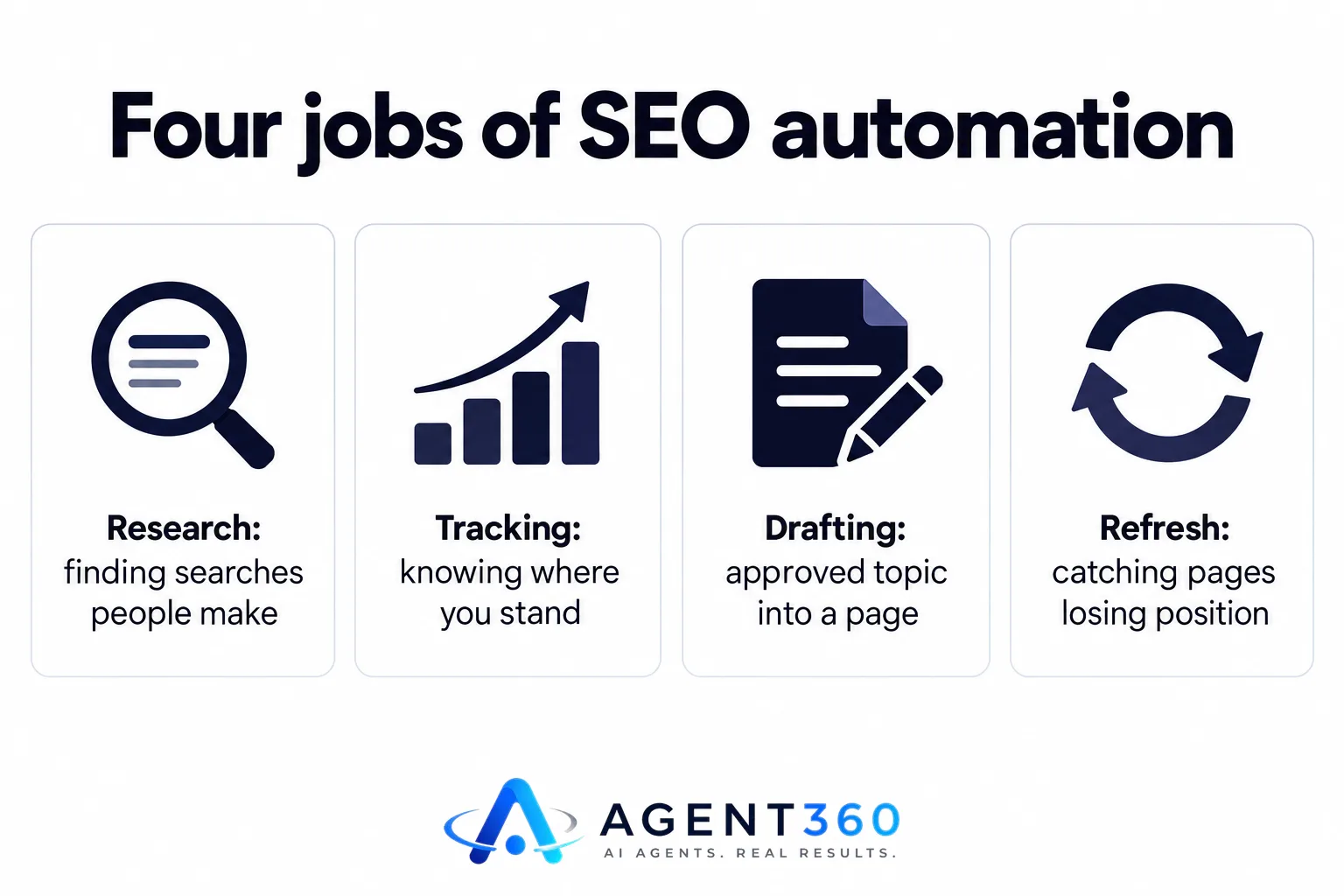
In practice it's four jobs running on their own: research (finding the searches people actually make), tracking (knowing where you stand today versus last week), drafting (turning an approved topic into a published page), and refresh (catching pages that have started losing position and rewriting them before they drop further). Tools differ in how many of these four they cover. Some only do research. Some only do drafting. The gap between “automated content” and “automated SEO” is usually the tracking and refresh pieces — skip them and you're publishing into the dark.
The judgment calls still need a human
Automation can tell you a competitor holds position one for a term you want. It can't tell you whether winning that term would move revenue, or whether your sales team would rather you wrote the pricing page instead. It can draft four hundred words on a topic in a minute. It has no idea your legal team flagged a claim on that exact topic last quarter. Treat the output as a fast first pass someone reviews before it goes live, not as a stand-in for the person who decides what's worth writing at all.
Is SEO dead now with AI?
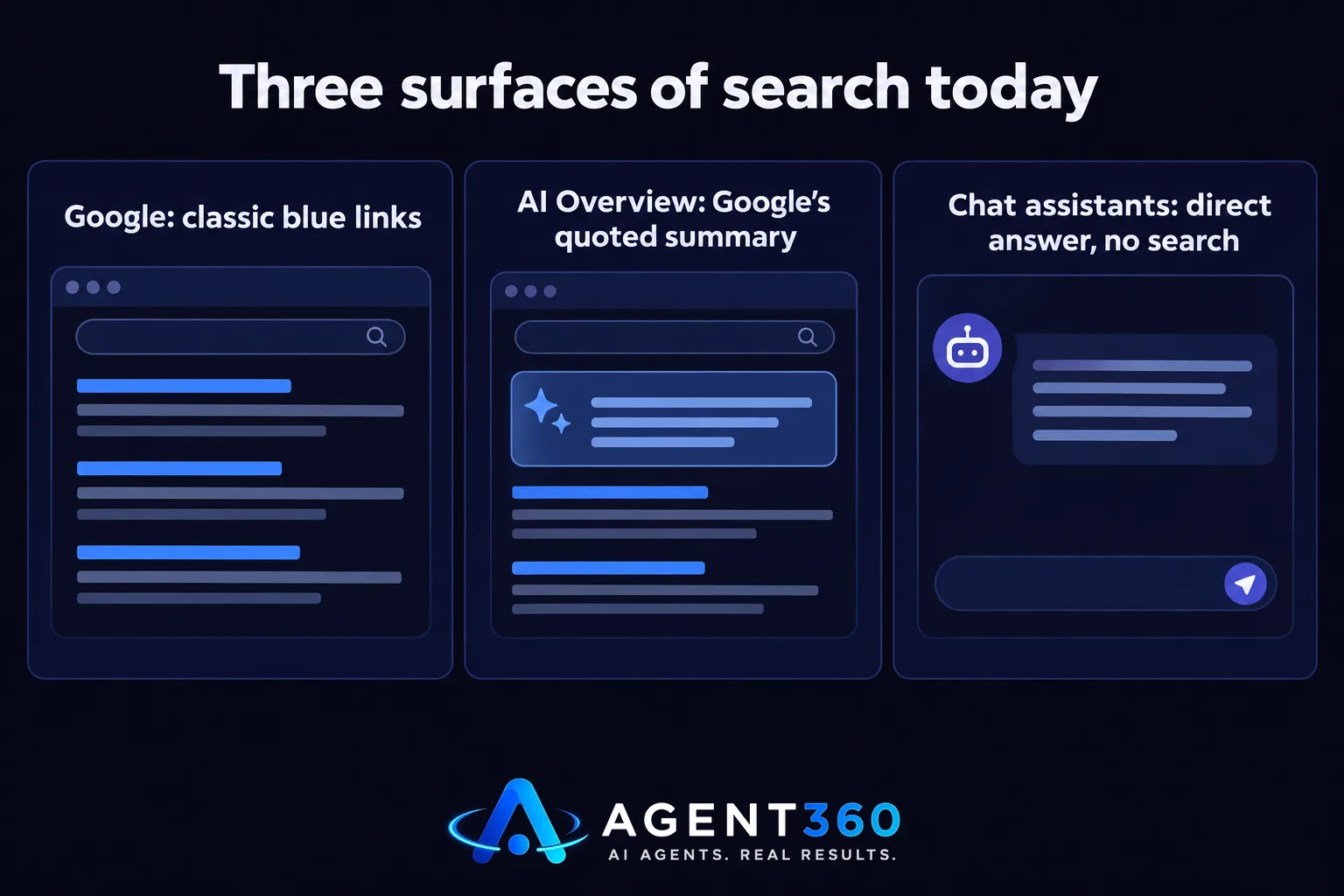
No. But “ranking” split into three surfaces, and treating them as one is how teams quietly fall behind. There's still the classic list of blue links on Google. There's the AI Overview Google writes above those links, which quotes a source rather than just listing it. And there's the answer ChatGPT or Claude gives when someone skips search entirely and asks the assistant directly. A page built only for the first surface — thin, keyword-stuffed, no clear answer near the top — tends to get skipped by the other two. One set of well-structured pages can serve all three, which is the real argument behind SEO, AEO and GEO being different names for overlapping work, not three separate jobs.
Can ChatGPT write SEO content?
It can turn out a readable draft fast, and that's genuinely useful for the first 70% of an article: structure, a reasonable outline, plain-language explanations. Where it struggles without oversight is anything that needs a current, specific fact — your actual pricing, a competitor's current feature set, a statistic that needs a real source. Left unchecked, model-written drafts also tend to converge on the same generic phrasing everyone else's model-written draft uses, which helps nobody who's already read five versions of those same five paragraphs. The fix isn't avoiding the tool. It's adding a check step: fact-verify anything specific, confirm the internal links go somewhere real, and read it once for whether it sounds like your business or like a template.
Can a beginner do SEO?
Yes, for the basics. Setting up Search Console, writing a clear title tag, structuring headings so a page answers one question per section — none of that takes years of experience, and a beginner who does it consistently will beat someone experienced who does it sporadically. Where beginners lose ground is cadence and triage: knowing which of fifty tracked terms deserves a new page this month, noticing that an article from eight months ago has quietly slid from page one to page three. That's less a skill gap than a bandwidth gap — the exact gap a content plan built from real search gaps and a scheduled refresh are built to close.

Where this gets built, if you'd rather not build it yourself
SearchAgent runs research, tracking, drafting and refresh as a connected set instead of four separate tools: it reads your Search Console nightly, asks the questions your buyers ask ChatGPT, Claude and Google AI Overviews on a schedule, then writes and publishes the articles that close the gaps it finds, with a person reviewing the setup. Plans start at $297 a month, month to month. If you're weighing hours billed against a system that runs daily, the comparison against hiring an agency is worth a look.
Frequently asked
What is SEO automation?
Software handling the repetitive parts of SEO — keyword research, rank tracking, drafting, and refreshing pages that are slipping — on a set schedule, so a person reviews and decides rather than doing the manual pulls themselves.
Is SEO dead now with AI?
No. Search split into three surfaces — Google's links, Google's AI Overview, and chat assistants like ChatGPT — and pages built to answer a question clearly tend to work across all three, not just the first one.
Can a beginner do SEO?
Yes for the fundamentals — titles, headings, Search Console setup. What's harder to sustain alone is the weekly cadence of tracking, publishing and refreshing. That's more a time problem than a skill problem.
Can ChatGPT write SEO content?
It can draft quickly, but it needs a fact-check pass for anything specific and a human read for whether it sounds like a template everyone else is also publishing.
More articles
- An AI Blog Writer Won't Rank You. Here's What Will
- What Is llms.txt and Do You Actually Need One?
- How to Appear in Google AI Overviews
- AI Visibility Tracking: What to Measure and How Often
- Track Brand Mentions in ChatGPT Without Fooling Yourself
- How to Get Mentioned by ChatGPT: A Practical Playbook
- How to Rank in ChatGPT: What Actually Gets You Named
- Generative Engine Optimization: What Actually Works
