How to Get Mentioned by ChatGPT: A Practical Playbook

ChatGPT names a business when its answer draws on a page that's crawlable, answers the exact question being asked, and hands the model a clean, quotable reason to pick that business over the five others it could have named instead. That's the whole mechanism. No form to submit, no directory to join, no fee that buys a mention. Just content a language model finds useful enough to repeat.
Most of the confusion here comes from treating ChatGPT like a search engine you optimize once and rank in forever. It isn't. Some answers come straight from the model's training data, frozen at a cutoff and updated only when a new model ships. Other answers — the ones with words like “best,” “near me,” or “compare” — trigger a live web lookup, and that's the moment a well-built page actually has a shot at being read and cited.
ChatGPT doesn't rank you, it picks you
Google sorts a list — you can sit third, then climb to first. ChatGPT writes a paragraph. It reads several sources, decides which two or three are worth naming, and that's it. Named or not named, nothing in between. So the question stops being “how do I rank higher” and becomes “am I the clearest, most specific answer to the exact thing someone typed.”
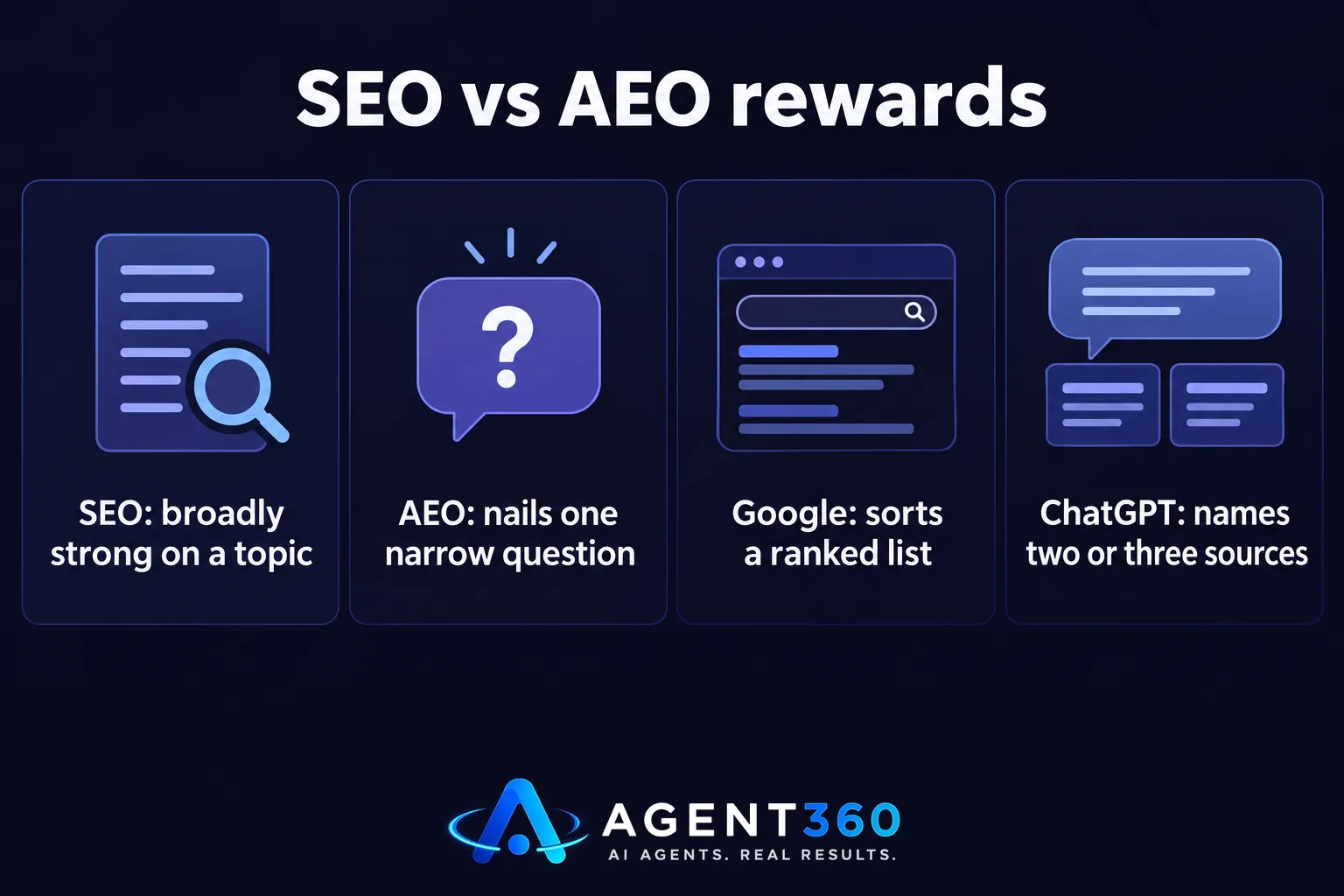
That's the real difference between classic SEO and AEO: SEO rewards a page that's broadly strong on a topic. A model synthesizing an answer rewards a page that nails one narrow question completely, with a sentence it can lift almost word for word. Vague, scope-everything pages rarely get quoted, even when they rank fine on Google.
How to become searchable on ChatGPT
Before content quality matters at all, the page has to be reachable. OpenAI crawls the web with a documented bot (GPTBot), and pages blocked in robots.txt, gated behind logins, or rendered entirely in JavaScript the crawler can't execute simply never make it into the pool of things ChatGPT can cite. Check three things first:
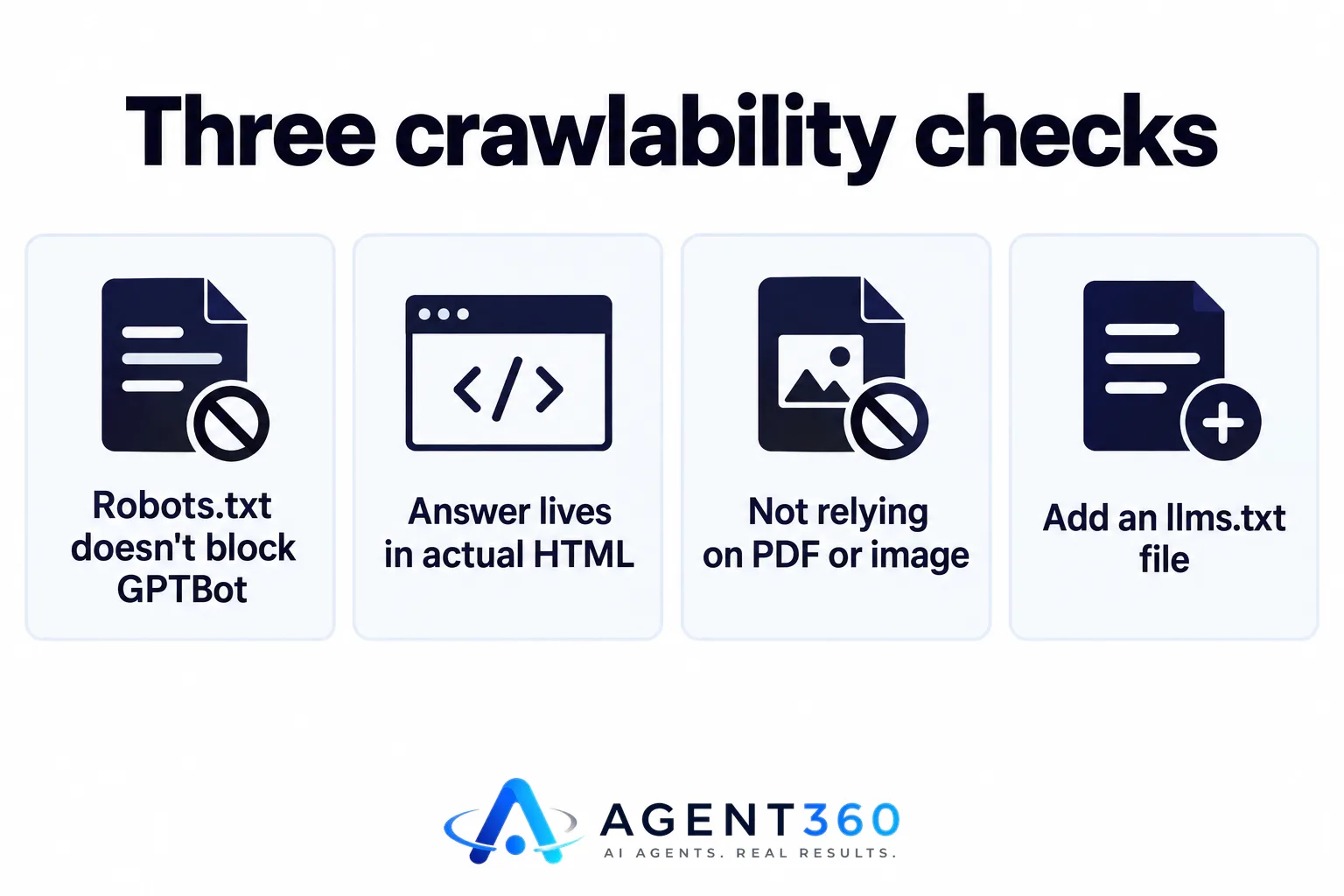
- Your robots.txt doesn't block GPTBot or other AI crawlers.
- The page's core answer is in the actual HTML, not injected after load by a script.
- You're not relying on a PDF or an image for the answer — text in the page body is what gets read and quoted.
Some sites also publish an llms.txt file, a plain-text index pointing AI crawlers to the pages meant to be read and summarized. It's not a ranking signal, and nobody has published numbers on how much weight it carries. But it costs little to add, and it removes any guesswork about which pages you want surfaced.
How to appear in ChatGPT: write the answer, not the pitch
The pages that get cited tend to share a shape: a direct answer in the first two sentences, a short list or table backing it up, and specific nouns — prices, locations, named competitors, real numbers — instead of adjectives like “leading” or “trusted.” A model building a recommendation needs something to point to. “We're the best choice for small business SEO” gives it nothing to work with. “Plans start at $297 a month with no contract” gives it a sentence it can actually use.
Comparison and “versus” pages do well here for a simple reason: the question people ask ChatGPT is often comparative — “is X better than Y for Z” — and a page already built as a comparison answers that exact shape of question. Same logic applies to “best for [use case]” pages. Build the page around the question, not around your product.
How to track brand mentions on ChatGPT
One prompt tells you almost nothing. Ask the same question twice and you can get two different answers — responses shift by session, by model version, sometimes for no reason you can find. A real read means asking the same set of buyer questions on a schedule and logging three things every time: were you named, who was named instead, and which sites got cited as the source.
Do it by hand with a spreadsheet and a recurring calendar reminder, or let it run on its own — the mechanics of a repeatable test are laid out in this guide to tracking your brand in ChatGPT. Either way, what you want out of it isn't a single yes or no. It's a trend line and a list of competitors who keep showing up where you don't.
Where this fits into the rest of your work
Checking ChatGPT, Claude, and Google AI Overviews by hand on a schedule is tedious enough that most teams quietly stop after a month. SearchAgent's AI Visibility Agent asks your buyers' actual questions to all three on a schedule, records who got named and who got cited, and turns the gaps into a list of pages to write next — the same ChatGPT tracking described above, just run continuously instead of once. Plans start at $297 a month, month to month, no contract.

How to track brand mentions on ChatGPT?
Ask the same set of buyer-style questions on a recurring schedule, record whether you're named and who's named instead, and watch the trend over weeks rather than trusting any single answer — responses vary between sessions even for an identical prompt.
How to become searchable on ChatGPT?
Make sure your pages aren't blocked to AI crawlers in robots.txt, put your actual answer in crawlable HTML rather than behind scripts or inside a PDF, and consider adding an llms.txt file pointing at the pages you want summarized.
How to appear in ChatGPT?
Give it one page that answers one buyer question directly in its first two sentences, back that answer with concrete details instead of adjectives, and shape the page the way buyers actually phrase the question — comparative, or “best for” a specific case.
More articles
- An AI Blog Writer Won't Rank You. Here's What Will
- SEO Content Automation: What to Automate, What Not To
- What Is llms.txt and Do You Actually Need One?
- How to Appear in Google AI Overviews
- AI Visibility Tracking: What to Measure and How Often
- Track Brand Mentions in ChatGPT Without Fooling Yourself
- How to Rank in ChatGPT: What Actually Gets You Named
- Generative Engine Optimization: What Actually Works
