Track Brand Mentions in ChatGPT Without Fooling Yourself

Want to track brand mentions in ChatGPT? Fix your login before you touch your prompt list. ChatGPT now carries memory across sessions and can pull in earlier chats and tasks, so if you're testing from the account you use for work every day, the answers aren't clean. You're not seeing what a stranger sees. You're seeing what ChatGPT thinks you, specifically, want to hear.
This matters more now than it did a year ago. OpenAI has rolled out memory, saved context, and the ability to pull in prior conversations, and the gap between what a cold prospect gets and what you get testing it yourself has widened. A question that looked reliable twelve months ago can quietly be answering a different one today — not “who is good at this,” but “who does this person already know about.”
Your own account remembers things a stranger's account does not
Mention your company, a competitor, or your own website inside ChatGPT — in any chat, for any reason — and memory can carry it forward. Ask “who are the best vendors for X” from that same account later, and the model has more to draw on than the open web. It may lean toward names you've already typed, including your own. That's not a mention you earned. It's one you planted.
OpenAI hasn't published the mechanics of how memory weighs into an answer, and it shifts as the product changes — don't bother trying to reverse-engineer it. Easier to remove the variable than to account for it.
Log out, or use a fresh account, before you test
Three ways to get a cleaner read, in order of effort:
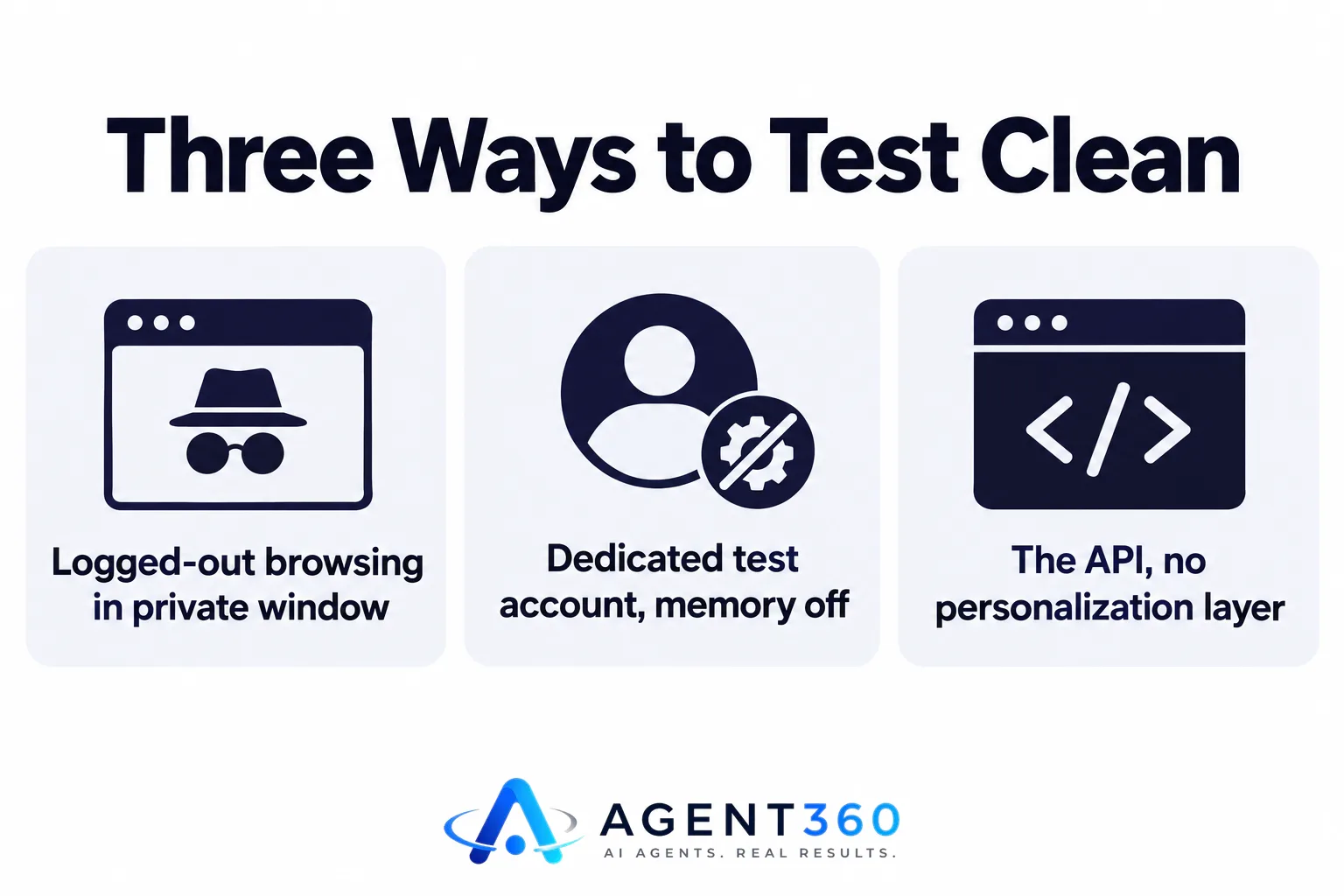
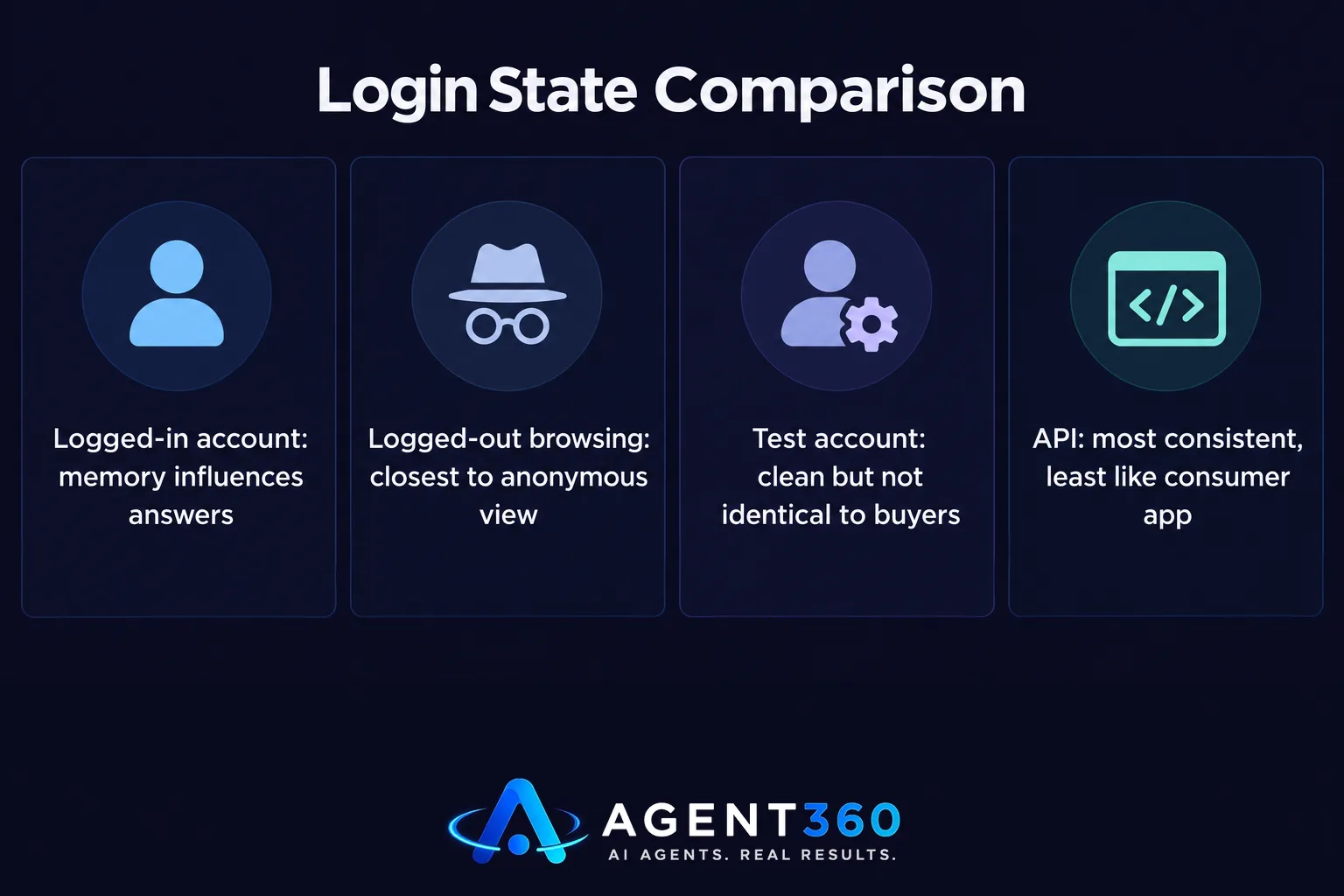
- Logged-out browsing. Open ChatGPT in a private or incognito window and ask your question without signing in. This is the closest thing to what an anonymous prospect sees, though some features and models are restricted when logged out.
- A dedicated test account that has never discussed your company, your site, or your competitors. Keep it clean — do not use it for anything else, and turn off memory in its settings as an extra safeguard.
- The API, which does not carry the memory and personalization layer the consumer app does. It is the most consistent option if you are running this regularly, though it is not exactly the same product your buyers use.
None of this is perfect. A prospect in another country, on another plan, with a different chat history will still see something slightly different from your test account. You're not after a perfect mirror — just removing the one variable most likely to lie to you: your own account's memory of you.
One answer is noise; a tracked question is signal
Ask a question once and you've got an anecdote. ChatGPT's answers vary run to run even with identical wording, identical login state, and no memory involved — that's just how the model works, not a bug you can prompt around. Before you draw any conclusion about whether you're named, run the same question across several fresh sessions spread over a few days. Look at the pattern, not any single response.
Then keep doing it, on a schedule. A brand that shows up in 7 of 10 checks this month and 2 of 10 next month has lost ground — even though any single check in either month might have looked fine on its own. A brand that never appears and starts showing up once a week is gaining ground, long before that shows up anywhere else. Neither pattern is visible from one test.
What to log every time you ask
Keep this simple enough that you will actually keep doing it:

- The exact question, word for word — not a paraphrase from memory.
- Date and, if you can tell, which underlying model answered.
- Logged-in state (logged out, test account, or API).
- Whether you were named, and where in the answer.
- Who else was named, in what order.
- Any site cited alongside the recommendation.
Skip the login state and you won't be able to tell later whether a lost mention was a real drop or just memory doing something different that day. That one field is the difference between a log you can trust and one you can't. For a longer walkthrough, including how to build the question list itself, see how to track your brand in ChatGPT.
If this sounds like more process than you want to run by hand
Controlling for login state by hand, running questions across multiple sessions, logging the pattern every week — it's exactly the kind of checking that's easy to start and hard to keep up. SearchAgent's AI Visibility Agent asks your buyers' questions to ChatGPT, Claude and Google AI Overviews on a fixed schedule, records whether you were named and who was named instead, and turns the gaps into page drafts. Plans start at $297 a month, no contract — details on the pricing page.
Does ChatGPT's memory actually change recommendations, or is this overstated?
OpenAI hasn't published a breakdown of how much weight memory carries in a given answer. It's reasonable to assume it varies by question type and how much relevant history sits in the account. For testing purposes, assume it can matter — that's reason enough to remove it rather than guess at its size.
How often should I check for brand mentions in ChatGPT?
Weekly is a reasonable floor if you're actively working on this. Daily only earns its keep when you're mid-campaign and want to see a change land fast. Frequency matters less than consistency — same question wording, same login state, same model where possible — so the pattern you see over a month actually compares to last month's.
Does the specific ChatGPT model version matter for testing?
Yes. Different models answer the same question differently, and OpenAI changes which model serves free versus paid users without much warning. Log which model answered each time — otherwise a shift in your numbers looks like a change in your visibility when it was really just a different model picking up the phone.
More articles
- An AI Blog Writer Won't Rank You. Here's What Will
- SEO Content Automation: What to Automate, What Not To
- What Is llms.txt and Do You Actually Need One?
- How to Appear in Google AI Overviews
- AI Visibility Tracking: What to Measure and How Often
- How to Get Mentioned by ChatGPT: A Practical Playbook
- How to Rank in ChatGPT: What Actually Gets You Named
- Generative Engine Optimization: What Actually Works
