Generative Engine Optimization: What Actually Works
Generative engine optimization is the work of getting your business named and cited when someone asks ChatGPT, Claude or Google's AI Overviews a question your buyers would ask. It is not the work of ranking higher in a list of ten blue links. If you've been treating GEO as SEO with a new acronym bolted on, unlearn that first.
The confusion is fair. GEO borrows real estate from SEO — the same pages, often the same keywords, sometimes the same writers. But the scoring system underneath is different, and tactics built for one don't automatically carry over to the other.
GEO rewards citation-worthiness, not keyword placement
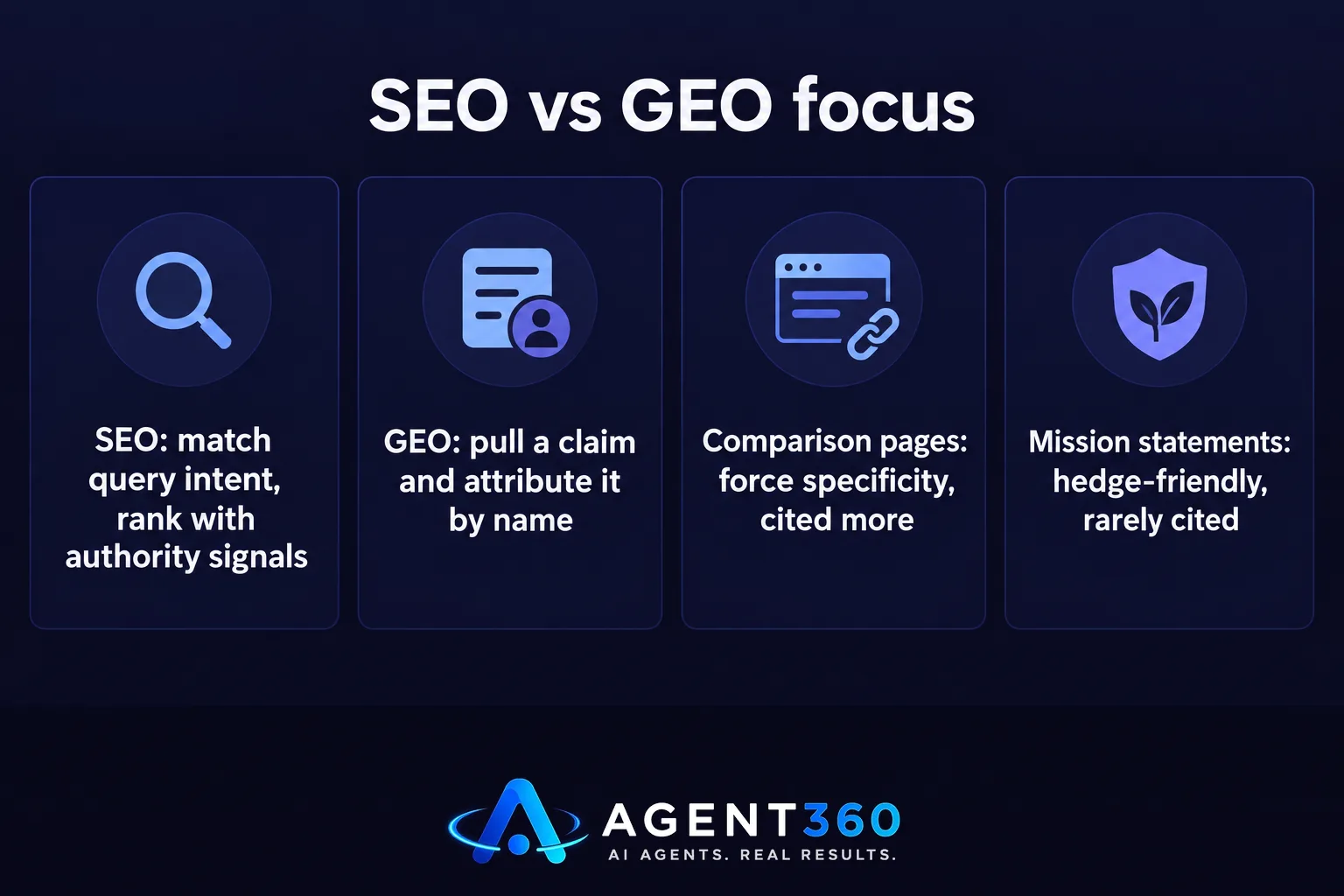
Search engines rank pages by matching query intent to a document, then layering in authority signals like backlinks and click behavior. Large language models don't rank your page. They read it, pull a claim out of it, and decide whether to attribute that claim to you by name. That's a different job entirely.
What gets pulled out tends to share a shape: a direct answer in the first two sentences of a section, a specific number or named entity, a structure the model can lift without much rewriting. A page that opens with three paragraphs of scene-setting before it answers anything gives the model nothing clean to quote. It moves on to a competitor's page that answered faster.
This is also why stuffing a page with your target keyword does little here. The model isn't matching strings. It's deciding whether your sentence is a confident, checkable answer to the question it was asked. Write the answer as if someone asked you out loud, not as if you were filling a content brief.
What is GEO, concretely, if you strip the jargon
Strip the acronym and GEO is three habits done on a schedule: ask the questions your buyers ask, see who gets named, publish the page that would have earned your name instead. None of that requires new tooling in principle — you can type questions into ChatGPT by hand and keep a spreadsheet. What makes it a discipline rather than a one-off experiment is the schedule. A single answer from a model tells you almost nothing, because the same question can return a different answer an hour later. You need repeated checks over weeks before a pattern, not noise, tells you whether you're gaining ground or losing it. A repeatable way to track your brand in ChatGPT is worth setting up before you touch a single page. Without a baseline, you won't know if anything you publish moved the needle.
Tracking before strategy, because strategy without a baseline is a guess
The temptation is to start writing GEO-flavored content right away. Resist it. First, run the same set of ten to twenty buyer-intent questions through ChatGPT, Claude and Google's AI Overviews, and record three things for each: whether you're named, who's named instead, and which site the answer cites as its source. That third column matters more than people expect. It tells you whose content the model currently trusts for that topic — the page you need to outdo, not just outrank.

Do this weekly, not once. Models get updated, source material changes, and one competitor publishing a well-structured page can flip an answer within a refresh cycle. A single snapshot is a photo. What you need is a trend line. If you don't want to run this by hand on a schedule, automated AI answer tracking runs the same checks on a cadence and logs the pattern for you.
The content format that earns a citation, and the one that doesn't
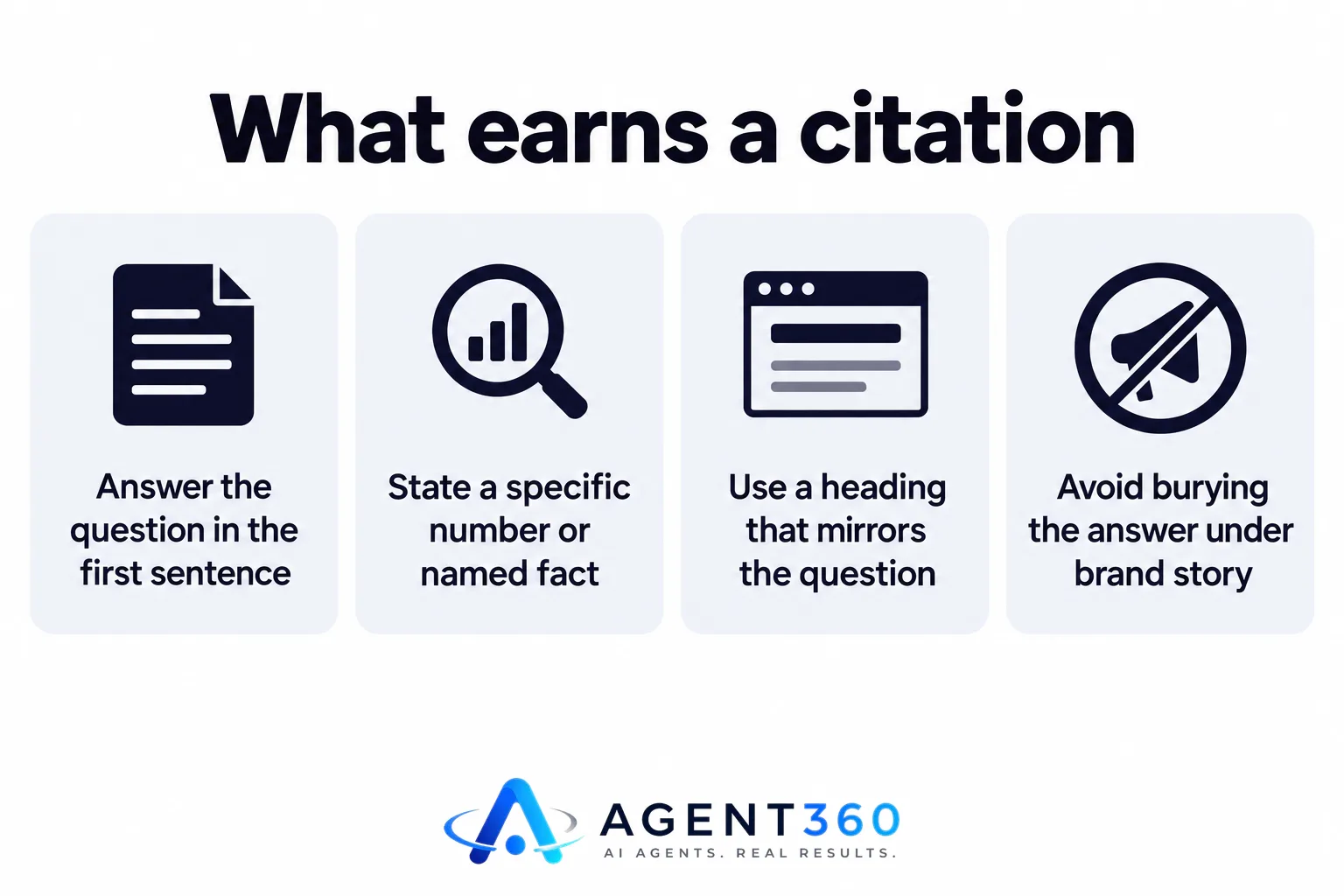
Pages that get cited tend to do four things: answer the likely question in the first sentence of the relevant section, state a specific number or named fact rather than a vague claim, use a heading that mirrors how someone would actually ask the question, and avoid burying the answer under a brand story. Comparison pages, pricing breakdowns and “X vs Y” pages tend to perform well here, because they force specificity. A model can't hedge its way through a direct comparison the way it can through a mission statement.
Pages that don't get cited usually share the opposite traits: an introduction that exists only to be an introduction, an answer that takes three paragraphs to extract, a claim with no number attached to it. If your content reads well to a human skimming for mood but takes real effort to extract a fact from, assume a model is skipping it too.
GEO and SEO overlap more than they conflict
None of this means abandoning search rankings. Google still sends the majority of buyer traffic for most businesses, and a page that ranks well for a term is also a reasonable candidate for the related AI question. The practical move is to build pages that do both jobs: structured enough to rank, direct enough to be quoted. How SEO, AEO and GEO actually differ goes into where the three diverge, and where one set of well-built pages genuinely serves all three. Want the shorter definition first? What GEO means in practice is a good place to start before you commit to a content plan.
Where a tool earns its keep
The slow part of GEO isn't understanding it. It's the repetition: asking the same questions on a schedule across three engines, noticing when a competitor gets named instead of you, and turning that miss into a published page before the gap widens. SearchAgent runs that loop automatically, checking ChatGPT, Claude and Google AI Overviews on a schedule, then writing and publishing the article that targets each miss. Plans start at $297 a month with no contract — a reasonable way to test whether the mechanism works for your category before you build a team around it.
Frequently asked questions
What is GEO, in one sentence?
Generative engine optimization is the work of making your business the one an AI assistant names and cites when someone asks it a question your buyers would ask, rather than just a page Google lists among its results.
What are realistic generative engine optimization strategies to start with?
Start by tracking: run a fixed set of buyer questions through ChatGPT, Claude and Google AI Overviews weekly and log who gets named. Then rewrite your weakest pages to answer the question directly in the first sentence, with a specific fact attached, and republish. Strategy without the tracking step is just guessing at what the model wants.
Do I need new content, or can I fix existing pages?
Usually both, but fixing is faster. A page already ranking reasonably well in Google often just needs its opening rebuilt into a direct, quotable answer. Write new pages only where none of your existing ones touch the question at all.
More articles
- An AI Blog Writer Won't Rank You. Here's What Will
- SEO Content Automation: What to Automate, What Not To
- What Is llms.txt and Do You Actually Need One?
- How to Appear in Google AI Overviews
- AI Visibility Tracking: What to Measure and How Often
- Track Brand Mentions in ChatGPT Without Fooling Yourself
- How to Get Mentioned by ChatGPT: A Practical Playbook
- How to Rank in ChatGPT: What Actually Gets You Named
