How Cannibalization Tools Pick Which Article to Merge

If you're looking for tools that detect cannibalization across posts and tell you which article to merge or redirect, in the United States the usable options mostly work off the same three signals, and it's worth being sure you understand that mechanism before you let a tool reply with a recommendation you just execute. This explains, in plain English, how those recommendations are actually generated: a tool compares the queries two pages both rank for, how often Google swaps which one it shows, and how similar the content underneath actually is. The merge-or-redirect call is just a rule applied to those three signals, not a judgment call the tool is making on its own.
Two pages ranking for one query is the trigger, not the proof
The starting signal is simple: the same search query shows impressions or clicks for more than one URL on your site, inside Search Console or inside the tool's own index. That alone doesn't mean you have a problem. A query like “pricing” might legitimately surface both your pricing page and a blog post that mentions pricing in passing — that's expected overlap, not cannibalization.
What turns overlap into a flag is volatility: the two URLs keep trading the top spot week to week, and neither one settles. If page A ranked position 6 last month and page B ranks position 6 this month for the identical query, Google is undecided about which one deserves the spot, and undecided usually means neither gets picked for a map pack, a featured snippet, or an AI Overview citation. That alternating pattern, tracked over several weeks of ranking history, is the actual evidence tools rely on — a single snapshot can't show it.
Content similarity decides whether to merge or just differentiate
Once two pages are confirmed to be competing for the same query, the next check is how alike they are underneath. Tools typically compare titles, H1/H2 structure, and body text — either with straightforward text overlap or with embeddings that measure semantic closeness rather than exact wording. High similarity, say the two pages cover nearly the same subtopics in nearly the same order, points toward a merge: fold the weaker page's unique paragraphs into the stronger one and retire the duplicate.
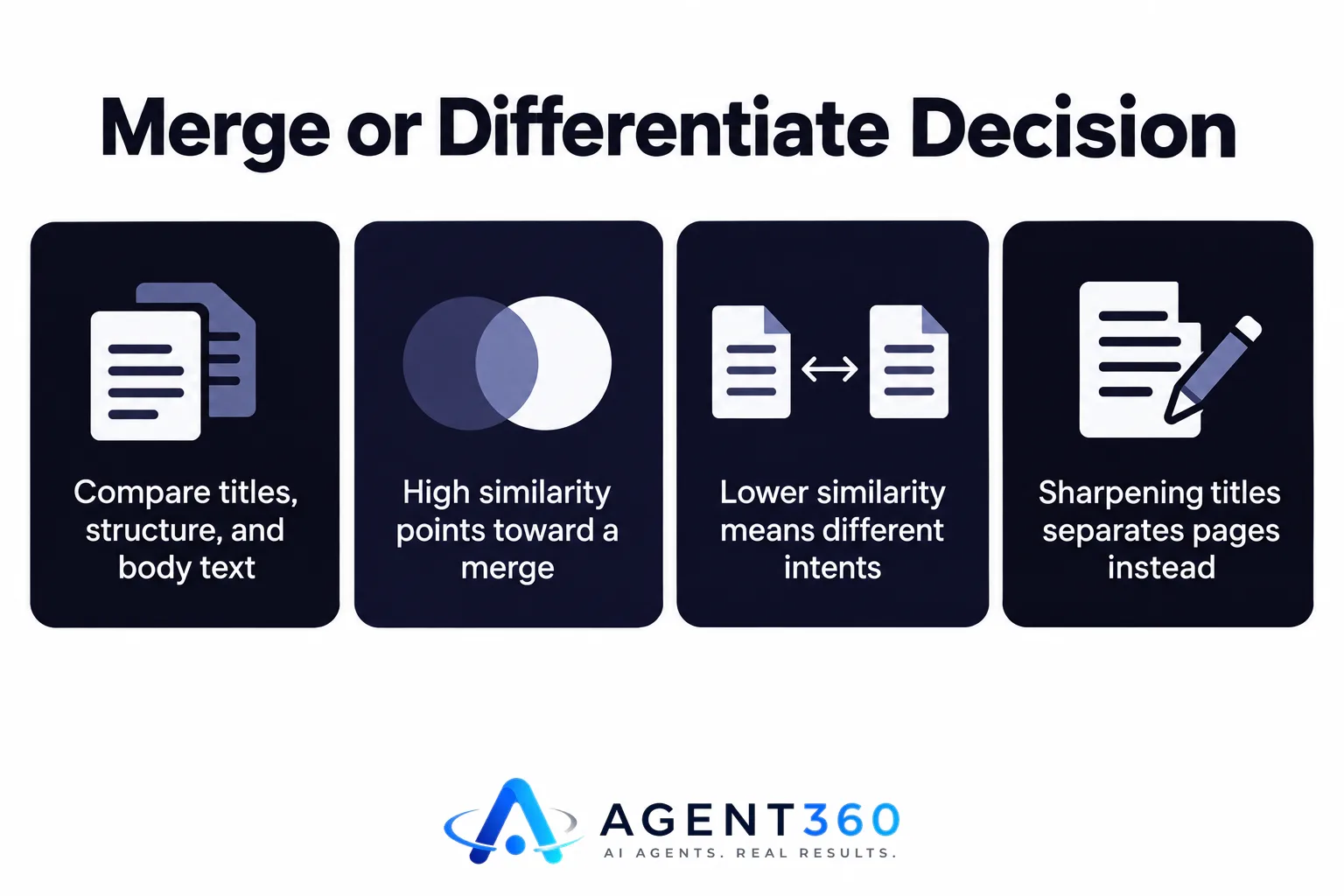
Lower similarity with the same target query usually means the pages serve different intents that happen to share a keyword — one answers “what is X,” the other compares “X vs Y.” The right move there isn't merging, it's sharpening each page's title and opening paragraph so Google can tell them apart, which is a rewrite, not a redirect. Mistaking this case for true cannibalization is the most common false positive, and it's worth reading through what actually counts as competing pages before you act on a tool's suggestion.
The merge-vs-redirect call usually comes down to which page has more to lose
When a merge is warranted, the tool still has to recommend which URL survives. The logic generally weighs three things: which page has more backlinks or referring domains, which page has more historical traffic or impressions, and which page is newer or better structured. The page that loses on all three gets a 301 redirect into the one that wins, so its link equity and any existing rankings transfer rather than vanish.
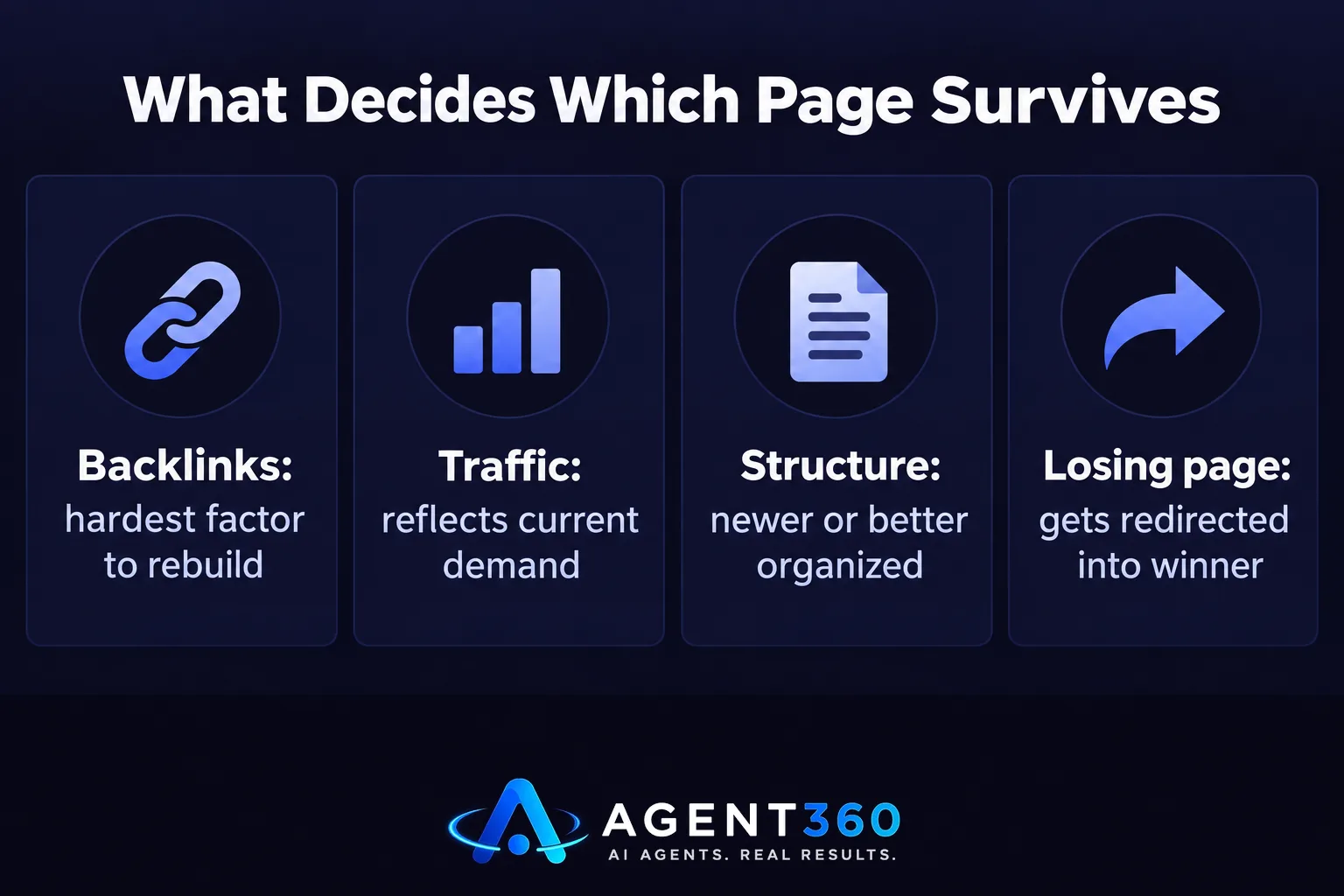
Where tools disagree is in how they weight those three factors — one might prioritize backlinks because they're hardest to rebuild, another might prioritize recent traffic because it reflects current demand better than a link profile built two years ago. Neither weighting is wrong, but it means two different tools can look at the same pair of pages and recommend redirecting in opposite directions. That's a reason to treat the recommendation as a starting point, confirmed against your own sense of which page actually serves the buyer rather than executed automatically.
Redirect loops and orphaned anchors are the failure mode nobody flags
Most detection tools stop at the recommendation. They don't check what happens after you implement it. Two problems show up consistently once a redirect goes live. First, if the merged page was already the target of other internal links using specific anchor text built around the retired page's angle, those links now point somewhere that doesn't match the anchor, which confuses both users and crawlers. Second, if you later publish a new page that accidentally covers the same ground as the survivor, you've recreated the exact problem the merge was meant to solve, and nothing re-checks for that unless the tool runs on a schedule rather than a one-time scan.

This is the gap worth asking about before you adopt any tool: does it re-scan after you act, or does it only tell you once? A one-time report is a snapshot of a moving target. For a fuller walkthrough of the actual merge-or-redirect decision once a tool hands you the pair, see the mechanics of merging, redirecting, or splitting two competing pages.
What a tool can automate, and what still needs a person
Detection — pulling the query overlap and the volatility pattern — is the part that's genuinely mechanical and worth automating. The merge-vs-differentiate call, and especially the choice of which page survives, benefits from someone who knows which page actually converts better, which a tool measuring only impressions and backlinks can't see. Research-heavy suites are strong at surfacing the overlap; they generally leave the decision and the rewrite to you.
SearchAgent's site health and ranking checks run nightly against Search Console and flag overlapping pages as part of the Pro and Scale plans, alongside the weekly refresh that rewrites the surviving page once you've picked it — see the full breakdown on plans and pricing. The detection step is only useful if something acts on it before the next crawl finds the same pair still competing.
Which tools detect cannibalization across posts?
Any tool that reads your Search Console query data, or crawls your own site and compares page content, can detect it — the detection itself isn't rare. What varies is whether the tool re-checks on a schedule, whether it compares content semantically or just by exact keyword match, and whether it hands you a redirect recommendation or just a list of overlapping URLs.
How are merge-or-redirect recommendations actually generated?
They come from comparing query overlap, ranking volatility, and content similarity between two pages, then weighing backlinks, traffic, and structure to decide which page survives. The weaker page gets redirected into the stronger one if the content is genuinely duplicate; if the pages serve different intents despite sharing a keyword, the fix is rewriting titles and openings to separate them, not merging.
Can cannibalization fix itself without merging or redirecting?
Sometimes, if the two pages drift toward different queries on their own as Google's index settles — but this can take months and there's no guarantee it resolves in your favor. Checking ranking history over several weeks, rather than acting on a single scan, is the only reliable way to tell whether it's settling or staying stuck.
More articles
- How to Get Into Google's AI Overview, Really
- Hur du rankar i ChatGPT (och vad det egentligen betyder)
- How to See If You're in AI Overviews (and Who Beat You)
- What a Refresh Agent Actually Does (and When to Use One)
- Keyword Gap Meaning: What It Is and How to Find Yours
- How to Appear in AI Search Results, Step by Step
- How to Show Up in AI Search Results, Not Just Google
- Whitelabel GEO: What to Check Before You Sign a Vendor
