Automated SEO for Small Business: What to Automate First

Automated SEO for a small business handles the repeatable half of the job well and fumbles the half that needs judgment. A machine can track rankings every night, check whether ChatGPT names you, draft a first pass of an article, flag a broken title tag — tirelessly, forever. It can't decide which twenty searches actually matter to your revenue, what tone your brand should take, or when a competitor's move deserves a response. That still takes a person who knows the business. The real question isn't whether to automate. It's which half you hand over.
Keep that split in mind as we go through the questions people actually ask.
Is SEO dead now with AI?
No. The target moved. Google still returns a list of links, and it still writes an AI Overview above that list for a growing share of searches. ChatGPT and Claude answer buyer questions directly now, often without sending anyone to a website at all. Getting into that list and that answer takes roughly the same work it always has: a well-structured page that answers one specific question clearly, hosted on a site that search engines and AI crawlers can actually read. What changed is the number of surfaces. You're now optimizing for two — the ranked list and the generated answer — and a page built only for the old one quietly misses the new one. Worth understanding before you automate anything: the difference between ranking, being quoted, and being named decides what a page needs to include.
Can ChatGPT do SEO?
It can draft a paragraph. It can suggest a headline. What it can't do is the part of SEO that needs current, connected data. ChatGPT has no live link to your Google Search Console, so it doesn't know which of your pages lost position this week. It doesn't crawl your competitors' top-ten rankings on a schedule, so it can't tell you who just took the spot you held. And it has no memory of your business from one session to the next, so every time you ask it to check something, you're re-explaining your market from scratch. Use it as a drafting assistant inside a process you still run by hand — research the question, pull the data, decide what to publish, check it landed. That's a real chunk of weekly work for one person to carry on top of everything else running a small business involves.
Which parts of SEO are safe to automate, and which need a human
Hand these over completely: reading rank positions and movement from Search Console every night instead of once a quarter; checking whether ChatGPT, Claude or Google's AI Overview name your business on a repeating schedule instead of whenever you remember to ask; scoring your site for the technical things that quietly block crawlers — broken headings, missing structured data, pages AI bots can't read. These are checklist tasks, not judgment calls. A tool doing nightly rank tracking and a tool running a technical and AI-readiness scan aren't deciding anything. They're just not forgetting to look.
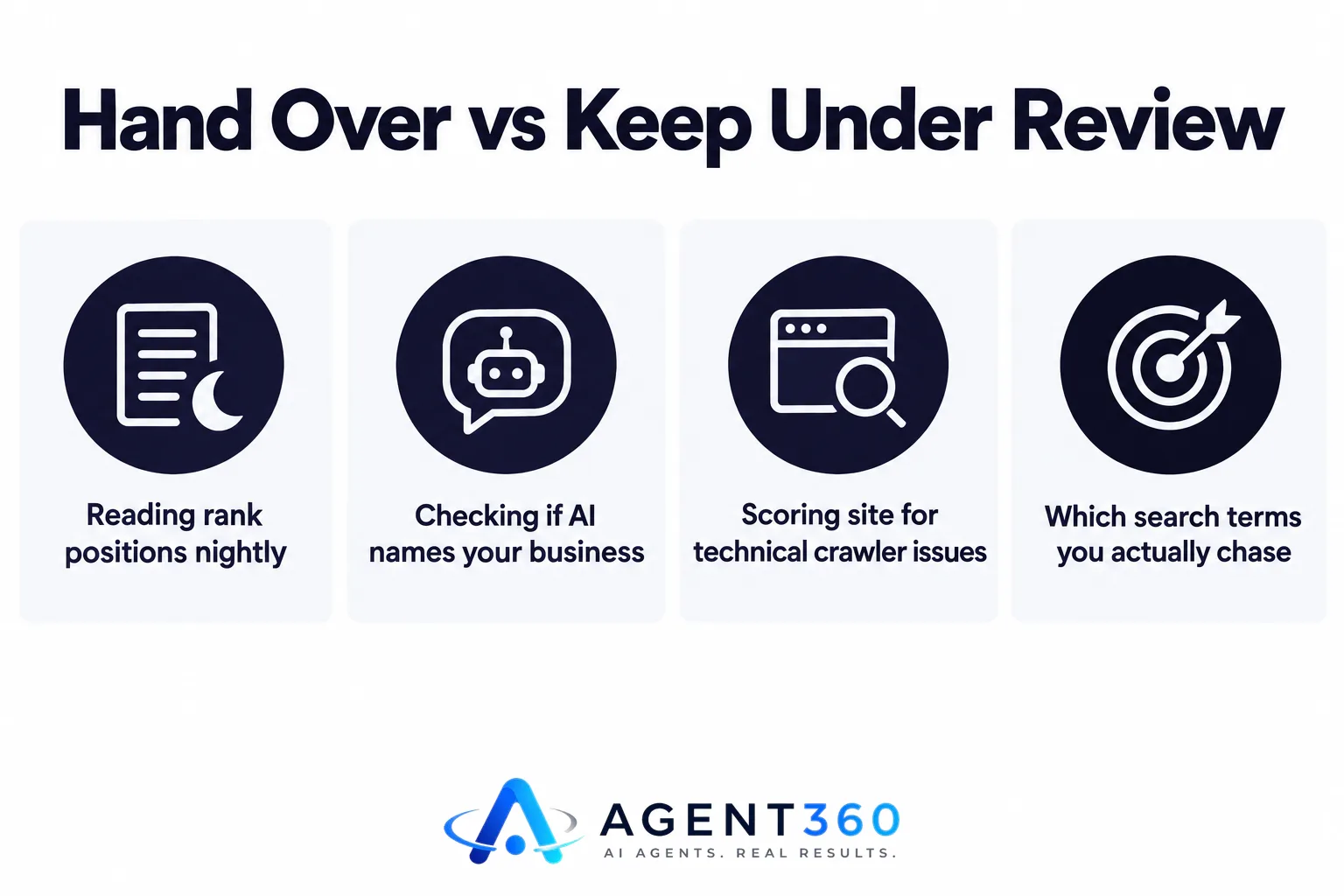
Keep these under review: which twenty or fifty search terms you actually chase — a tool will happily track terms that bring traffic but never bring a customer; the voice and claims in anything published under your name; and any decision to spend money on backlinks or paid boosts, which carry real risk if done badly. Automation should produce the list and the draft. A person still approves what goes out the door.
Is SEO worth it for a small business?
Worth it when three things line up. First, people actually search for what you sell, either by category or by “near me” — if your buyers only ever find you through referrals, SEO is a slower lever than fixing the referral pipeline. Second, you can sustain publishing and fixing for several months before judging results, because new or improved pages take time to earn position. Not days. Third, you have an honest way to measure it: actual search traffic and the leads it produces, not just “we're ranking for something now.” Search Console is the only source of that third thing that isn't a guess. Everything built on top of it, including keyword ideas and content plans, is only as good as whether it's wired to your real numbers or to someone's estimate of them.
What is the best automated SEO tool?
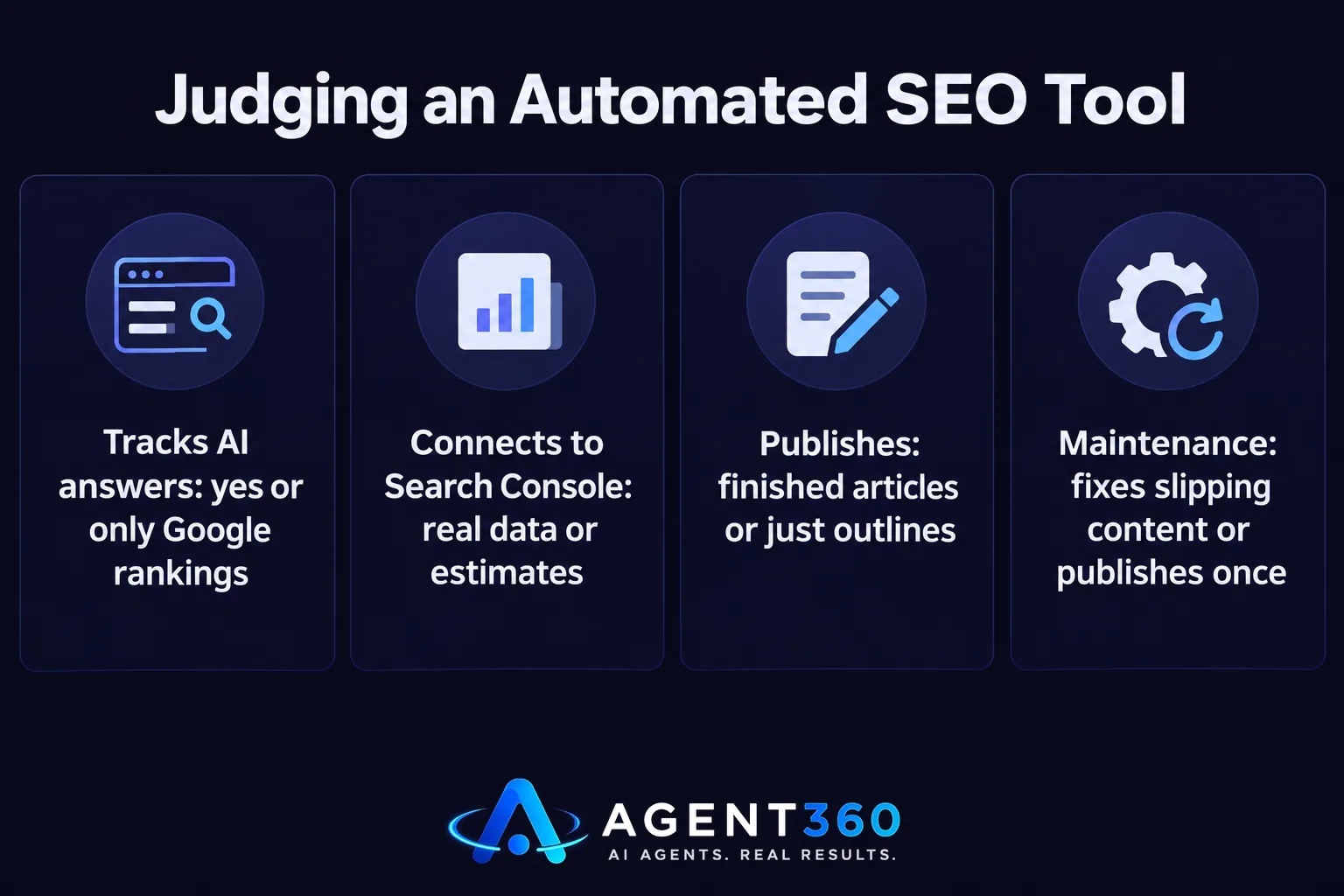
Judge any candidate against four questions, not a feature list. Does it track AI answers — ChatGPT, Claude, Google's AI Overview — or only classic Google rankings, which misses where a growing share of buyer questions now get answered? Does it connect to your actual Search Console data, or show you estimated numbers that may not match what's happening on your site? Does it publish finished articles, or hand you an outline and leave the writing to you? And does it come back to fix content that's slipping, or publish once and walk away?
We built SearchAgent around that shape: it reads your Search Console nightly, asks ChatGPT, Claude and Google's AI Overview the questions your buyers ask on a schedule, and its agents write and publish the articles that close the gaps, with a human team setting it up and keeping it pointed at the right searches. Plans start at $297 a month with no contract — detailed on the pricing page — and if you're weighing it against paying an agency by the hour, the comparison is worth reading before you commit either way.
What is the best automated local SEO tool for businesses?
For a local business the bar shifts: the tool needs to know “best plumber” and “best plumber near me” aren't the same search, and that the competitors worth tracking are the other businesses in your town, not national brands with ten times your budget. A generic keyword tool mixes those together and wastes your attention. Look for competitor tracking that knows your location and AI answer checks phrased the way a local customer would actually ask — covered in more detail under local business SEO.
How long before automated SEO shows results?
Automation speeds up the mechanical work — publishing, tracking, checking — but it doesn't shorten how long a search engine takes to trust a new or improved page. Judge results in months, not weeks. The first visible sign is usually movement in position for terms you already rank for somewhere on page two or three, well before brand-new terms show up at all.

Do I still need someone managing it?
Yes. Even the sharpest automated process still needs someone deciding which gaps matter, approving what goes out under the business's name, and reading the monthly numbers closely enough to redirect it when a plan stops working. Automation removes the grind. It doesn't remove the ownership.
More articles
- An AI Blog Writer Won't Rank You. Here's What Will
- SEO Content Automation: What to Automate, What Not To
- What Is llms.txt and Do You Actually Need One?
- How to Appear in Google AI Overviews
- AI Visibility Tracking: What to Measure and How Often
- Track Brand Mentions in ChatGPT Without Fooling Yourself
- How to Get Mentioned by ChatGPT: A Practical Playbook
- How to Rank in ChatGPT: What Actually Gets You Named
