What an AI SEO Tool Can and Can't Do for Your Rankings

Ask ten vendors what an “AI SEO tool” is and you'll get three different answers, because the category is really three jobs wearing one label: a research assistant that finds keywords and gaps, a writing assistant that drafts content, or a monitoring agent that tracks rankings and flags what changed. No tool does all of SEO end to end. Fixing a broken canonical tag, deciding which ten pages deserve a backlink push, judging whether a competitor's content actually beats yours — that still takes a person who knows the business. So the real question isn't “can AI do SEO.” It's which of these three jobs you want off your plate, and what you're willing to hand it to.
Most of the confusion buyers run into starts right here: treating “AI SEO tool” as one thing when it's three, often sold off the same landing page as if they were interchangeable.
Is there an AI that can do SEO?
Parts of it, yes. Keyword research, content drafting, rank tracking, even flagging missing structured data — AI software handles all of that reliably now. What it won't do unsupervised is strategy. Deciding a declining product line doesn't deserve new content. Noticing that two pages are quietly splitting the same search and one needs to be merged or cut — worth checking for directly, since two pages competing for the same term is one of the more common ways sites waste the content they already have. AI tools can surface the data behind that call. They rarely make the call well on their own, because it depends on context the tool doesn't have: your margins, your sales team's priorities, which page a rep actually wants to send a prospect.
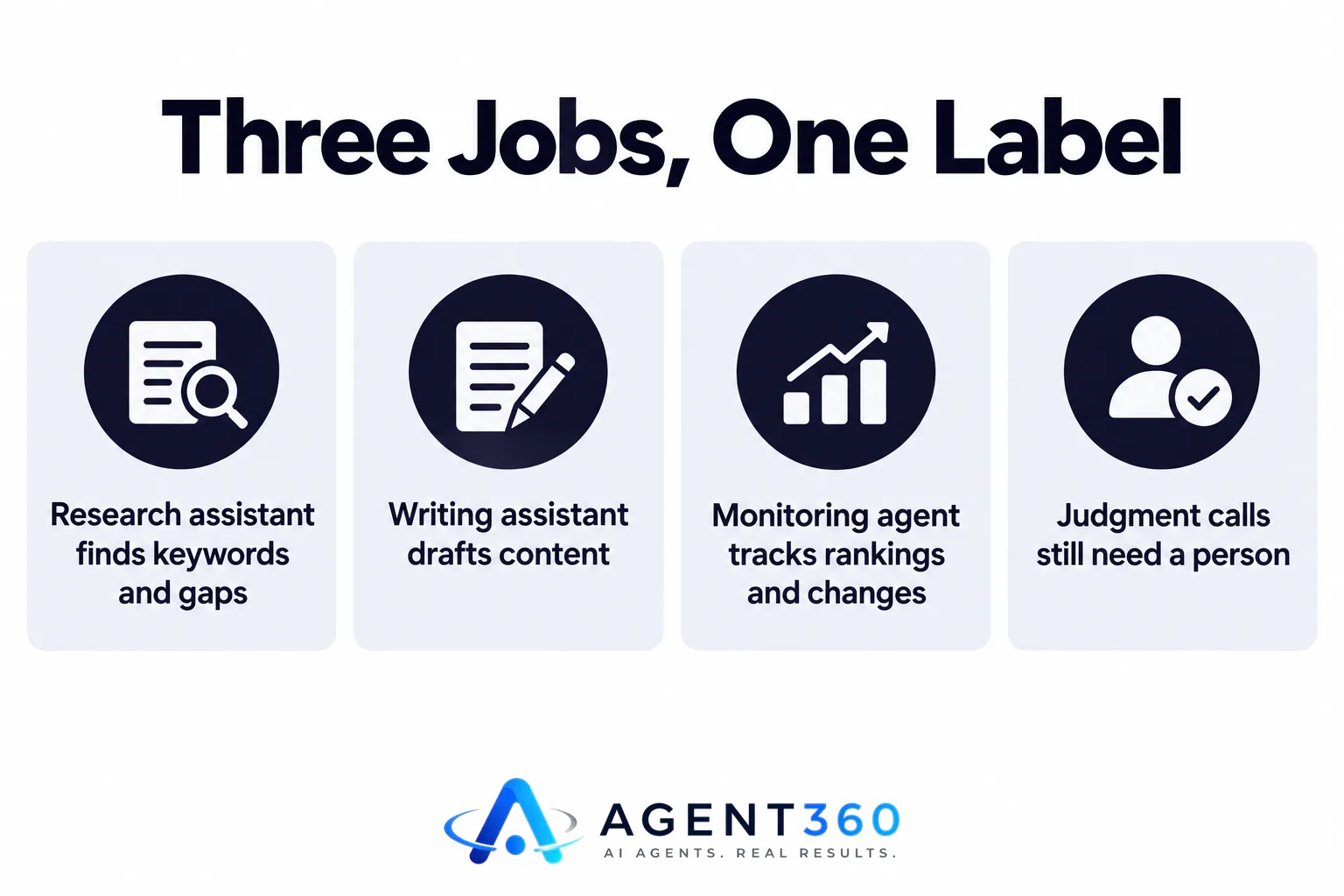
So here's the honest split: an AI can do the mechanical half of SEO — research, drafting, monitoring, basic technical checks — faster than any person could. The judgment half still needs someone watching the output.
Can ChatGPT do SEO?
ChatGPT can brainstorm keyword angles, draft an outline, explain a technical SEO concept faster than most reference pages manage. What it can't do is see your Google Search Console data, know which pages are losing position this week, or remember what it told you to publish last month unless you paste it back in. No scheduled check-ins, no memory of your site's history, no way to confirm its own advice worked. Ask it the same question on different days and you'll sometimes get different answers, because it isn't querying a live index. It's generating a plausible one.
That's also why tracking whether ChatGPT names your business in buyer questions is a different exercise entirely from using ChatGPT to write. One monitors an engine from the outside; the other asks the engine for help on the page. Mix the two up and you end up disappointed, expecting a chat window to do a tracking system's job.
What are the best AI SEO tools?
There isn't one best tool. The category splits into jobs that barely overlap:
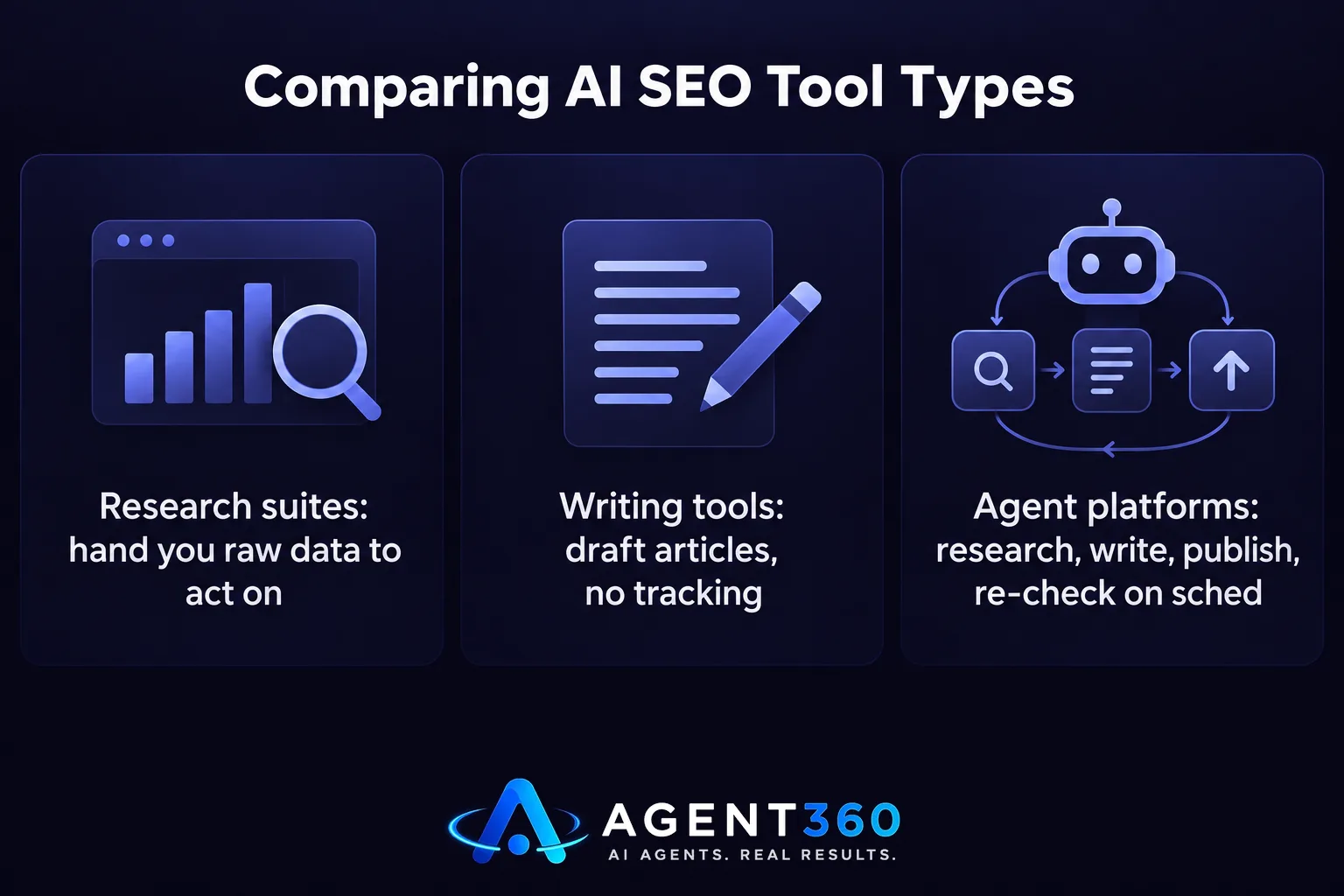
- Deep research suites that hand you keyword difficulty, backlink profiles and site crawls, and expect you to act on the data yourself.
- AI writing tools that draft articles from a prompt but don't track whether those articles rank or get cited.
- End-to-end agent platforms that research, write, publish and re-check on a schedule, trading some depth of data for less manual work.
Which one fits depends on whether someone on your team will spend hours a week interpreting raw data, or whether you'd rather the gaps turn into drafts on their own. Comparing a research suite against an agent platform is a reasonable way to see that trade-off before you pick either.
What is AI SEO called now?
Getting quoted inside an AI-generated answer — the summary above Google's links, or ChatGPT's reply to “who does X near me” — now goes by a couple of names that have actually stuck: answer engine optimization (AEO) and generative engine optimization (GEO). Neither replaces SEO. They extend it. A page built to rank in Google's list of links tends to get cited in AI answers too, because both systems reward the same things: a direct answer near the top, clear structure, a source that reads as credible. The differences between SEO, AEO and GEO are worth knowing even if you only ever optimize one set of pages — the terms show up in every tool's marketing now, and it helps to know what's actually new versus just relabeled.
Where an agent fits instead of a chat window
If what you're after is the monitoring and publishing half handled without someone checking Search Console every morning, that's the gap an agent platform fills rather than a chat assistant. SearchAgent reads your Search Console nightly, asks ChatGPT, Claude and Google AI Overviews the questions your buyers ask, and turns the gaps it finds into drafted articles — plans start at $297 a month, month to month, laid out on the pricing page. It won't replace the judgment calls above. It just takes the manual grind out of the mechanical half.

Frequently asked questions
Is there an AI that can do SEO? It handles the mechanical parts well — research, drafting, rank tracking, basic technical checks — but calls like which pages to merge, cut or prioritize still need a person with context the tool doesn't have.
Can ChatGPT do SEO? It can draft content and brainstorm ideas, but it can't see your Search Console data, track your rankings over time, or confirm its own advice worked — it has no memory between sessions and no live connection to your site's performance.
What is AI SEO called now? The parts of SEO aimed at getting cited in AI-generated answers are usually called AEO (answer engine optimization) or GEO (generative engine optimization) — both extend traditional SEO rather than replace it.
More articles
- An AI Blog Writer Won't Rank You. Here's What Will
- SEO Content Automation: What to Automate, What Not To
- What Is llms.txt and Do You Actually Need One?
- How to Appear in Google AI Overviews
- AI Visibility Tracking: What to Measure and How Often
- Track Brand Mentions in ChatGPT Without Fooling Yourself
- How to Get Mentioned by ChatGPT: A Practical Playbook
- How to Rank in ChatGPT: What Actually Gets You Named
