AEO Tools: What They Track, and What They Miss
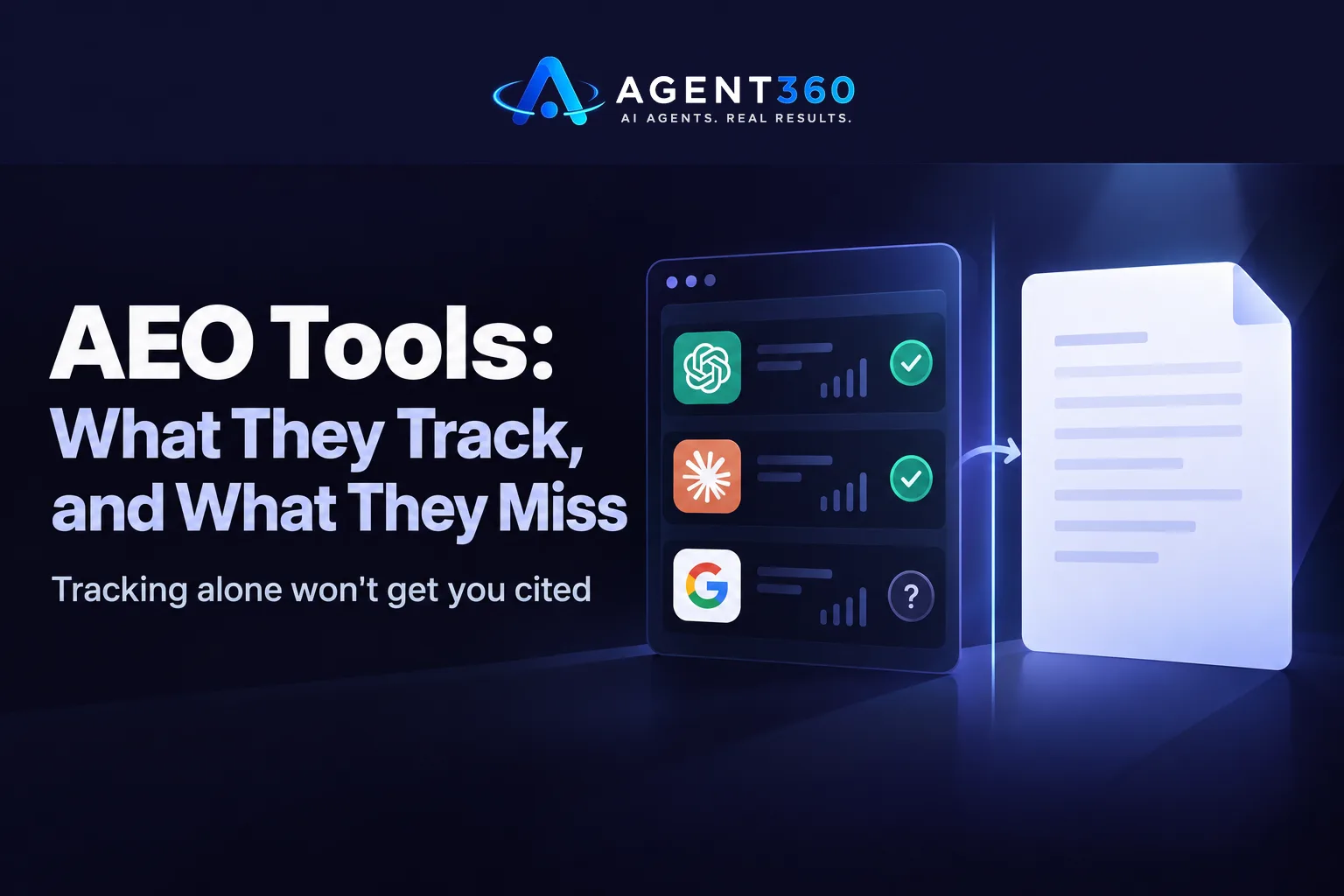
An AEO tool asks the questions your buyers ask — to ChatGPT, Claude, Google AI Overviews, sometimes Perplexity — on a repeating schedule. Then it records whether your business got named, and whose site got cited instead. That's the whole job. Most products sold under the label do the asking and the recording. Fewer of them close the loop by telling you what to publish so the answer changes.
That gap matters more than the category name suggests. A log of misses with no fix attached is just a more depressing version of a Google Alert.
What does AEO include?
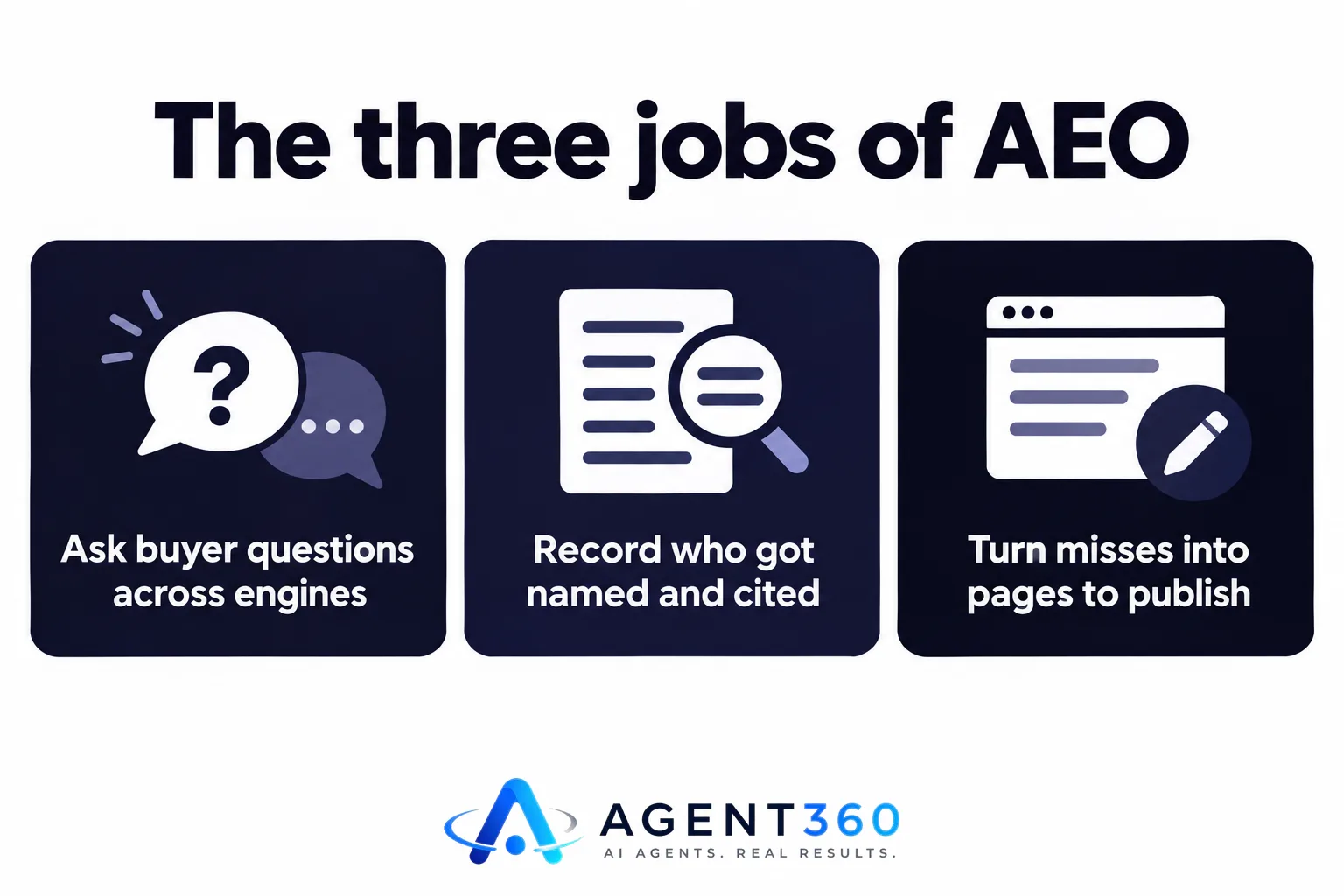
AEO includes three distinct jobs. A tool that does only one of them is doing a third of the work. First, asking real buyer questions across engines on a schedule, not once. Second, recording who got named, whose site got cited, and how that shifts week to week. Third, turning every miss into something concrete to publish — a page, a comparison, an answer to the exact question that got asked. AEO as a discipline is closer to answer-writing than to link-building: the target is the sentence inside the answer, not a position on a results page.
Plenty of dashboards stop after step two. They'll tell you, accurately, that a competitor got named in 6 of the last 10 checks and you got named in 1. What they won't tell you is which page to write, or whether the page you already have is close enough to fix with a rewrite.
A single check tells you almost nothing
AI answers vary run to run, even for the identical question, because the model samples differently each time. A tool — or a person — that asks ChatGPT once and reports the result as fact is reporting noise. The only honest way to read AI visibility is as a rate over repeated checks: named in 3 of 10, cited in 1 of 10, trending up or down over a month. A repeatable way to track that matters more than any single screenshot of a chat window. It's also why “we asked ChatGPT and we're not mentioned” is a weak data point on its own.
What are the most common SEO tools?
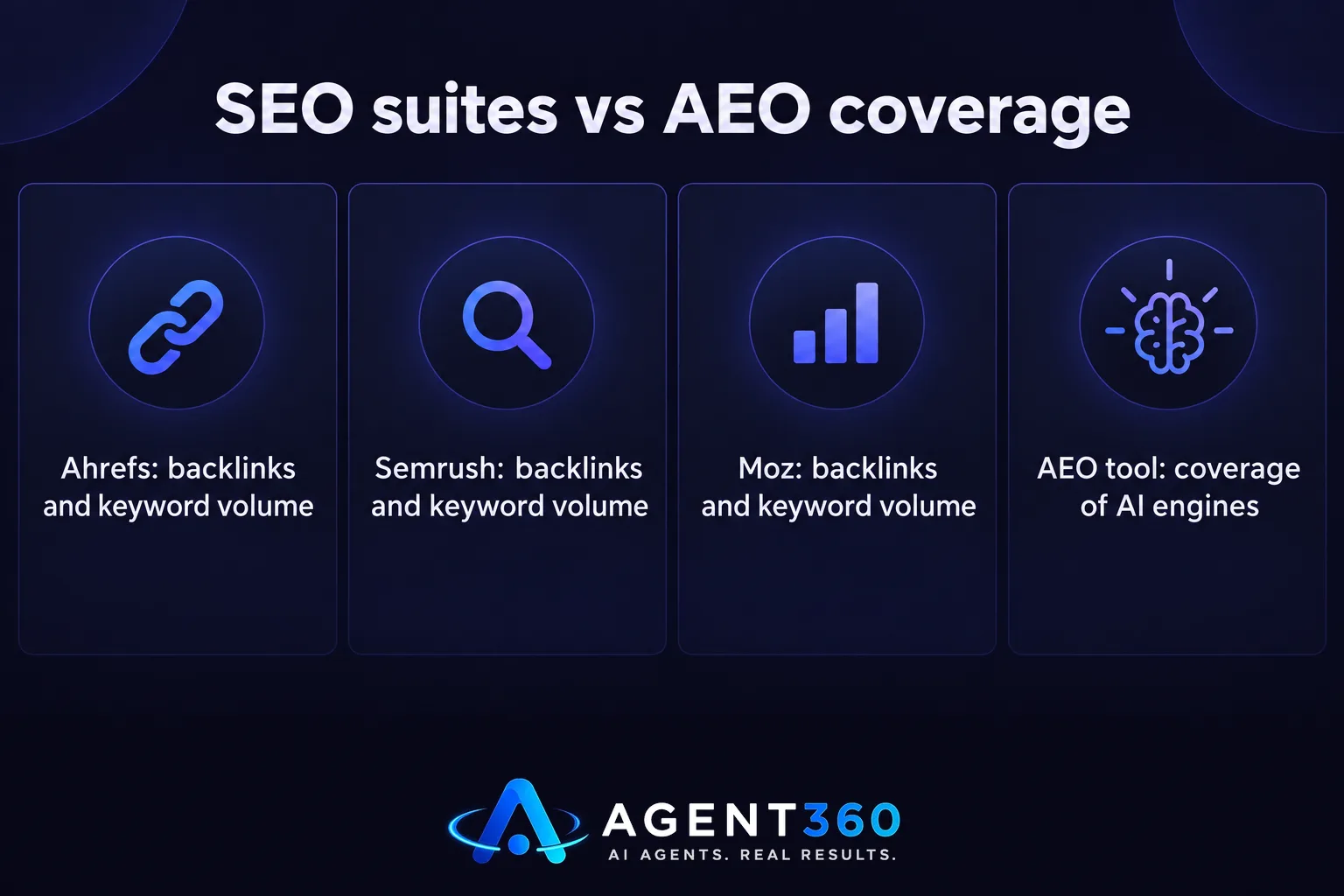
Ahrefs, Semrush and Moz are the three most common. All three were built around Google's link graph and keyword volume — backlinks, domain authority, search volume, keyword difficulty. That's still useful work. None of it tells you whether ChatGPT named you this morning. A few have bolted on an AI-mentions panel, but it's usually a thin layer over the same crawl data, not a system that asks AI engines directly and tracks the answer over time. If you're deciding between a research suite and an AEO-specific tool, the honest comparison is depth of keyword data versus coverage of AI engines. Few products do both well, and most make you choose.
A tracker without a writer just adds a report to your pile
Knowing you're absent from an AI Overview or a ChatGPT answer is step one. The step that actually moves the needle is publishing a page that answers the question directly enough to get cited — with the question in the heading, a clear answer in the first two sentences, and the kind of specificity models tend to quote rather than paraphrase. A gap list nobody acts on for three months is worth exactly as much as no gap list. If your team is already stretched thin on content, the bottleneck usually isn't finding the gaps. It's writing to them at the pace the gaps appear.
How to utilize AEO?
Four steps, in order. First, write down the actual questions your buyers ask before they call you — not keywords, questions, in their words. Second, run those questions against ChatGPT, Claude and Google AI Overviews on a schedule, at least weekly, and log who gets named. Third, for every question where you're absent or thin, publish a page that answers it directly, with a clear claim near the top and specifics an AI engine can lift and cite. Fourth, re-check the same questions a month later. If you're still absent, the page needs a rewrite, not a new page next to it — two pages aimed at the same question tend to split the signal rather than double it.
What is the best AEO platform?
There isn't a single correct answer. Anyone claiming theirs is the definitive one is selling, not reporting. What separates a usable AEO platform from a vanity dashboard is three things: it checks more than one AI engine, because ChatGPT, Claude and Google AI Overviews name different sites for the same question; it shows the trend, not a single snapshot; and it connects the gap it finds to a page it can produce, rather than stopping at the report.
SearchAgent is built around that last requirement specifically. Its AI Visibility Agent asks buyer questions to ChatGPT, Claude and Google AI Overviews on a schedule and hands every miss to a writing queue, rather than leaving it as a line item for someone to action later. Plans start at $297 a month, month to month, with no setup fee.
Check whether your pages can even be read before you chase mentions
An AI engine can only cite a page it can parse and crawl. Broken headings, missing structured data, or a robots file that blocks the wrong crawler will keep even a well-written answer out of the rotation. Before you put more money into AEO tracking, confirm the basics are in place — titles, headings, schema, crawler access. No amount of tracking fixes a page the engines never reach.

Questions
Is AEO the same as SEO? No. SEO gets you into the list of results; AEO gets your business named or your page cited inside the answer itself, which is a different target with different page requirements.
Do I need to track every AI engine, or is one enough? One engine isn't enough — ChatGPT, Claude and Google AI Overviews regularly name different sites for the same question, so tracking only one gives you a partial and sometimes misleading picture.
How often should I re-check my AEO questions? Weekly is a reasonable floor for anything competitive. AI answers shift as models update and as competitors publish, so a monthly check will miss movement a weekly one catches.
More articles
- An AI Blog Writer Won't Rank You. Here's What Will
- SEO Content Automation: What to Automate, What Not To
- What Is llms.txt and Do You Actually Need One?
- How to Appear in Google AI Overviews
- AI Visibility Tracking: What to Measure and How Often
- Track Brand Mentions in ChatGPT Without Fooling Yourself
- How to Get Mentioned by ChatGPT: A Practical Playbook
- How to Rank in ChatGPT: What Actually Gets You Named
