Why Social Media Content Creation Burns Teams Out by Week Six

Nobody quits posting because they ran out of ideas on day one. They quit six weeks in, when the cost of making each post has crept up and the reward hasn't moved an inch — and by the time anyone names the problem, the backlog has already won.
Most burnout diagnoses blame motivation. The real cause is structural: every post requires the same five decisions — what to say, how to say it, what it looks like, when it goes out, and whether it was worth doing — and almost no one automates any of them. Decision cost compounds. Motivation doesn't need to drop for output to stop. The cost per post just needs to cross whatever counts as sustainable for one more week.
The backlog, not the blank page, is what kills the habit
Week one is easy. No backlog yet. You post, check the numbers, feel fine about it. By week four you've got twelve posts behind you, a rough sense that two of them flopped, and a nagging feeling you should be doing something different — without the time to work out what. That unresolved backlog weighs more than any single post. It's why people who post daily for a month often go quiet for two. Not because the ideas ran out, but because the unprocessed pile of “was that working” got too big to look at.
The fix isn't posting less. It's separating the three jobs that got bundled together: deciding what to say, producing it, and judging whether it worked. Bundle all three into one person's Tuesday afternoon, and the Tuesday afternoon eventually loses.
One person can't be writer, designer and editor at the same sitting
Writing a post, picking an image, resizing it for Instagram, and checking whether last week's post actually landed — that's four different cognitive modes. Switching between them inside one session is where the real fatigue lives, not in any single task but in the gear-changing. Teams that batch writing on one day and review performance on another, instead of doing both at once, say the work feels lighter even at the same volume. The batching itself is the intervention, not a scheduling nicety — there's a reason batching content creation comes up as a fix before volume ever does.

The same logic applies to format. Rewrite every post from scratch for LinkedIn, then again for Instagram, then again for X, and you've tripled the writing load without tripling the ideas. The idea is the expensive part. The reformatting shouldn't be.
A ratio you never check is a backlog you can't trust
Part of what makes the pile feel unresolved is not knowing whether any of it is working. Post on instinct with no sense of what's pitch and what's useful to the reader, and you can't tell a bad week from a quiet algorithm — so every dip in engagement reads as proof the whole effort is failing, which wears on you in a way actual failure doesn't. A simple pitch-to-value split, checked occasionally, turns that anxiety into a number you can act on instead of a feeling you have to carry around. The value vs pitch split is a low-effort way to get that signal back.
Fix the unit of work, not the calendar
Most burnout fixes target the wrong lever — a new schedule, a new app, a resolution to “be more consistent.” None of those touch the unit of work. The unit of work is this: one idea, turned into a finished post, in a format that doesn't need rebuilding by hand for every platform. Shrink that unit and the backlog stops piling up, because each piece clears faster than the next one arrives.
This is also where a content pillar system earns its keep — not as a branding exercise but as a way to stop re-deciding “what do I even post about” every single session, itself one of the five decisions eating your time. Fewer, firmer pillars mean the topic decision gets made once a quarter instead of once a sitting; see content pillars for social media for how narrow that list should actually be.
Where this gets automated instead of just managed
BrandAgent exists for exactly this bundling problem: the Writer Agent drafts platform-specific versions of one idea, the Designer Agent builds the picture, and the Scheduler Agent publishes on the time you set — so the five decisions collapse into one, approve or don't, instead of five separate sessions a week. Founders running the whole company off the side of their desk are the clearest case for this; see founders and executives for how a short interview becomes a month of drafts. Plans start at $97 a month with no contract, detailed on pricing.

What's actually sustainable
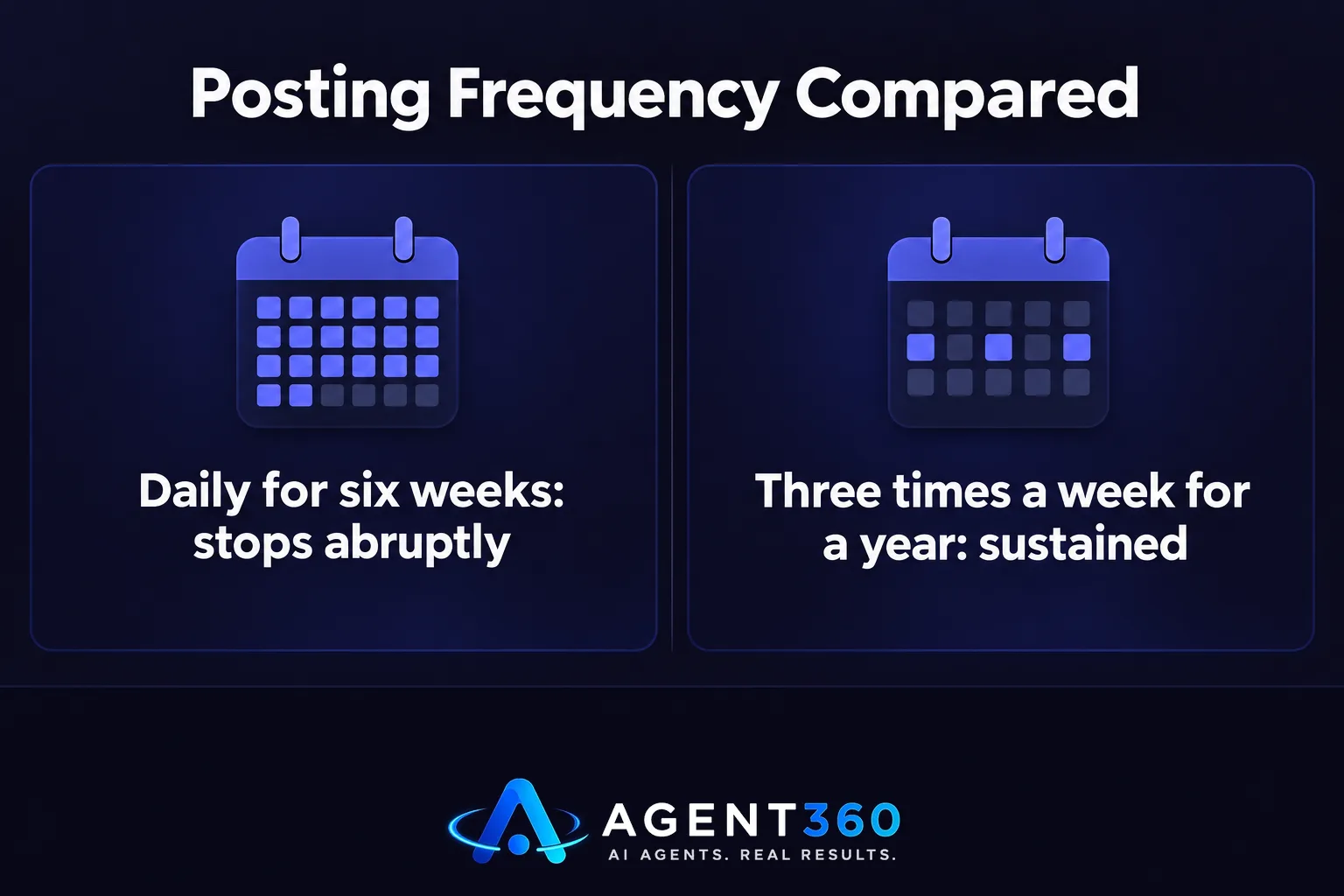
Sustainable doesn't mean low-effort. It means the effort goes to the parts that need a human — the opinion, the story, the approval — and nowhere else. A founder who posts three times a week for a year beats one who posts daily for six weeks and stops. The schedule that survives is the one built around the cost per post, not the ambition behind it.
Questions
Is burnout a sign the content strategy is wrong?
Not necessarily. More often it's a sign the production process has no batching and no clear split between writing, reviewing and judging results — all three happening in one sitting, over and over.
How many posts a week is sustainable long-term?
No universal number. It depends on how much of the production is repeated manual work per platform. The more that's shared across formats, the higher the sustainable frequency.
Does hiring a writer fix this?
It fixes the writing decision but not the design, scheduling or review decisions, unless one person or system handles all of them — which is why bundled tools tend to outlast single-task hires for this specific problem.
More articles
- A Social Media Approval Workflow That Doesn't Stall
- How to Batch Social Media Content Creation Without Losing a Day
- How to Measure Social Media ROI Without Guessing
- The Social Media Scheduling Tool Checklist Small Businesses Skip
- An AI Social Media Content Creator Needs Five Things to Work
- The LinkedIn Content Strategy Founders Actually Have Time For
- An AI Instagram Post Generator Is Not a Content Strategy
- Content Pillars for Social Media: Pick 4, Not 12
