How to Build a Personal Brand on LinkedIn (That Sticks)
Forget the headline, the photo, the polished About section. None of that is a personal brand. A personal brand is one claim about what you know, repeated in public often enough that people recall it before they recall your job title. Skip that part, and the profile upgrade changes nothing. Get it right, and a mediocre photo stops mattering at all.
Most people build the profile first and wait for the claim to show up on its own. It never does. The claim comes first. The profile is just where you prove it.
How do I create a personal brand?
Pick one sentence you are willing to repeat for a year: the problem you solve, for whom, and how you think about it differently from everyone else saying the same generic thing. Not three sentences. One. If you cannot say it in under ten words, it is not ready to post.

Then prove that sentence in public, weekly, for months. Proof looks like: a specific opinion with a reason attached, a mistake you watched a client or a market make, a number that surprised you, a decision you made and why. Vague encouragement (“consistency wins”) proves nothing, and it reads exactly like everyone else's feed. A claim someone could argue with — “most onboarding emails fail because they're written for the buyer, not the new user” — proves you actually think about the problem.
Here is what kills this fastest: switching the claim every few weeks because last week's post did not get much engagement. A personal brand is a pattern people recognize over months, not a post that happened to perform. If you need a repeatable shape so the posts don't drift, working from a fixed set of formats keeps the claim consistent even when the topic changes — see the ten post formulas that cover most of what actually works on the platform.
What 4-5 things should your LinkedIn brand include?
Five elements carry almost all the signal on a profile. People get the order wrong constantly:
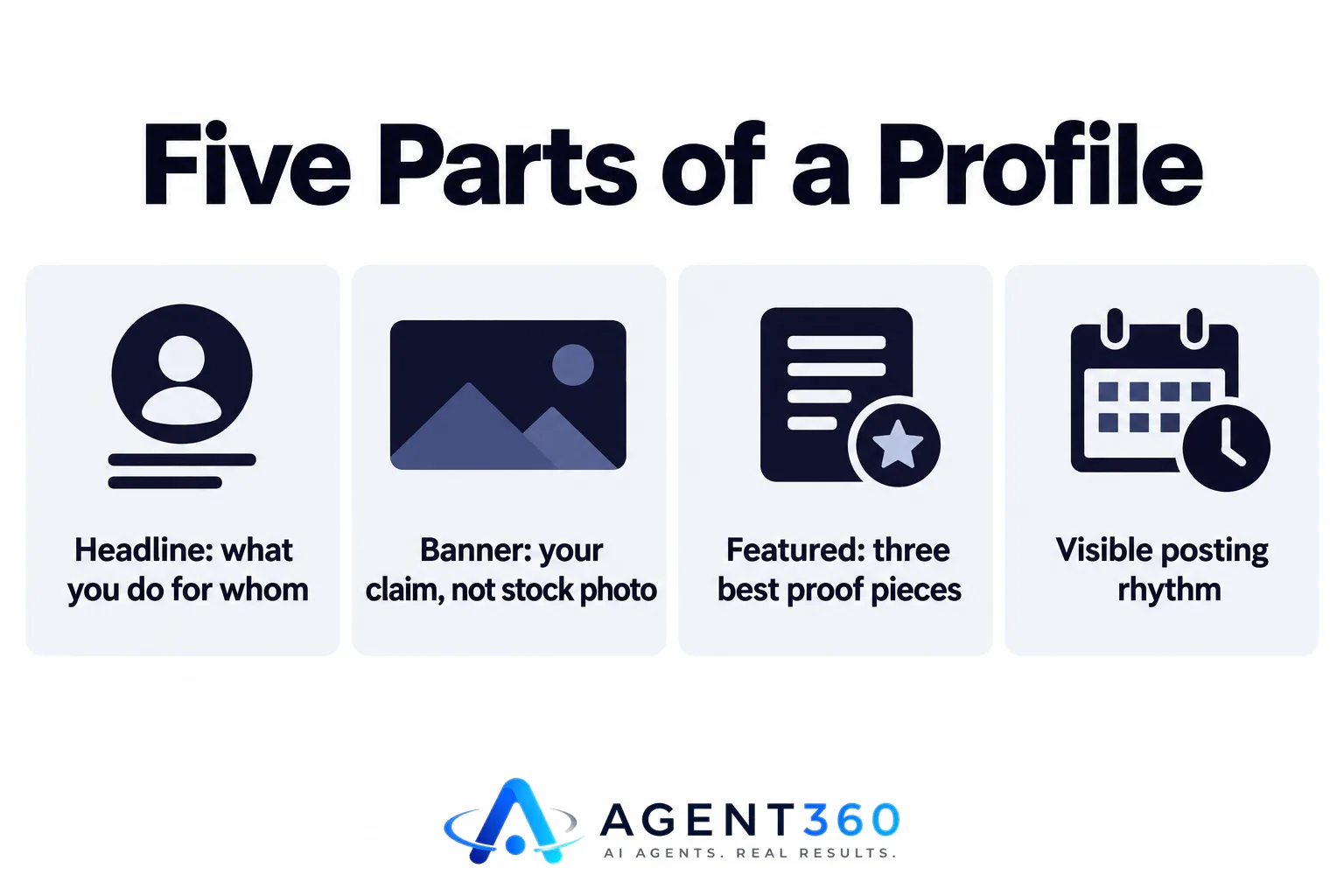
- The headline, written as what you do for whom, not your job title. “VP of Marketing” tells a stranger nothing. “Helping B2B SaaS teams cut CAC without cutting pipeline” tells them whether to keep scrolling or reach out.
- The banner image, used as free billboard space most people waste on a stock photo. Put your claim or your next event on it instead.
- The About section, written in first person, leading with the problem you solve and ending with how to reach you — not a resume in paragraph form.
- The Featured section, holding your three best proof pieces: a post that got real replies, a case result, a short video. This is the only part of a profile most visitors actually click into.
- A visible posting rhythm — the activity feed itself. A profile with a perfect headline and no posts in four months reads as abandoned, and visitors notice.
Photo and cover matter, sure. But they're tie-breakers. They never substitute for the claim and the proof.
How do you add your own business to LinkedIn?
Create a LinkedIn Company Page for the business separately from your personal profile — Page creation sits under the “Work” menu on desktop. Once it exists, add it as your current position under the Experience section of your personal profile so your title links directly to the Page, which lets visitors click through to see open roles, company posts and headcount.
Two things people skip. First, setting the Page's own banner and About section — a blank Page undermines the credibility it is supposed to lend you. Second, posting from the Page occasionally so it does not look dormant next to an active personal profile. The personal brand still does the heavy lifting — a founder's own posts consistently outperform the same company's Page posts on reach — but the Page gives the business a real address once someone clicks through.
What is the 3-7-27 rule in branding?
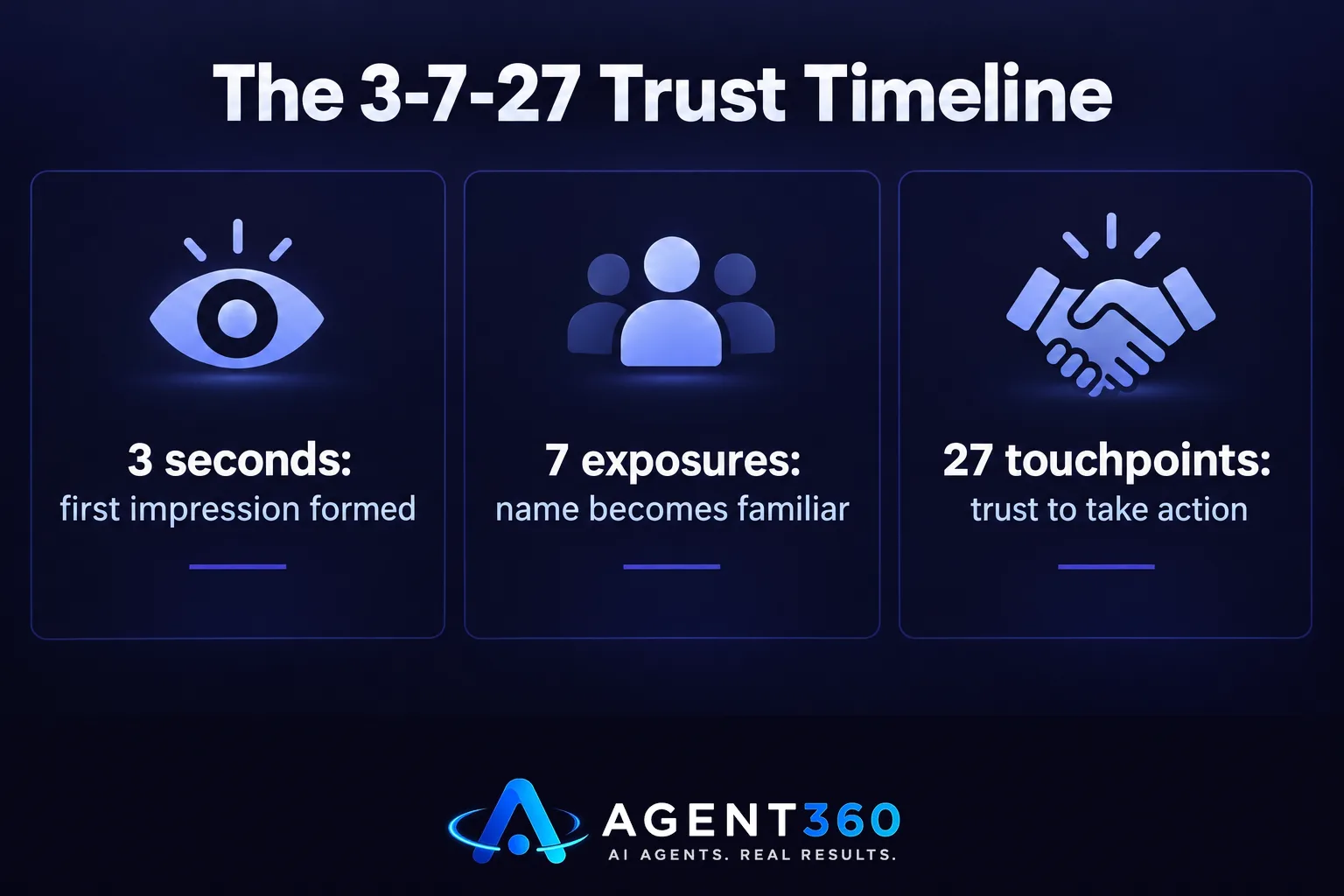
It's shorthand for how long recognition and trust actually take to build: roughly three seconds for someone to form a first impression of your profile or post, about seven exposures before your name starts to register as familiar rather than new, and somewhere around twenty-seven touchpoints before someone trusts you enough to take action — reply, book a call, refer you. The exact numbers vary by who is citing them. What's worth keeping is the mechanism underneath: a single good post does not build a brand, and nobody converts off their first view of your name. Plan for a long run of consistent touches, not one post that's supposed to carry the whole thing.
Which is also why one post a week undersells the effort. Seven touches at one post a week takes almost two months before a stranger even registers your name. At three or four posts a week, the same familiarity builds in under three weeks.
Where this breaks down in practice
The claim drifts. The posting stops after a strong month. Or every post quietly turns into a pitch once the founder feels behind on pipeline. All three kill the thing you're trying to build. A feed that's only pitches stops getting shown to people, which is the opposite of what a personal brand needs — the ratio that avoids this is worth getting right before volume.
Writing and publishing a consistent, on-brand stream of posts every week is the part that stalls most personal-brand efforts, not the strategy behind it. BrandAgent learns your voice from your website through its Brand Kit, drafts platform-specific posts from proven formulas, and publishes them to your LinkedIn profile on the schedule you set — you approve every post before it goes out. Plans start at $97 a month, month to month.
Questions worth asking before you start
How long before a LinkedIn personal brand actually works?
Expect the first real inbound reply somewhere after the fortieth to sixtieth post, not the fourth. That maps roughly to the twenty-seven-touchpoint idea above — most people quit before they get there.
Do I need video to build a personal brand on LinkedIn?
No. Text posts with a sharp claim and a picture carry most personal brands on the platform. Video helps once you already have an audience checking for you. It rarely builds one from zero on its own.
Should I post from my personal profile or the company Page?
Personal profile, by far. People follow people, reply to people, and refer people. A Company Page is useful infrastructure — it just isn't where the brand actually lives.
More articles
- The Real Alternatives to a Social Media Agency
- Done-For-You Social Media Management: What It Costs
- Social Media Marketing on Autopilot: The Ratios That Work
- Repurpose Content for Social Media: The Rules That Work
- YouTube Shorts for Business: The Rules That Get Views
- How Often to Post on LinkedIn: The Rules That Actually Matter
- Social Media Content for Small Business: The Rules That Work
- Brand Voice AI: What It Means and What It Can’t Fake
