What a Real AI Agent Content Idea Workflow Looks Like
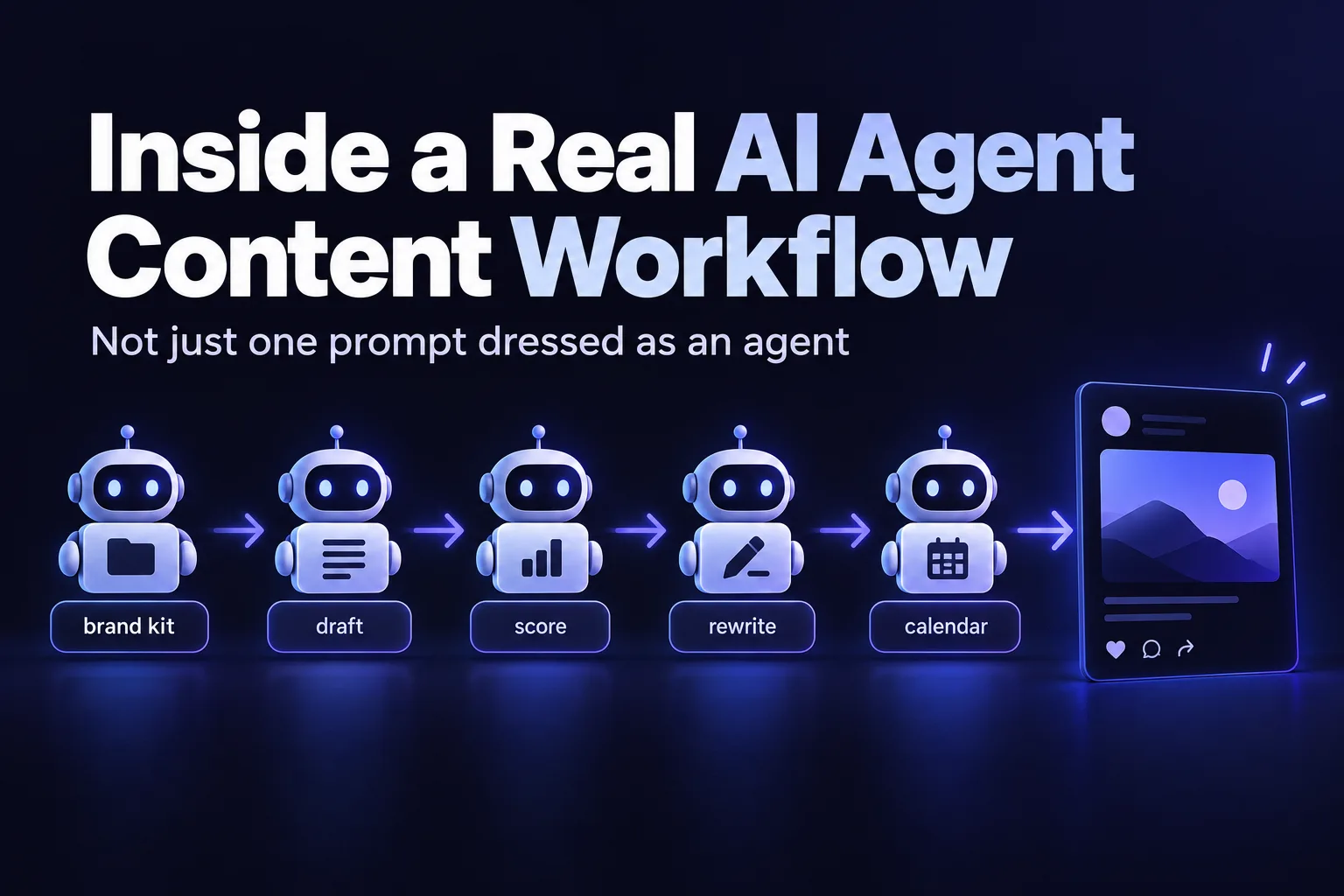
AI agent content idea creations only work when more than one agent is actually doing something. Most tools marketed as “agents” are a single language model answering a single prompt, dressed up with a nicer interface. That produces ideas, sure — generic ones, disconnected from your brand, with no mechanism to check whether any of them are good before you see them. A real workflow needs separate steps that each do one job, hand off to the next, and catch mistakes before a human has to.
If you are evaluating this category, the question worth asking is not “can it generate ideas” — every large language model can do that in a sentence. The question is whether the system has a structure behind the generation: a source of brand truth, a scoring step, a platform-specific rewrite, and a place for your approval to sit before anything goes live.
A single prompt is not an agent workflow
Type “give me 10 LinkedIn post ideas about B2B sales” into any chatbot and you get 10 ideas that could belong to any company selling anything to anyone. That is not a workflow, it is autocomplete. An agent workflow chains distinct steps — research, draft, check, rewrite, format, schedule — where each step has a defined job and a defined output the next step can use. The difference matters because quality in, quality out applies at every link: skip the brand step and every downstream idea inherits the generic tone; skip the check step and weak drafts reach you at the same rate as strong ones.
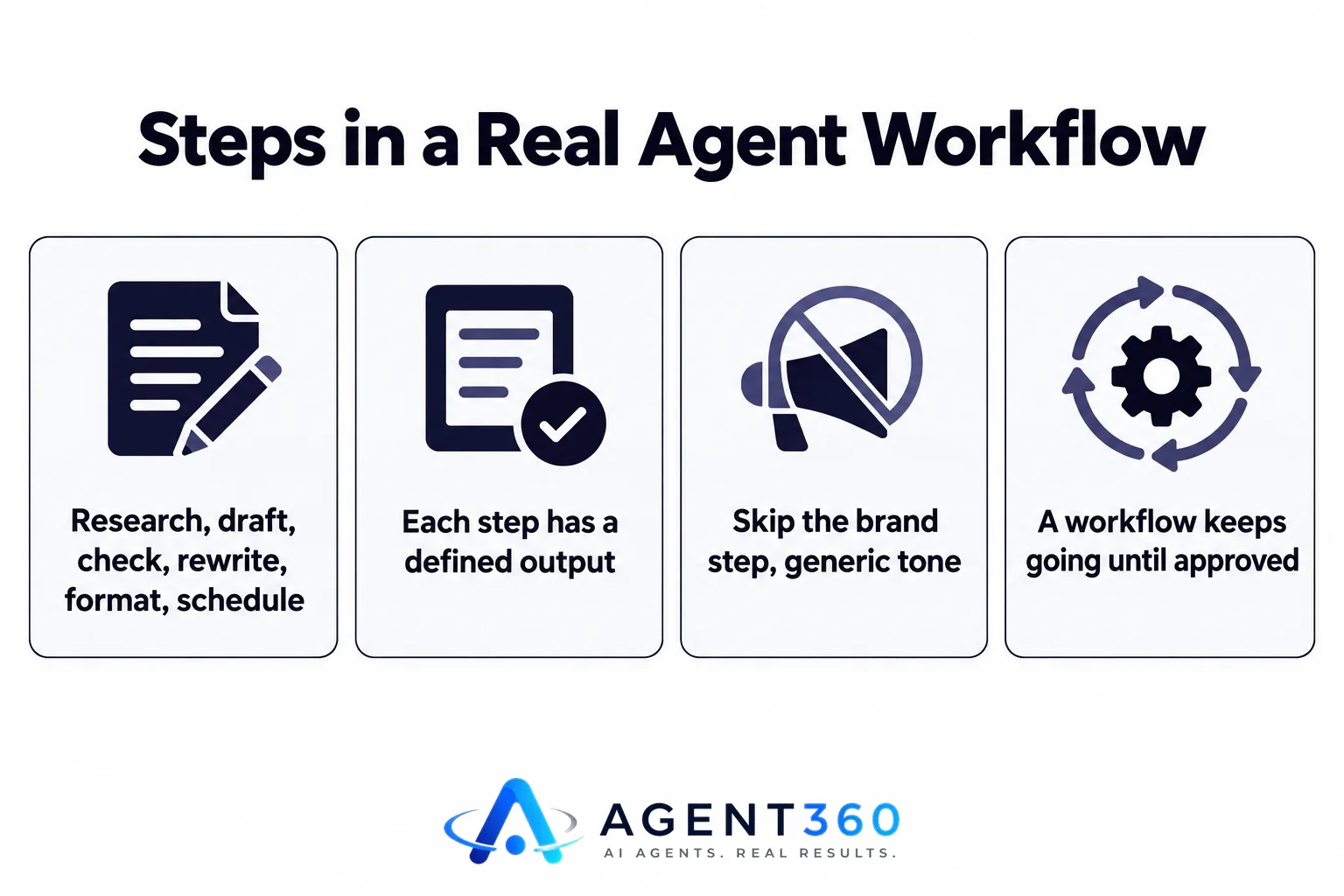
Compare this to what a chat tool actually delivers versus a system built as a chain of agents: a chat tool gives you a draft and stops. A workflow keeps going until the draft is checked, fixed, fitted to the platform, and ready to approve.
Idea generation fails without a brand kit behind it
Ideas are not the hard part — fit is. Ten ideas about “the importance of follow-up” mean nothing until they are filtered through what your company actually sounds like, what it has said before, and what its audience already knows. Without that filter, an agent produces plausible-sounding ideas that any competitor could post word for word.
The fix is a standing reference the idea-generation step pulls from every time: your voice, your tone, your colours, the problems you actually solve, pulled from your own site and material rather than reinvented each session. A brand kit built from your website does this by giving every downstream step something concrete to check against, so an idea about pricing objections comes out sounding like your company's actual answer to pricing objections, not a stock answer any SaaS could post.
Score the draft before a human ever sees it, or volume kills quality
Serious content generation means volume — multiple ideas, multiple platforms, multiple drafts a week. Volume without a quality gate just means more mediocre drafts landing in your inbox, which trains you to stop checking carefully and approve on autopilot. That is worse than posting less.
The workflows that hold up at volume have a scoring step built in: each draft gets evaluated against the rules of the platform it is headed for — length, hook strength, format — before a person sees it. A weak draft gets rewritten automatically and only the corrected version reaches your approval queue. This is the difference between a system that drafts, scores and rewrites before you ever open it and one that just hands you everything it produced, good or bad, and calls that “output.”
One idea must fork into platform-specific versions, not get copy-pasted
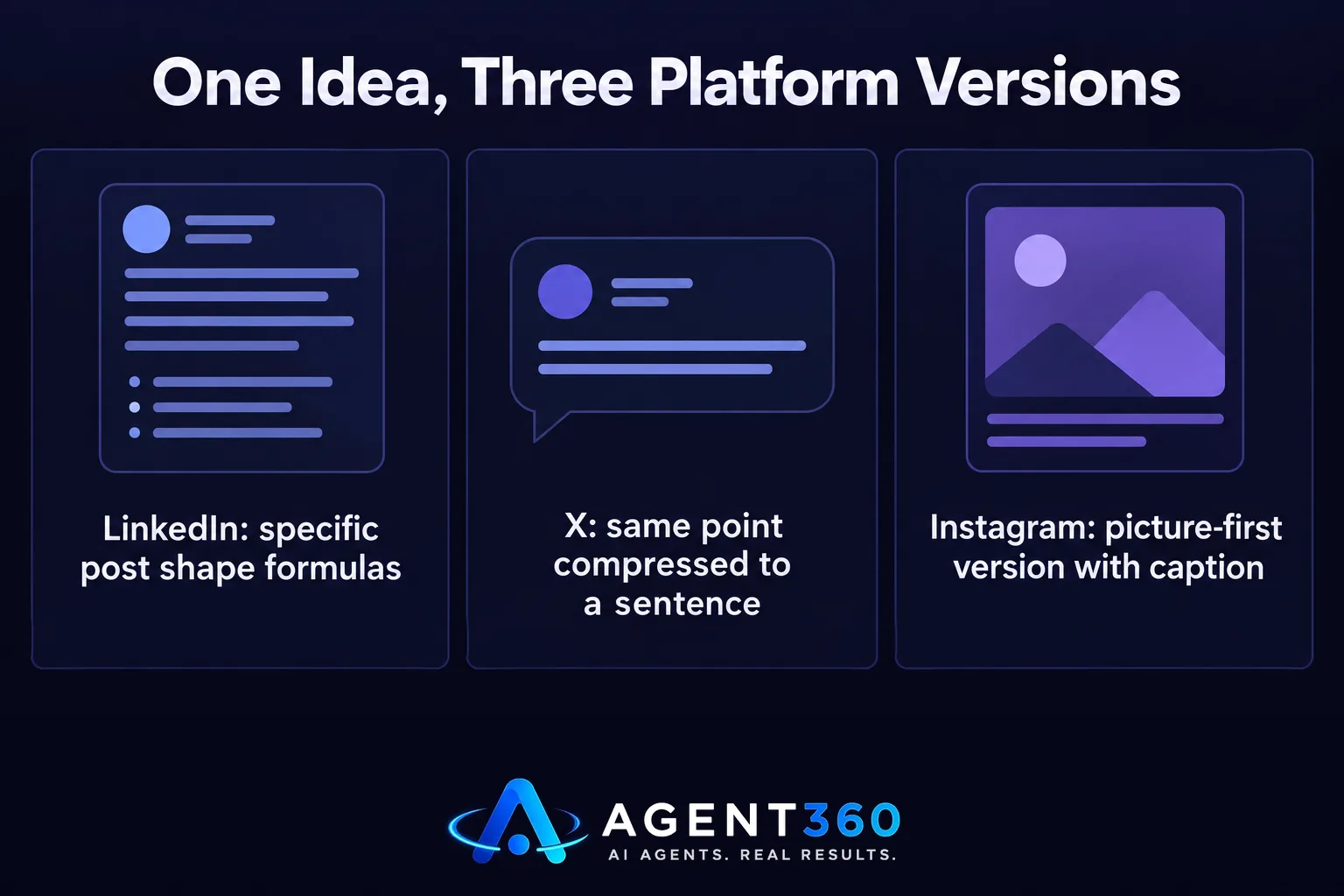
An idea generated for LinkedIn is not automatically a good idea for Instagram or X. LinkedIn rewards a specific post shape — see the breakdown of the ten formulas that actually hold attention there — while X needs the same point compressed to a sentence or two, and Instagram needs a picture-first version with a caption that works without the context a LinkedIn reader brings. A workflow that treats “one idea” as “one post copy-pasted everywhere” is doing idea creation, not content creation. The agent step that matters here is the one that forks a single idea into separate, platform-correct drafts, not the one that generates the idea in the first place.
The idea only earns its keep once it is scheduled and measured
An idea that sits in a doc is not content. A workflow worth calling “serious” closes the loop: approved drafts go onto a calendar at a set time, and the numbers from what got posted — views, saves, shares — come back to inform the next batch of ideas. Without that return trip, idea generation runs on guesses forever. A calendar that publishes on schedule and tells you when something failed is what turns a pile of drafts into a cadence you can actually measure and adjust.
Where BrandAgent fits
BrandAgent runs this as separate agents rather than one prompt: a Brand Agent that builds the brand kit from your site, a Writer Agent that drafts and scores per platform, a Designer and Video Agent for the picture or short video that goes with each idea, and a Scheduler Agent that publishes what you approve. Plans start at $97 a month with no contract, and every post waits for your approval before it goes anywhere — see what each plan includes if you want the specifics.

What's your take on AI agents in content creation?
They are worth it only when the steps are separate and visible — brand reference, draft, score, rewrite, platform fork, schedule — and worthless when the whole thing is one prompt rebranded as an agent. Ask any tool you are evaluating to show you each step, not just the final output.
Are AI agent workflows for serious content generation actually different from a chatbot?
Yes, structurally. A chatbot answers a prompt once. A workflow runs multiple agents in sequence, each checking or improving the previous step's output, before anything reaches a human for approval — which is what makes volume sustainable instead of exhausting.
More articles
- AI Social Media Content Generator for Instagram, Explained
- The Best Time to Post on Instagram Is Not a Clock
- Which Social Platforms Deserve Your Time, Not Your Guilt
- Why Social Media Content Creation Burns Teams Out by Week Six
- A Social Media Approval Workflow That Doesn't Stall
- How to Batch Social Media Content Creation Without Losing a Day
- How to Measure Social Media ROI Without Guessing
- The Social Media Scheduling Tool Checklist Small Businesses Skip
