Restaurant Marketing Ideas That Actually Fill Tables

The restaurant marketing ideas that actually work capture a decision someone is already close to making: hungry, nearby, picking between you and the three places next door. A plated-food photo with no link to that moment isn't a strategy. It's content.
Most restaurant marketing fails for a boring reason. It treats every diner the same. The person searching “best brunch near me” at 10am Saturday, the regular who hasn't booked in six weeks, and the person scrolling Instagram at 9pm with no plans — three different jobs. They need three different moves.
The best restaurant marketing strategy stacks three layers, not one channel
Ask what the best marketing strategy for restaurants is and you'll get three different answers from three different consultants. The honest one: no single channel does the job alone. A strategy that works runs three layers at once:
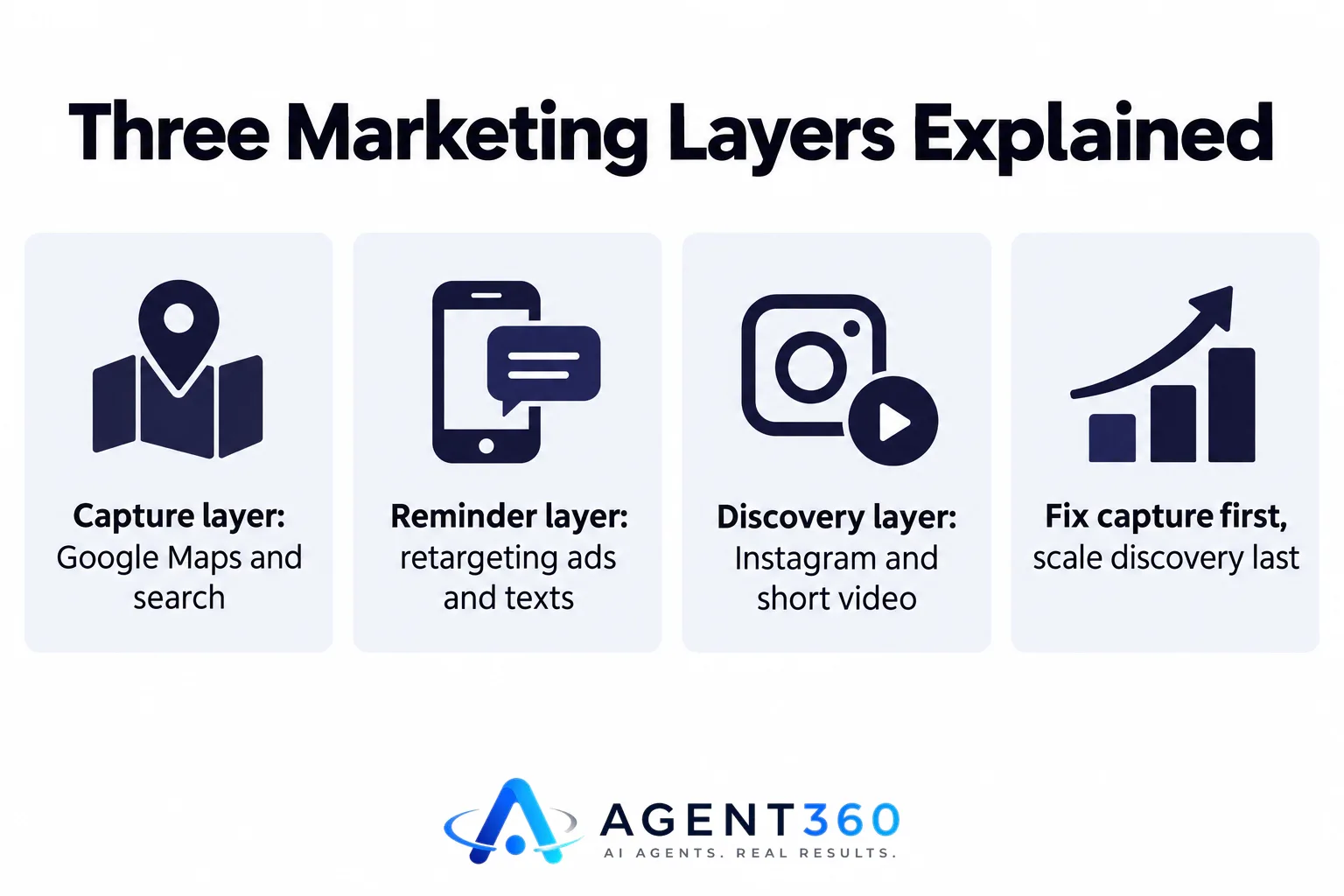
- Capture layer — Google Maps, Google search, and your menu showing up in AI answers when someone asks “where should I eat near [neighborhood]”. This is where most of your bookings already come from, whether you've invested in it or not.
- Reminder layer — retargeting ads and email or text to people who looked at your menu or visited once and did not come back. This is the cheapest booking you will ever generate, because the person already knows you exist.
- Discovery layer — Instagram and Facebook ads, short video, and posts that put you in front of people who were not looking for a restaurant tonight but will be this weekend.
Spend everything on discovery and you're paying to meet strangers while your regulars drift off to whoever texts them first. Spend everything on capture and you win the people already searching, but you never grow past your current radius. Order matters here: fix capture first, add reminder second, scale discovery last.
Six restaurant marketing ideas worth the budget, and three that are not
Worth it:
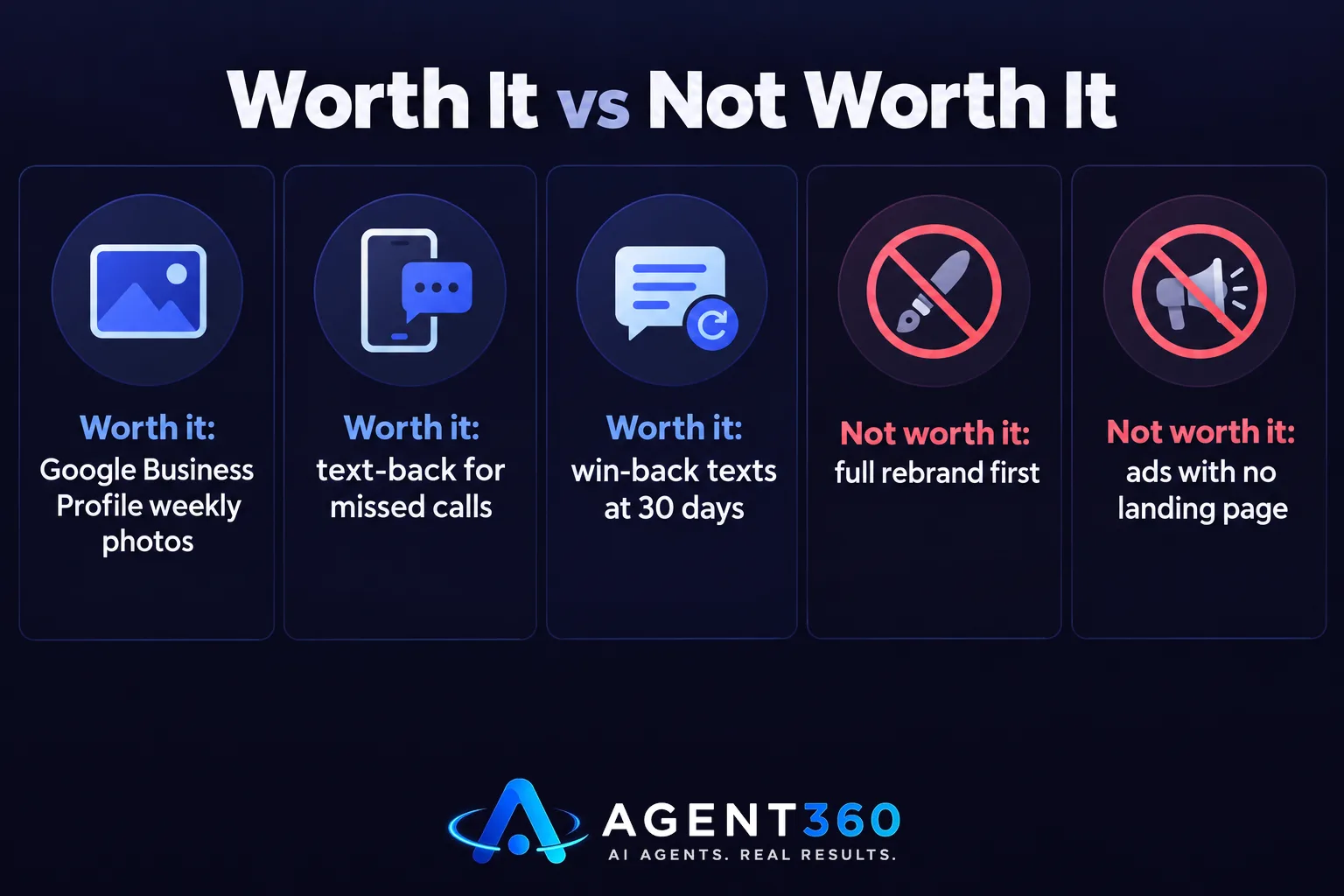
- Google Business Profile with weekly photos and an updated menu. A profile with current photos and hours outperforms a nicer website that nobody can find.
- A text-back to every missed call. A caller who hears four rings and voicemail calls the next place. A caller who gets an instant text with a booking link often still books with you.
- Win-back texts at the 30-day mark. Not a coupon blast to your whole list — a short message to people who haven't ordered or booked in roughly a month, before they've formed a new habit elsewhere.
- Retargeting ads for menu viewers. Someone who looked at your menu and left is a warmer lead than almost anyone an ad platform can find cold.
- Short video of the kitchen or the dish, not the dining room. Food in motion outperforms a static plated shot on almost every platform that serves video.
- Being named in AI answers. When someone asks ChatGPT or Google's AI overview for a recommendation, restaurants with structured, consistent info across their site and listings get named more often than ones with none.
Not worth it, at least not first:
- A full rebrand before fixing whether people can find you on a map search.
- Paid ads with no landing page — sending traffic to a homepage with six nav links loses most of the click before it converts.
- Posting daily with no plan for what happens after someone clicks follow. Attention without a next step is wasted spend.
Reviews decide who gets the table before the menu does
By the time someone's comparing your menu to a competitor's, they've already filtered on star rating and review count. A restaurant with 40 reviews at 4.6 stars will beat one with 400 reviews at 3.9 in almost every map pack result — review velocity and recency weigh as heavily as volume. Ask for the review at the table, or in the follow-up text. Not three weeks later, in a generic email nobody opens. And be specific about the ask: “mention the [dish] if you loved it” gets a more useful review than “please review us.”
What is the 3-3-3 rule for marketing?
The version most restaurant owners run into: three pieces of content, repurposed three ways, posted across three platforms. A short video of tonight's special becomes a Reel, a Story, and a Google Business post — instead of three separate ideas you have to invent from nothing. The numbers aren't the point. Most small teams burn out trying to create original content for every channel, and one good piece repurposed beats three mediocre ones made from scratch. If you're making content alone or with one other person, treat 3-3-3 as a ceiling on how much you create in a week, not a quota you owe.
What is the 30/30/30/10 rule for restaurants?
One common split: roughly 30% on bringing in new customers (ads, SEO, local search), 30% on keeping the ones you already have (win-back texts, loyalty, email), 30% on brand and community (events, sponsorships, partnerships with nearby businesses), and 10% set aside to test a new channel each quarter. Treat it as a starting point, not a law. A new location should weight acquisition heavier; a restaurant with a long regular base should weight retention heavier. The real value of the rule is that it forces a retention line at all — most restaurant budgets have one for new customers and nothing for the ones already walking out the door.
Where the work actually gets done
Running all three layers at once — capture, reminder, discovery — plus reviews, content, and a text-back for every missed call, is more than most restaurant owners or their one marketing hire can keep up with every week. Booked runs it as a flat monthly service built for restaurants: Google Business profile, local SEO and AI-answer visibility, Google and Meta ads on a budget you control, retargeting, win-back texts, and an instant text-and-email reply to every lead, reported in one dashboard. Plans start at $297 a month, no setup fee, no contract. See what's included on the pricing page, or check what the service covers for restaurant marketing specifically.
How fast you respond to a lead matters just as much as any ad campaign. See how instant follow-up changes which restaurant gets the booking, and how local search and AI visibility decide who gets found before the comparison even starts.
Questions worth asking before you spend
What are some effective restaurant marketing ideas for a tight budget?
Start with what costs time, not ad spend: an updated Google Business Profile with weekly photos, a text-back for every missed call, and asking for a specific review at the table. Those three plug the leaks before you spend a dollar on ads.
How much should a restaurant spend on marketing each month?
There's no universal number. Rent, competition density and ticket size vary too much between a fast-casual spot and a full-service dinner house. A more useful question is cost per booked reservation or order — track that first, then decide whether the budget should grow.
Do I need social media ads if I already rank well on Google Maps?
Ranking well on Maps wins the people already searching for a restaurant tonight. Social ads reach the ones who weren't planning to eat out until the ad reminded them. Different problems, not the same one twice.
More articles
- Marketing for Auto Repair Shops That Keeps Bays Full
- Law Firm Marketing: What Actually Brings In Cases
- Marketing for HVAC Companies: What Actually Books Jobs
- Marketing for Dentists: What Actually Fills the Schedule
- Google Business Profile Optimization: What Moves Rankings
- Local SEO Services: What They Should Actually Do
- Done-For-You Marketing for Small Business: What It Buys
- Marketing for Small Local Businesses: The Rules Worth Keeping
