Marketing for Small Local Businesses: The Rules Worth Keeping
Pick the channel that matches how your customers already look for you, not the one everyone online says you should be on. Search and maps catch people comparing options right now. Social and local ads reach people who don't know they need you yet. Most owners get this backwards — they pour money into awareness while the phone stays quiet because they're invisible on the map, or they chase rankings for a service nobody even searches by name. Figure out which problem you actually have before you pick a tactic.
There's a cottage industry of marketing “rules” floating around search results — 3-3-3, 70/30, 40-40-20 — and most get repeated without anyone checking whether they fit a local business at all. Here's what each one actually means, and which ones deserve your time.
Most small businesses need to capture demand, not create it
Demand for your service already exists somewhere: a homeowner with a broken water heater, a patient with tooth pain, a couple picking a restaurant for Saturday. That demand shows up as a search, a map lookup, or a scroll through Instagram. The marketing question isn't “what type is best” in the abstract — it's whether you're missing people who are already looking, or trying to convince people who aren't thinking about you at all.
For most home services, dental and medical practices, auto shops and law firms, the first job is capture: showing up in local search and Google Maps when someone searches with intent to buy today. For restaurants, med spas, salons and fitness studios, a bigger share of the job is creation: getting in front of people before they've decided, through social content and local ads. Nearly every local business needs both eventually. If your budget is thin, though, fund the channel that matches where your category of customer actually starts looking.
The 40-40-20 rule says your list matters more than your ad
This is one of the older rules in direct-response marketing: results come roughly 40% from who you're targeting, 40% from the offer you're making, and 20% from the ad or creative itself. Applied to a local business, it means the headline on your flyer or the design of your Google ad is the smallest lever you have. The bigger levers are who you're putting it in front of — people within your actual service radius, searching for your actual service — and what you're offering them: a same-day slot, a specific price, a reason to call this week instead of “someday.”
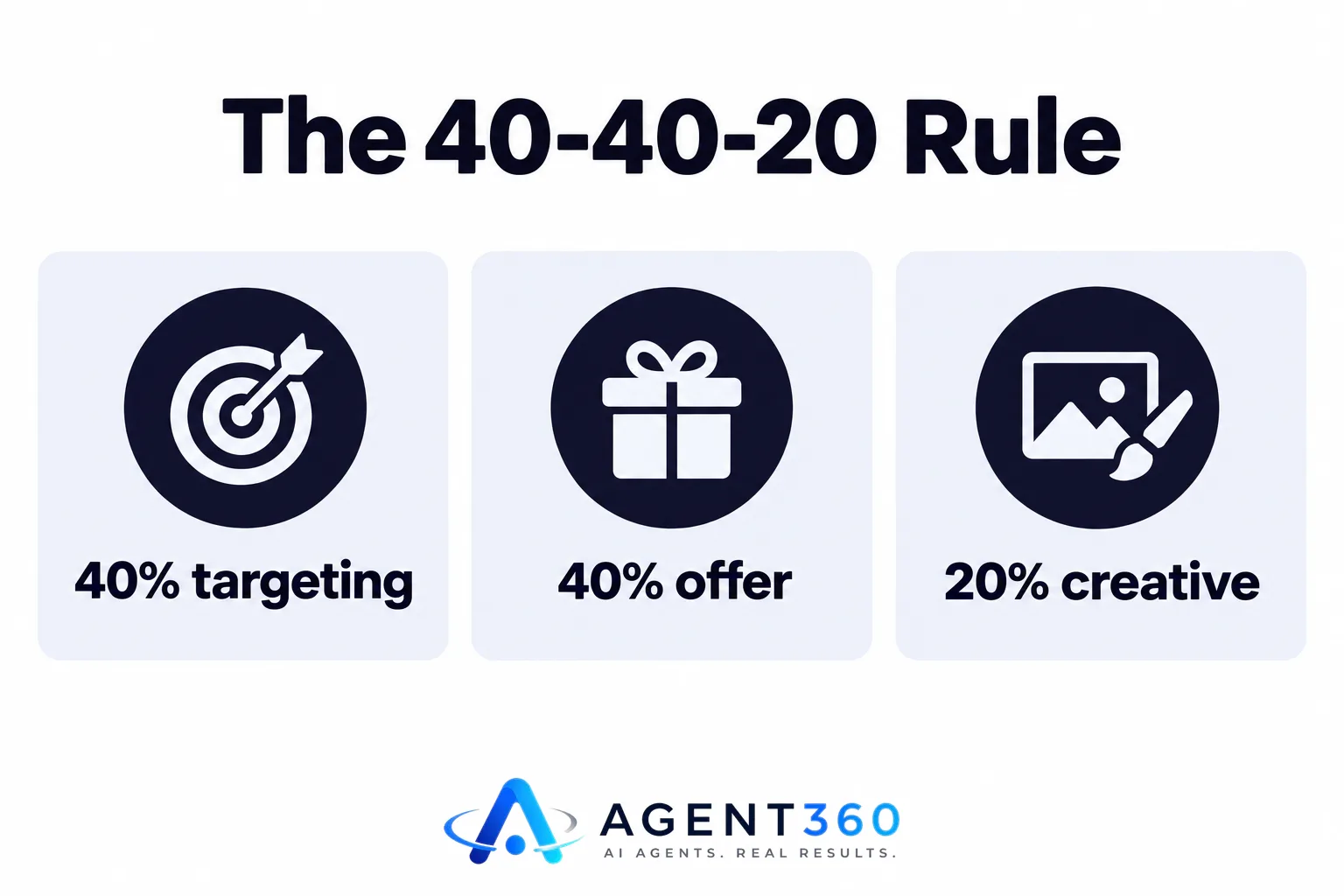
Owners spend hours agonizing over ad copy and five minutes on targeting and offer. Flip that ratio before you flip your budget.
The 70/30 split protects you from a channel that stops working
Several versions of a 70/30 rule circulate online — brand versus performance spend, proven channels versus testing. The version that holds up for a local business is budget allocation: put roughly 70% behind the channel that's already converting (usually search, once you're ranking or running Google Ads) and keep 30% testing something new, like Instagram ads, a referral push, or a win-back campaign to past customers. The 70% keeps the lights on. The 30% is how you find the next channel before the first one gets more expensive or more crowded with competitors.
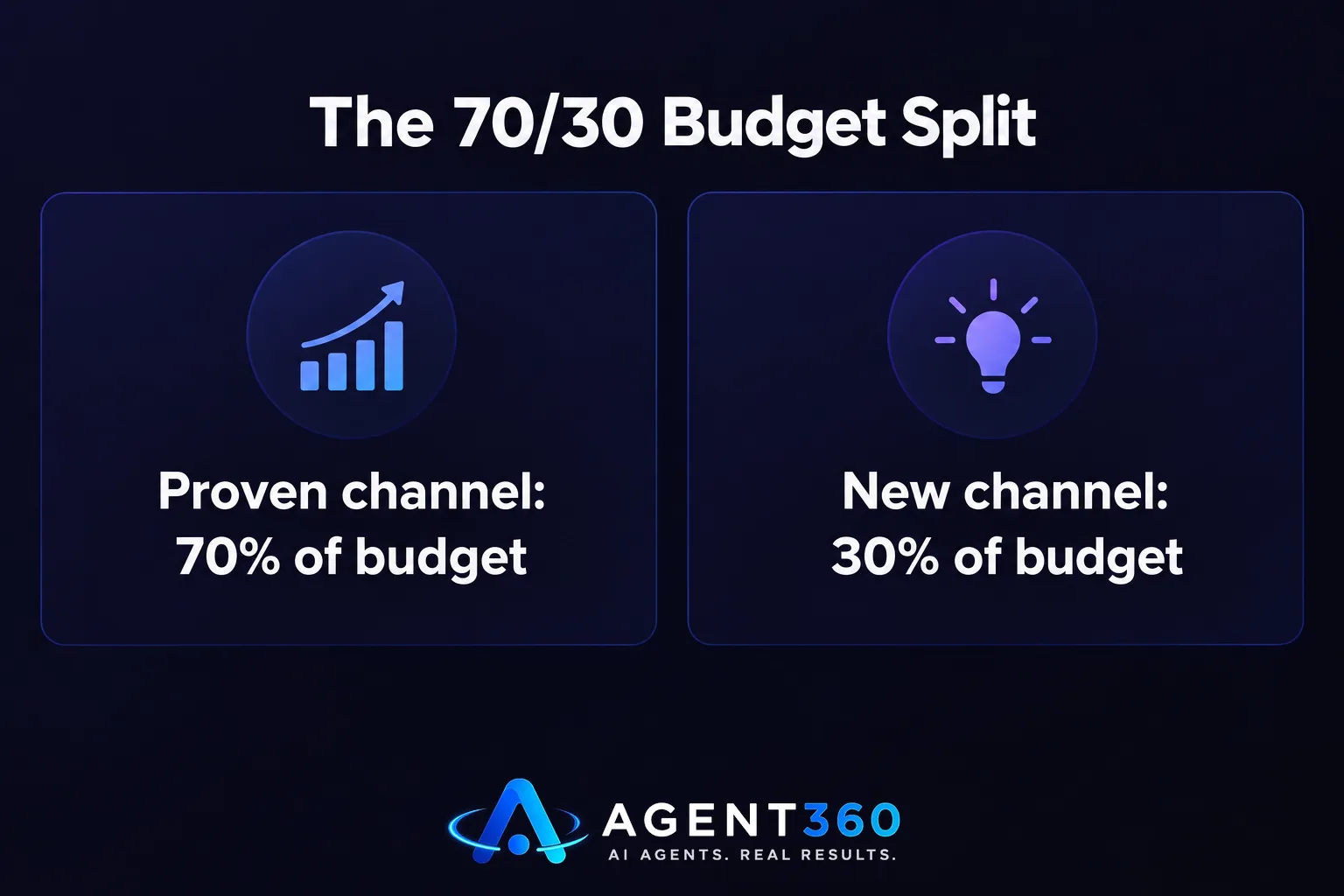
A business running everything through one channel — all Google Ads, or all referrals — has no fallback when that channel's cost per lead climbs or a competitor outbids them. Running ads on both Google and Meta at once is a cheap form of this insurance, not a luxury.
The 3-3-3 rule has no single definition — use this version
Search for the 3-3-3 rule and you'll find at least two unrelated versions: a sales-prospecting rule about spending three minutes researching three companies before writing three personalized lines, and a looser content rule about three message types across three channels. Neither was written with a local business in mind, so treat the number itself as less important than the principle underneath it: repetition across more than one surface, with more than one message, beats a single ad running in a single place.
A practical local version: one offer, shown in three places — your Google Business Profile, a social post, and a retargeting ad to people who already visited your site — said three different ways. Someone who sees the same offer from three angles is far more likely to act than someone who saw one ad once.
Building a small business ad starts with the offer, not the business name
The most common mistake in a first local ad is leading with the business name and a logo, which means nothing to someone scrolling who has never heard of you. Lead with the offer and the outcome: “Same-day AC repair, $89 diagnostic” beats “Smith Heating & Air — Serving the Valley Since 1998” every time, because the first line answers the only question the viewer has, which is what's in it for them right now.
Keep one offer per ad. An ad trying to promote your spring tune-up, your referral program and your new location all at once converts worse than three separate ads running at a fraction of the budget each, because the viewer has three seconds to understand what you want them to do.
Where Booked fits
Booked runs this as a done-for-you system rather than a pile of separate tactics: your Google and local search presence, Google and Meta ads, a site built to convert, and instant follow-up on every lead that comes in, all under one monthly plan starting at $297. It won't settle which internet rule is correct, but it does put the capture channels and the creation channels to work together, with a dashboard that shows which one actually brought in the booking.

How much should a small local business spend on marketing a month?
There's no fixed percentage that fits every local business, because the right number depends on your margin per job and how many new customers you can actually handle. A more useful starting point than a percentage is a target cost per lead for your service and area, set before you spend a dollar, so you know within a week whether a channel is working or not.
Is social media enough marketing for a small business?
On its own, usually not. Social media is strong at creating demand among people who aren't searching yet, but it does little for the much larger group already searching Google or Maps for your service today. A business relying only on social is usually invisible to its highest-intent customers.
What's the fastest way to get more customers without paying for ads?
Claim and fully fill out your Google Business Profile, then ask recent customers for reviews — it moves faster than almost anything else, because it affects whether you show up in the map pack for searches that already have buying intent. It costs time, not ad spend, and it compounds every time a new review goes up.
More articles
- Marketing for Auto Repair Shops That Keeps Bays Full
- Restaurant Marketing Ideas That Actually Fill Tables
- Law Firm Marketing: What Actually Brings In Cases
- Marketing for HVAC Companies: What Actually Books Jobs
- Marketing for Dentists: What Actually Fills the Schedule
- Google Business Profile Optimization: What Moves Rankings
- Local SEO Services: What They Should Actually Do
- Done-For-You Marketing for Small Business: What It Buys
