Done-For-You Marketing for Small Business: What It Buys

Done-for-you marketing means one team handles your website, your search rankings, your ads and your lead follow-up for a single monthly fee — instead of you cobbling together a designer, an SEO contractor, an ad buyer and a receptionist on your own. You still pick the offer, the prices, the area you serve. Everything after that — the posts, the ads, the landing pages, the reply to whoever just filled out a form — gets handled without you juggling five vendors or burning out one employee trying to do all five jobs.
That's the appeal. It's also where the category gets murky. “Done-for-you” gets stamped on everything from a $200 social media autopilot to a $5,000 full-funnel retainer, and most buyers don't find out which parts of the funnel are actually covered until the invoice shows up and the leads don't.
Most small businesses should budget 6 to 10 percent of revenue on marketing
That range is a guideline for an established business trying to grow, not a law. A brand-new location fighting for awareness often needs to run higher in year one. A business living off referrals can run lower. The more useful question isn't “how much” — it's “how is it split.” A flat monthly fee should cover the work: the site, the content, the campaign management, the follow-up systems. Ad spend is a separate line that goes straight to Google or Meta, not to the agency, so you always know what you paid the platform versus what you paid for labor. If a proposal folds ad spend into the management fee, ask why. Usually it means you can't see what's actually being spent on media.
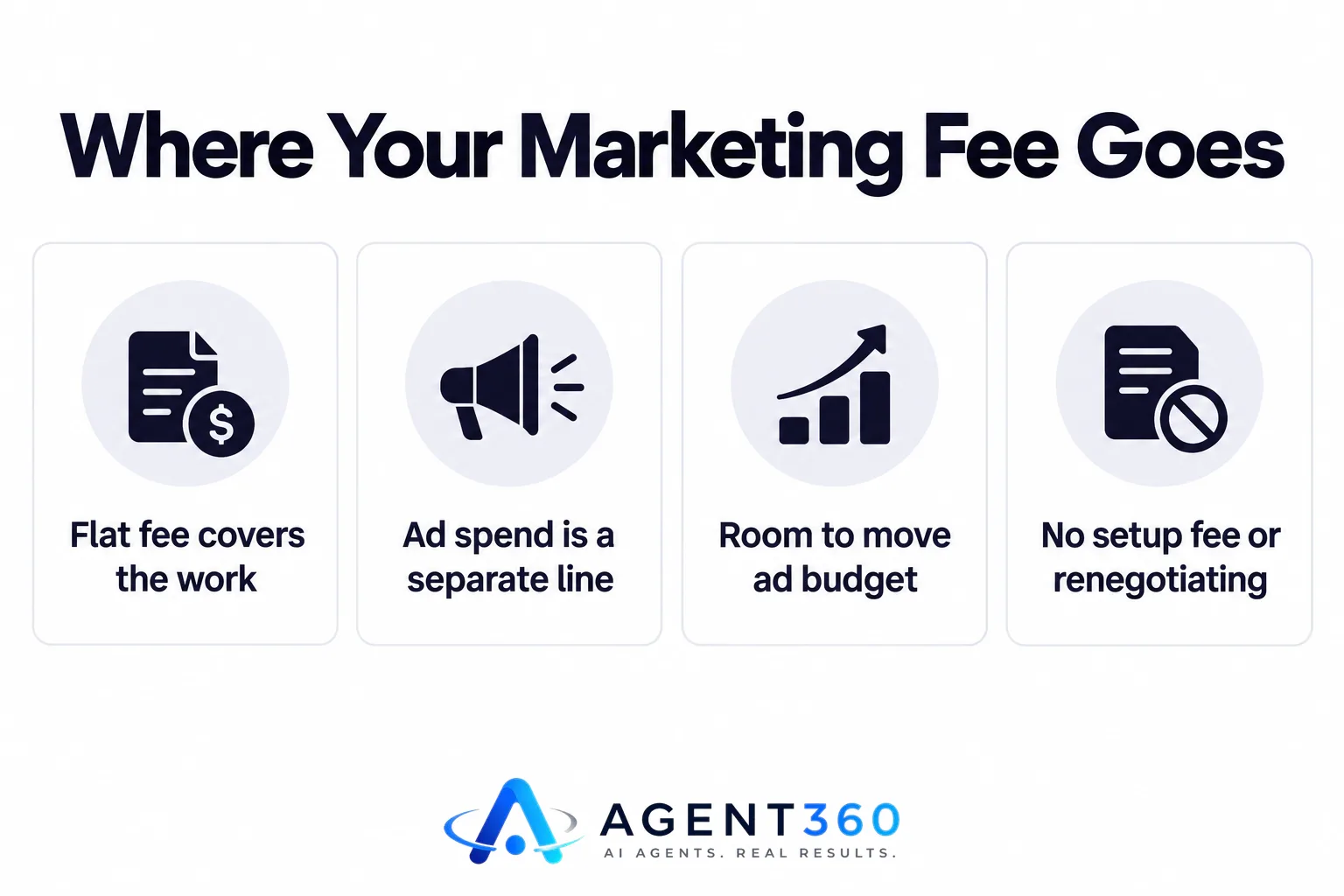
On a flat monthly plan, that split is easy to check: one number for the work, a separate number you control for ad spend, no setup fee, and room to move the ad budget up or down without renegotiating anything.
The 3-3-3 rule is less a formula than a warning against quitting too early
There's no single agreed definition of the 3-3-3 rule in marketing, but the version most owners run into splits a budget or a plan into three roughly equal pieces: a channel you already know converts, a channel you're currently testing, and content that compounds over time instead of paying off right away. The name is loose, but the discipline behind it is real: don't judge a new channel — a new ad account, a rewritten website, a fresh SEO push — inside the first 30 days. Paid search usually needs a few weeks of spend before the algorithm has enough data to stop guessing. Local SEO moves on a slower clock, often three to six months, because it depends on Google re-crawling and re-ranking your site and your Google Business Profile. Judge either one at week two and all you've learned is that you were impatient.
There is no single best channel — match the channel to how the customer decides
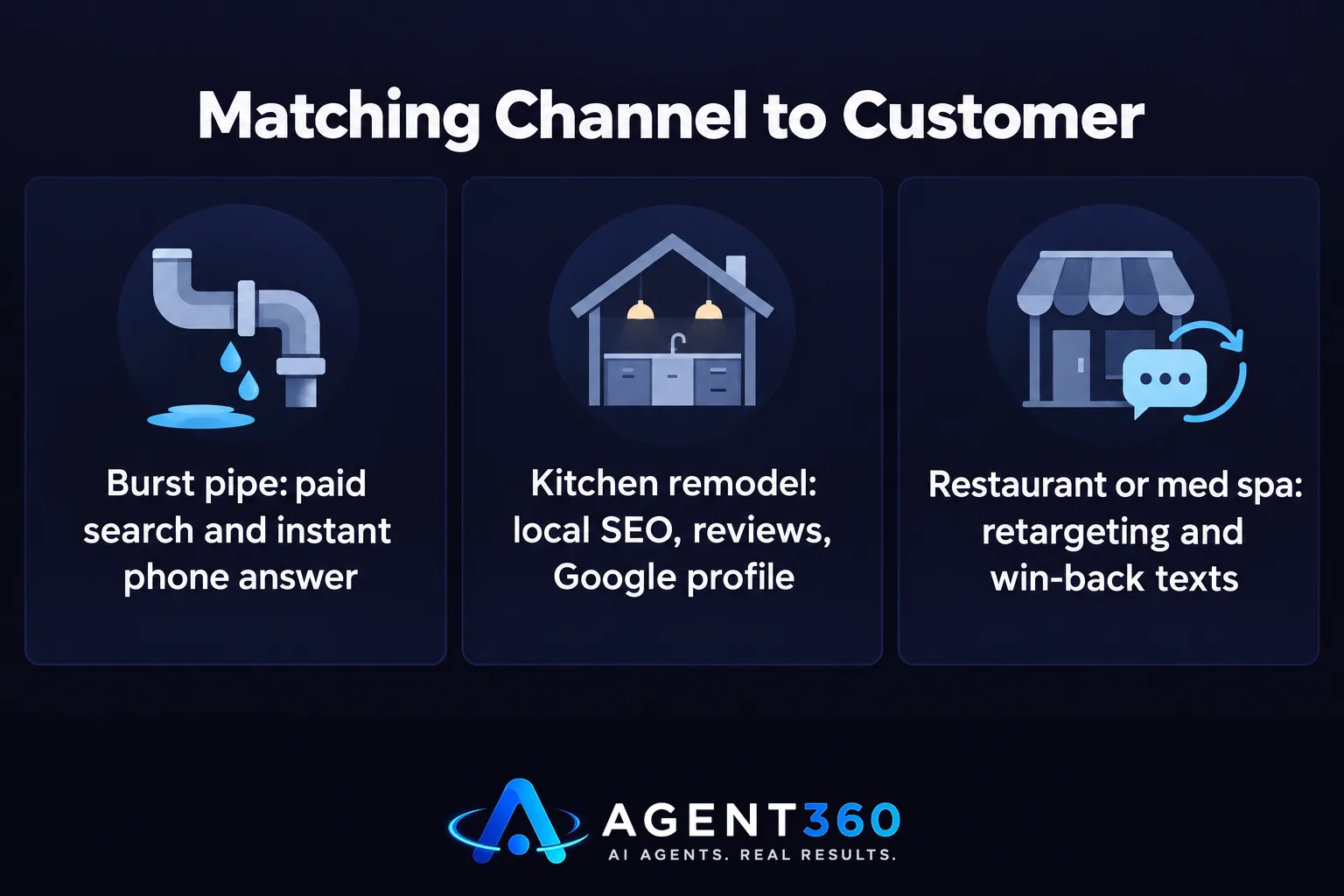
“What's the best marketing for a small business” has no universal answer, because it depends on how your customer buys. Nobody Googles a burst pipe three weeks in advance — that customer needs paid search ads that show up the second they search, and a phone that gets answered on the first ring. A kitchen remodel or a wedding photographer gets researched for weeks, which means local SEO, reviews and a Google Business Profile that shows up every time the prospect circles back to compare options. Restaurants and med spas live on repeat visits, so retargeting and win-back texts to past customers often beat new-customer ads dollar for dollar. The mistake is picking a channel because a competitor uses it, or because it's the one you happen to understand, instead of picking it because it matches how long your customer takes to decide.
Speed of response beats cleverness of message, almost every time
Ask business owners what actually worked, and the answer is rarely a clever ad or a viral post. It's usually something unglamorous — they started texting leads back in minutes instead of hours, or they stopped losing after-hours calls to voicemail. Studies on lead response all point the same direction, even without one precise number everyone agrees on: the business that replies first tends to win the job, and the gap between “fast” and “too late” is measured in minutes, not days. A beautiful landing page that feeds a lead into an inbox nobody checks until tomorrow isn't an underperforming marketing plan — it's a plan with a hole in it. Fix that hole (instant text replies, online booking, a receptionist that answers after hours) and you'll usually see a bigger jump in booked jobs than any amount of extra ad spend poured into the same leaky bucket. It's also the part of “done-for-you” that gets skipped most, because follow-up software is a lot less visible than a shiny new website.

What a done-for-you plan from Booked actually includes
Booked runs this as one plan instead of a patchwork: a website, SEO and AEO/GEO for AI search, Google and Meta ads with the ad spend paid directly to the platforms so you see exactly what went where, landing pages, retargeting, and instant text-and-email reply to every lead with online booking built in — starting at $297 a month, with speed-to-lead handled automatically, no setup fee and no contract. Higher plans add 24/7 AI phone answering, more content, and a dedicated strategist as the ad budget and the number of locations grow. Run your own numbers against a plan on the pricing page before you talk to anyone.
Frequently asked questions
How much should a small business pay for marketing?
A commonly used range for an established business is 6 to 10 percent of revenue, split into a flat fee for the work and a separate, owner-controlled budget for ad spend. New locations, or businesses in a crowded category, often need to run above that range for the first year.
What is the 3-3-3 rule for marketing?
There's no single fixed definition, but most small businesses mean splitting attention three ways — a channel that already works, a channel being tested, and content that compounds — and giving each one a full quarter before judging results.
What is the best marketing for a small business?
The right channel depends on how fast your customer needs to buy. A burst pipe or a broken AC calls for paid search and a phone that gets answered now. A kitchen remodel or a custody case calls for local SEO, reviews and retargeting that stay in front of someone over weeks of deciding.
More articles
- Marketing for Auto Repair Shops That Keeps Bays Full
- Restaurant Marketing Ideas That Actually Fill Tables
- Law Firm Marketing: What Actually Brings In Cases
- Marketing for HVAC Companies: What Actually Books Jobs
- Marketing for Dentists: What Actually Fills the Schedule
- Google Business Profile Optimization: What Moves Rankings
- Local SEO Services: What They Should Actually Do
- Marketing for Small Local Businesses: The Rules Worth Keeping
