Real Estate Agent Marketing: What Actually Gets You Clients

The agent who texts back first gets the showing. Not the agent with the prettiest listing photos, not the one with the clever tagline on a bus bench — the one who answers while the lead is still sitting there with their phone in hand. Every other tactic, SEO, social, paid ads, open houses, exists to feed that first moment. Get the first moment wrong and the rest of the budget is wasted.
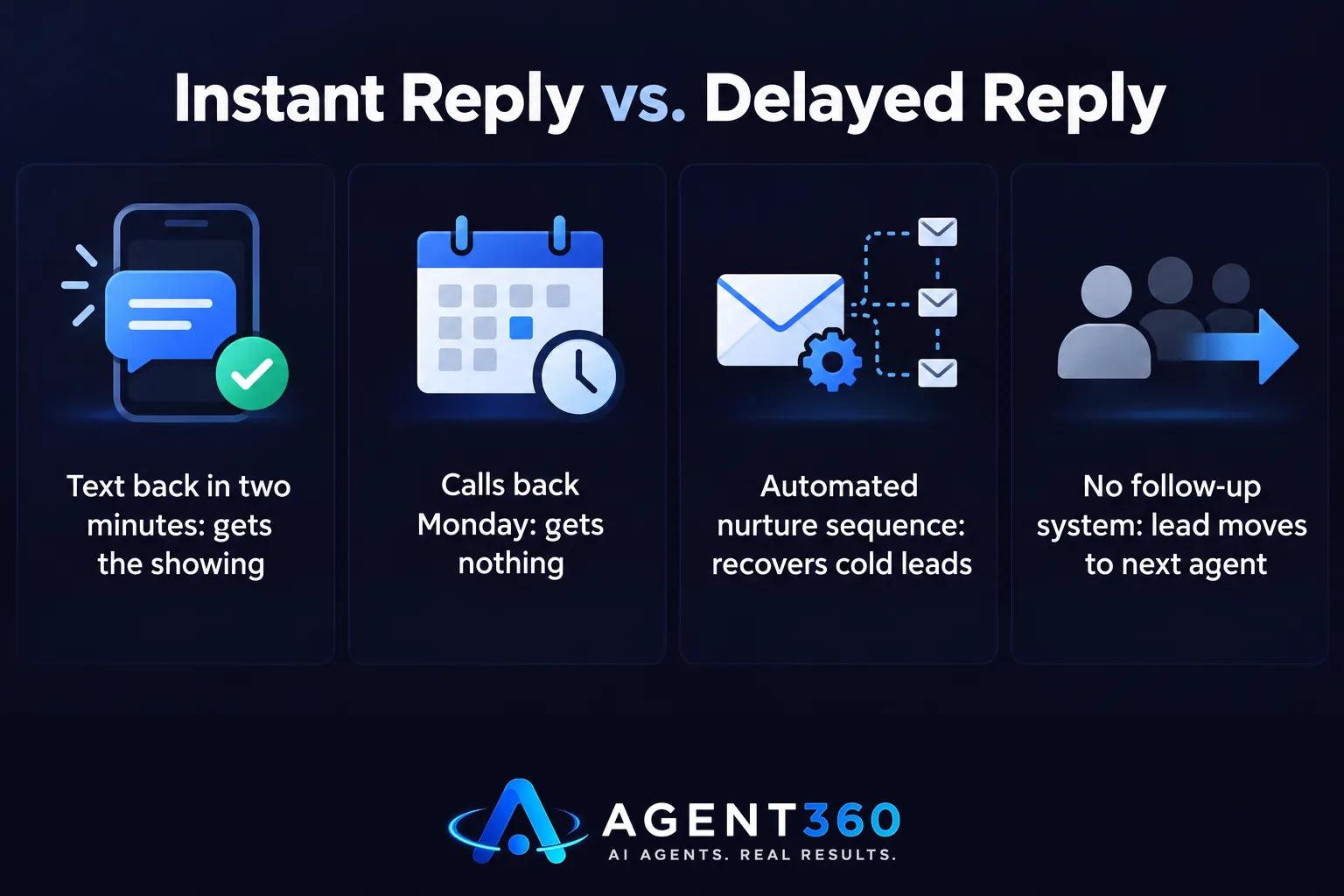
Most agents spend their marketing dollars on visibility and almost nothing on response. That's backwards. A buyer who fills out a form on a Saturday afternoon is filling out three or four others at the same time. The agent who texts back in two minutes gets the showing. The one who calls back Monday gets nothing.
Real estate is a marketing job before it is a sales job
Yes, and new agents underestimate this more than any other part of the business. Commission-based real estate has no base salary and no assigned territory. Nobody hands you buyers. You generate your own pipeline through referrals, content, ads, and your sphere of influence, then you convert what you generated. Negotiating, closing, handling inspections — that part is smaller than most people expect walking in. The bigger, harder piece is making sure a steady number of people know you exist and think of you the moment they're ready to move. Agents who treat marketing as someone else's job, or as something to get to later, run out of pipeline within a year.

The 5 P's are a classroom framework, not a prospecting plan
Product, price, place, promotion, and people is a general marketing mix, and it applies loosely to real estate. Your “product” is your service and your listings. “Price” is your commission structure and the price points you work. “Place” is your market area, “promotion” is your channels, and “people” is you and your team. Fine for structuring a business plan. It won't tell you why a lead went cold. The variable that actually separates agents who hit their numbers from agents who don't is response time: how fast a new lead hears back, and how many touches they get before someone else answers. If you want a framework that predicts outcomes, build your plan around speed to lead and follow-up cadence, not the five P's.
Seven channels do the job — but only two or three deserve most of your time
The common list of digital marketing channels includes search engine optimization, pay-per-click or paid search, social media, content marketing, email marketing, video, and SMS or messaging. Run all seven at once as a solo agent or small team and your budget gets spread so thin that none of them work. A more realistic split:
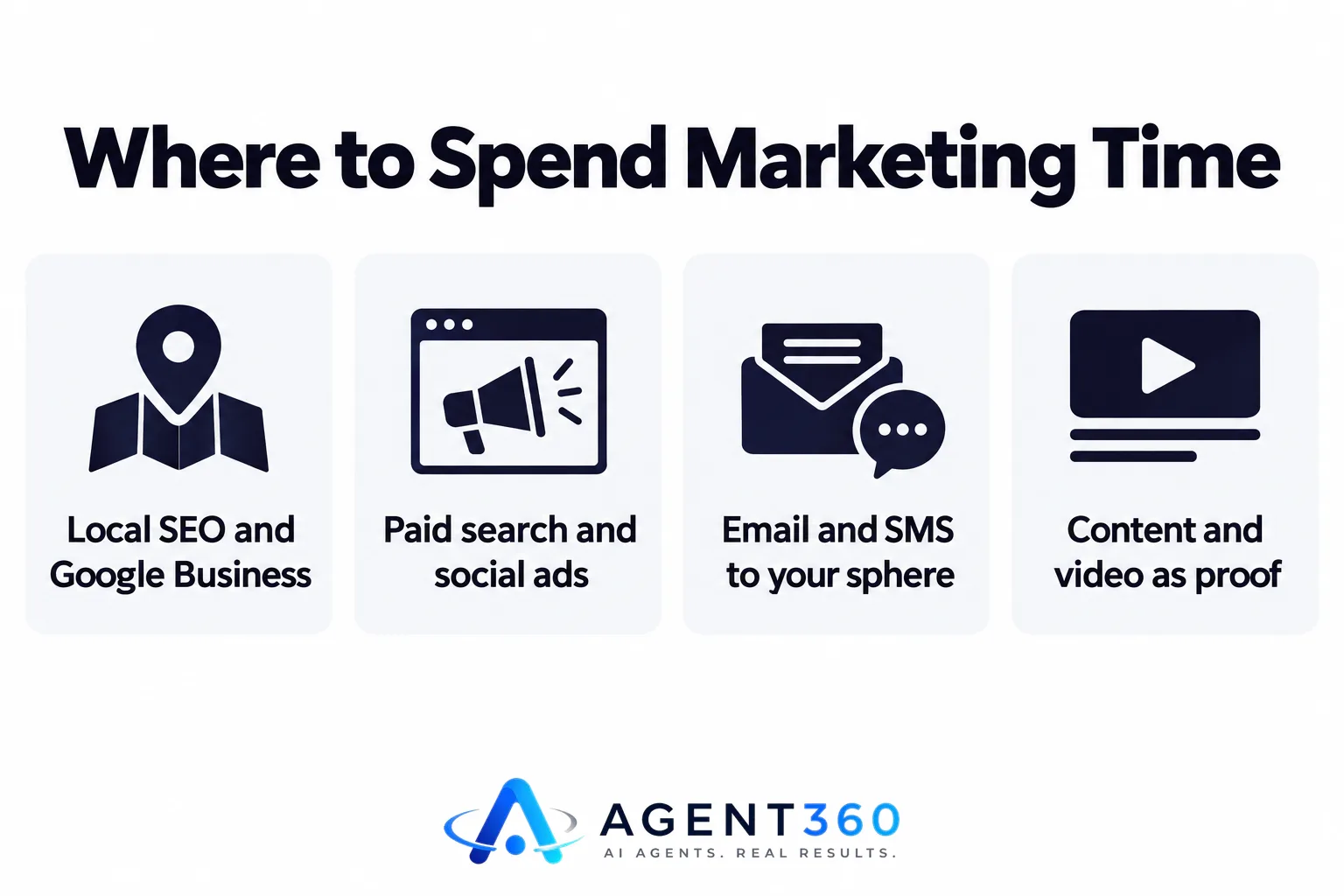
- Local SEO and Google Business — buyers and sellers searching “real estate agent near me” or your neighborhood name should find your profile and site before a national portal.
- Paid search and social ads — put your listings and your face in front of people actively searching or scrolling in your zip codes, with every lead tracked back to the ad that produced it.
- Email and SMS to your sphere — past clients and referral sources are cheaper to reach than cold leads and close at a higher rate when you stay visible.
Content, video, and organic social matter, but mostly as proof once someone has already found you — testimonials, market updates, walkthroughs. They rarely start the first contact on their own. A service built around paid lead generation paired with local search visibility covers the two channels that actually bring buyers and sellers to your door.
The $100,000 first-year math, worked backward
Agents ask this because the number feels arbitrary until you break it into parts. It isn't. Start with your average commission check in your market — the price range you work times your split. Divide 100,000 by that number to get the closings you need for the year. Then look at your lead-to-closing rate: what share of leads that enter your pipeline actually close, from any source. That rate varies enormously by agent, market, and how fast leads get followed up — which is exactly why generic advice can't hand you a number. You have to measure your own. Once you know it, multiply your required closings by the inverse of that rate to get your required lead volume for the year, then divide by twelve for a monthly target. An agent chasing six figures on a modest average commission in a slow-converting pipeline needs a very different lead volume than one with a higher-priced market and fast follow-up. The lever most agents can actually move quickly isn't lead count. It's conversion rate, and conversion rate is almost entirely a function of how fast and how often you follow up.
Follow-up speed is the cheapest lever you have
A lead that waits more than a few minutes for a reply starts calling the next name on the list. An instant text reply, paired with a short automated nurture sequence for leads who aren't ready yet, recovers deals that would otherwise go cold. This is a system problem, not a willpower problem. Agents don't lose leads because they're lazy — they lose them because they're in a showing, in escrow, or asleep when the lead comes in.
This is the piece most agent marketing advice skips, because it's less exciting than talking about Instagram reels. But a done-for-you setup — instant lead response, booking, and a CRM that tracks every lead back to its source — closes more of what the ads and SEO already produce. Booked runs this for real estate agents under its real estate plan, starting at $297 a month with no setup fee and no contract, and it bundles the website, ads, local search work, and the instant follow-up system described above into one plan instead of five separate vendors.
Questions worth answering plainly
What are the 5 P's of real estate?
Product, price, place, promotion, and people — a general marketing mix framework. Useful for planning a business, but it won't tell you why leads go cold; response speed and follow-up cadence predict that far better.
What are 7 types of digital marketing?
SEO, paid search, social media, content, email, video, and SMS. Most individual agents get the best return from focusing on local search visibility, paid ads, and direct outreach to their sphere rather than running all seven at once.
Is real estate a marketing job?
Yes, more than it looks from the outside. Commission-based agents generate their own pipeline, which means prospecting, follow-up, and visibility work take up more time than negotiating and closing.
How do I figure out what I need to earn $100,000 in my first year?
Divide 100,000 by your average commission check to get required closings, then divide that by your actual lead-to-closing rate to get required lead volume. Track your own conversion rate from day one — run the real numbers through a free ROI calculator instead of guessing at them.
More articles
- Marketing for Auto Repair Shops That Keeps Bays Full
- Restaurant Marketing Ideas That Actually Fill Tables
- Law Firm Marketing: What Actually Brings In Cases
- Marketing for HVAC Companies: What Actually Books Jobs
- Marketing for Dentists: What Actually Fills the Schedule
- Google Business Profile Optimization: What Moves Rankings
- Local SEO Services: What They Should Actually Do
- Done-For-You Marketing for Small Business: What It Buys
