AI Receptionist for Small Business: What It Costs and Does
The price of an AI receptionist for a small business splits into two camps: a tool that bills by the minute, and a service that folds it into one flat monthly fee. The number that actually matters isn't the sticker price — it's what you're paying for. Does it just answer and route calls, or does it quote the job and book it without you touching the phone?
Most owners typing this into Google aren't shopping for a gadget. They're trying to stop losing calls after hours, mid-job, or on the day the one person who answers the phone calls in sick. Price it against that problem, not against the feature list.
How much does an AI receptionist cost?
Stand-alone AI answering tools price one of two ways: a flat base fee plus per-minute charges past an included volume, or a flat fee with a hard cap on minutes. Either way, the bill tracks your call volume. That's hard to budget around — a slow month costs less, a busy one costs more, and busy is exactly when you want the thing working.
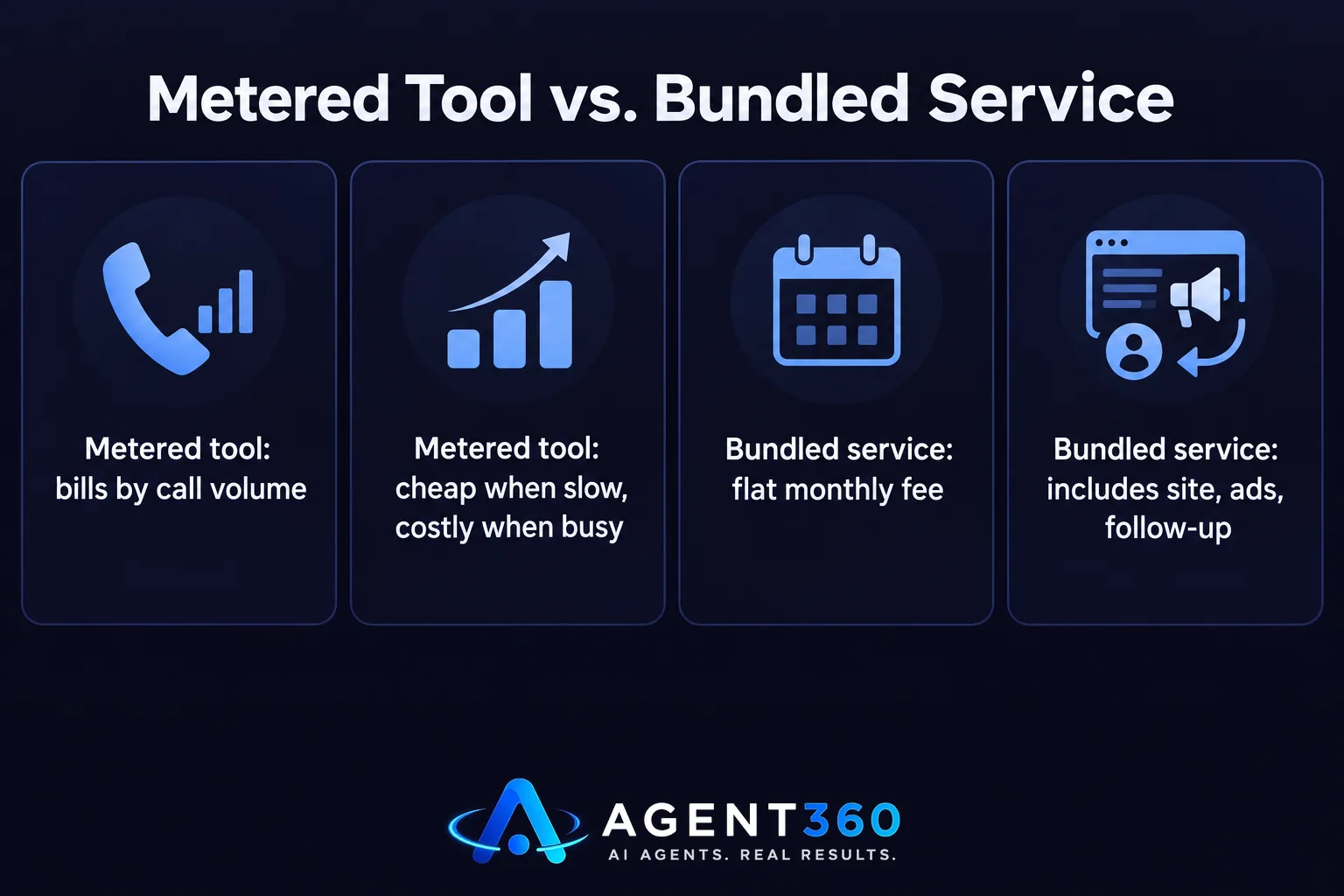
Bundled services skip the metering. The AI answering gets folded into a monthly marketing plan alongside the site, the ads, and the follow-up, so one bill covers both the system that brings the call in and the one that answers it. A receptionist that answers well but was never connected to your booking calendar or your ad spend is only solving half the problem — see Respond for what the other half looks like.
Either way, ask what happens past the included limit before you sign. A tool that's cheap at low volume and expensive the moment business picks up is a bad trade for a business trying to grow.
What is the best AI receptionist for small business?
There's no single best one — the job changes by industry. A dental office needs insurance and appointment-type questions answered correctly. An HVAC company needs same-day jobs triaged from routine maintenance. A law firm needs intake handled without crossing into legal advice. The best AI receptionist isn't the one with the most features. It's the one trained on your actual services, prices, and hours, wired directly into your calendar so a booked call becomes a booked appointment — no human re-entering it.
Test any option on three things before you commit. Can it handle a caller who asks something outside its script without making something up? Does it hand off cleanly to a person when the call needs one? Does every call show up transcribed somewhere you can review it? Miss on any of those and you've bought a voicemail with better manners.
How much do people sell an AI receptionist for?
Agencies and consultants reselling AI answering as an add-on usually mark it up into a flat monthly retainer rather than pass through usage-based pricing — an unpredictable bill is a hard sell to a small business owner. That retainer tends to sit alongside other services, website, ads, follow-up, rather than stand alone. An AI receptionist with nothing feeding it calls has nothing to answer.
If someone quotes you a price for “AI receptionist” on its own, ask what it's connected to. A phone tree that sounds smart but dumps into a shared inbox is not the same product as one that books straight into a calendar and texts the customer a confirmation.
Is AI replacing receptionists?
Not in the sense of eliminating the role. It's absorbing the part of the role that was already failing. Most small businesses weren't losing calls because a human receptionist was bad at the job — they were losing calls because no one was at the desk at 7pm, mid-job, on a Saturday, or during the three rings before voicemail picked up. That's the gap an AI receptionist fills: never off, never on another line, instant on every missed call instead of catching up at the end of the day.

Where a human still wins is judgment on anything unusual — a complaint, a negotiation, a situation the script was never written for. A well-built setup routes those straight to a person and automates only what's genuinely repeatable: hours, pricing, availability, booking.
What to check before you buy one
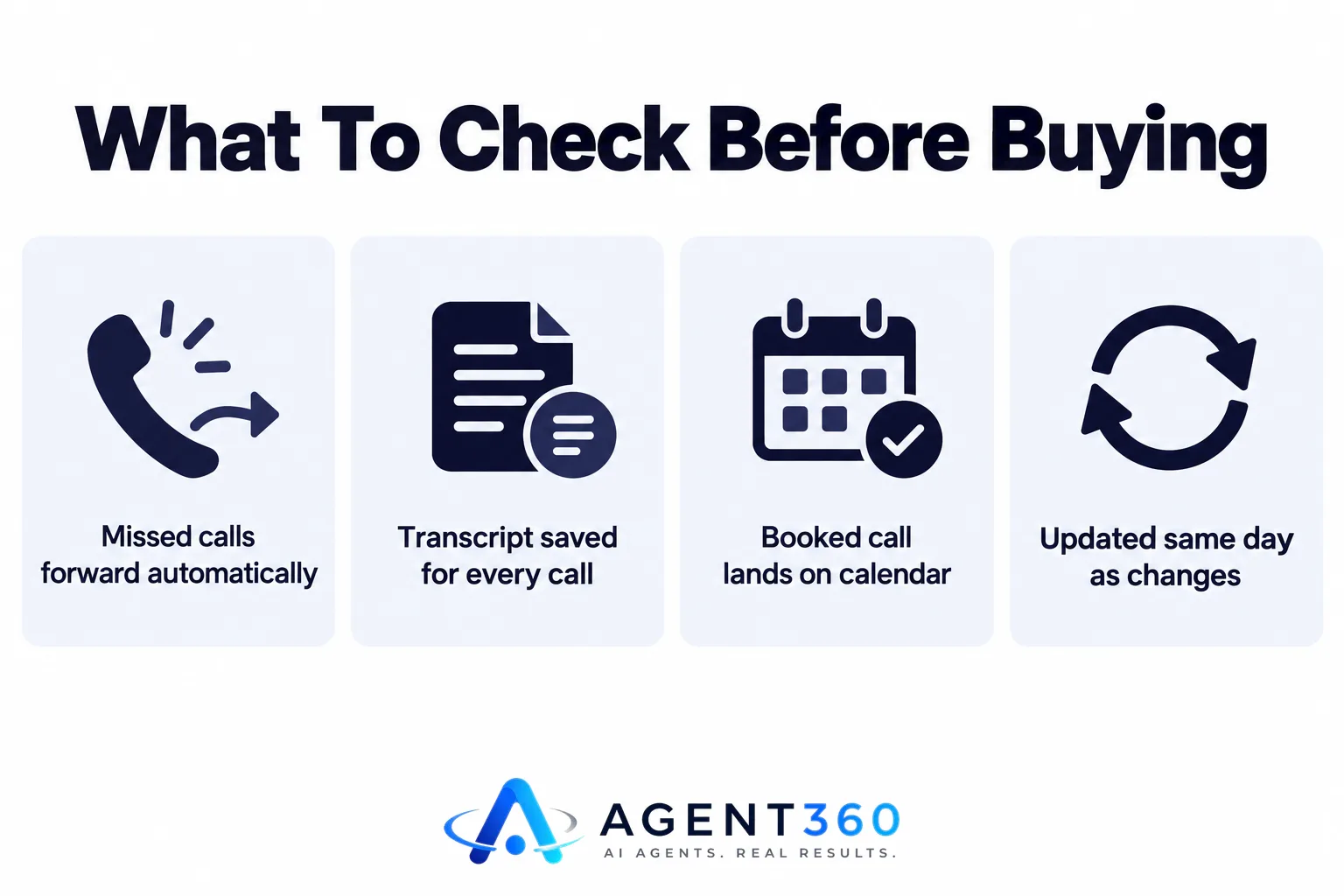
- Does every missed call forward to it automatically, or does someone have to remember to turn it on?
- Is the transcript of every call saved somewhere you can read it later?
- Does a booked call actually land on your calendar, or does someone still have to re-enter it by hand?
- Can it be updated the same day your hours, prices, or services change?
If the answer to any of those is no, the tool is answering calls but not closing the loop — and the loop is where most of the value lives. The same question holds whether you run a clinic, a shop, or a firm; browse industries for how the follow-up side differs by business.
Where this fits inside a marketing plan
Booked's Pro plan, at $497 a month, bundles 24/7 AI phone answering and booking with the website, ads, SEO, and instant text-and-email reply that already come with every plan — a missed call gets answered, transcribed into your CRM, and booked onto your calendar without a separate tool or a separate bill. No setup fee, no contract. Full breakdown on pricing.
FAQ
How much does an AI receptionist cost?
Depends on whether you buy it as a metered stand-alone tool, where the bill moves with call volume, or as part of a bundled monthly service folded into a flat fee alongside your website, ads, and follow-up. Ask what happens once you exceed any included call volume before comparing prices.
What is the best AI receptionist for small business?
The one trained on your actual services and prices, wired into your booking calendar, and able to hand off cleanly to a human when a call needs judgment — not the one with the longest feature list.
Is AI replacing receptionists?
It's replacing the hours nobody was covering anyway — nights, weekends, the minutes a human was already on another call — while routing anything unusual straight to a person. Check the FAQ page for the rest of what owners ask before they switch the phones over.
More articles
- Fitness Studio Marketing: Why the 3-3-3 Rule Falls Short
- Real Estate Agent Marketing: What Actually Gets You Clients
- Marketing for Auto Repair Shops That Keeps Bays Full
- Restaurant Marketing Ideas That Actually Fill Tables
- Law Firm Marketing: What Actually Brings In Cases
- Marketing for HVAC Companies: What Actually Books Jobs
- Marketing for Dentists: What Actually Fills the Schedule
- Google Business Profile Optimization: What Moves Rankings
