Fitness Studio Marketing: Why the 3-3-3 Rule Falls Short

Fitness studio marketing fails for one reason more than any other: studios spend money filling trial classes, then do nothing structured to convert or keep the people who show up. The trial is the easy part. The membership is the business.
If you searched for the 3-3-3 rule hoping it was a membership formula, you're out of luck — it wasn't built for studios, and chasing it won't fix what's actually costing you members.
The 3-3-3 rule is a trading rule, not a marketing plan
The 3-3-3 rule comes from day trading: check a position after 3 minutes, 3 hours and 3 days, and see if it's moving the way you expected. Some fitness influencers have borrowed the name for a workout structure instead — 3 strength days, 3 cardio days, 3 mobility days a week. Neither version tells you how to get someone to sign a membership. That formula doesn't exist in the 3-3-3 rule. It exists in the funnel from stranger to trial to member, and that funnel needs its own structure.
Build your own version: check the lead at day 3, day 10 and day 30
Borrow the shape of the idea, not the workout. A trial member who hasn't heard from you by day 3 is already drifting. Someone who hasn't booked a second class by day 10 is close to gone. A member who hasn't hit a 30-day habit — four or more visits — is at serious risk of canceling before the second billing cycle. Those three checkpoints matter more than any posting schedule:
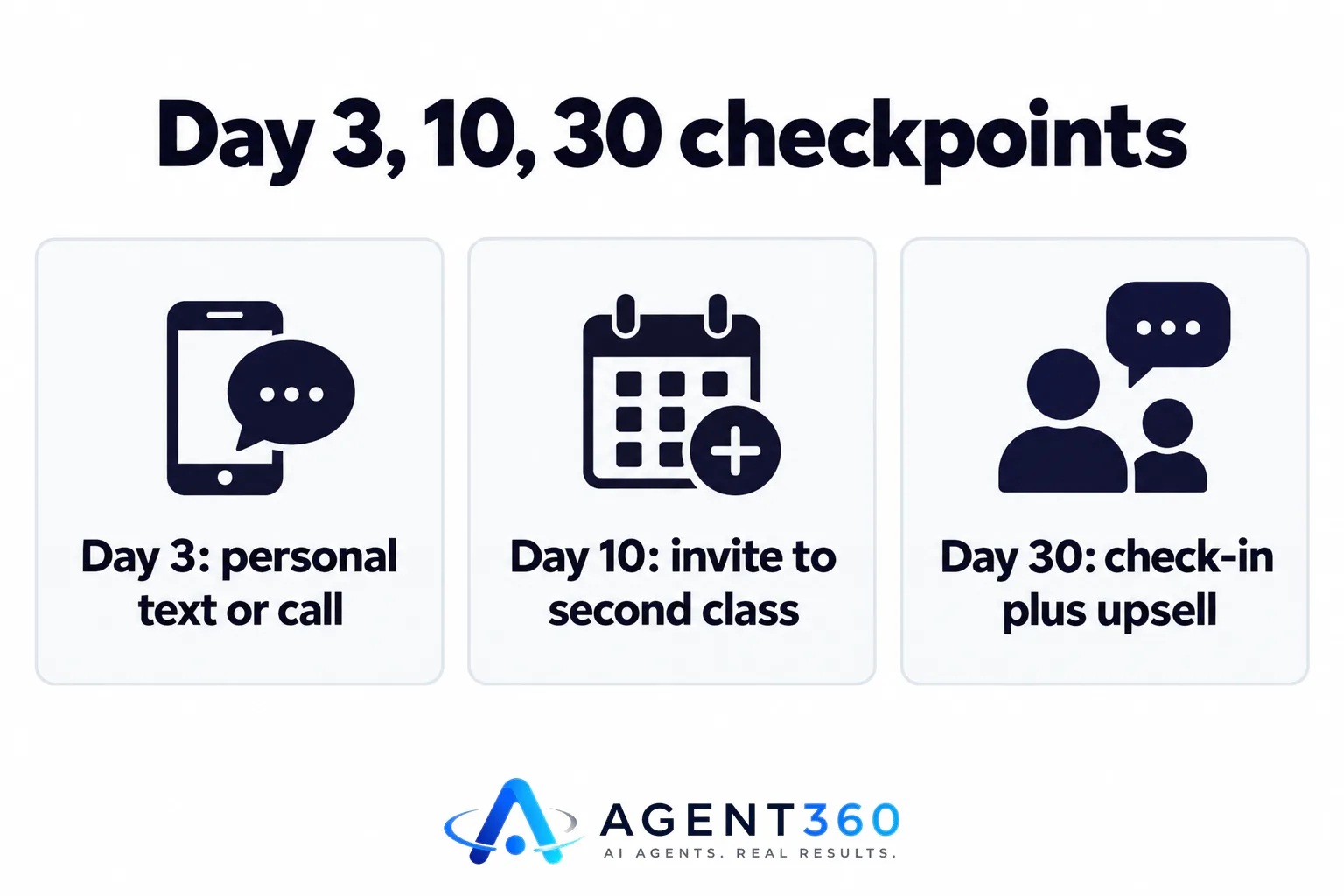
- Day 3: a personal text or call, not an automated email, asking how the first class felt.
- Day 10: an invite to a second class format or a small-group session, timed to when their trial window is closing.
- Day 30: a check-in on goals, plus an upsell to a package before the free period runs out.
Skip these checkpoints and you're relying on front-desk staff to remember them — which means they happen inconsistently, and stop happening at all the moment the studio gets busy.
How profitable are fitness studios, really
Fitness studios run on fixed costs: rent, equipment leases, and payroll for instructors whether the room has 3 people or 20. Margin is brutally sensitive to occupancy. A class at 40% capacity and a class at 90% capacity cost almost the same to deliver, but one is barely profitable and the other is carrying the studio. So the real marketing question isn't “how do I get more leads” — it's “how do I fill the classes already on the schedule and keep the members I already have paying.” Acquiring a new member costs far more than keeping one who already trusts you. Retention spend — a win-back text, a loyalty perk, a format they haven't tried — usually returns more than another round of trial ads.
How to market your fitness business without wasting the ad budget
Three moves do most of the work, in this order:
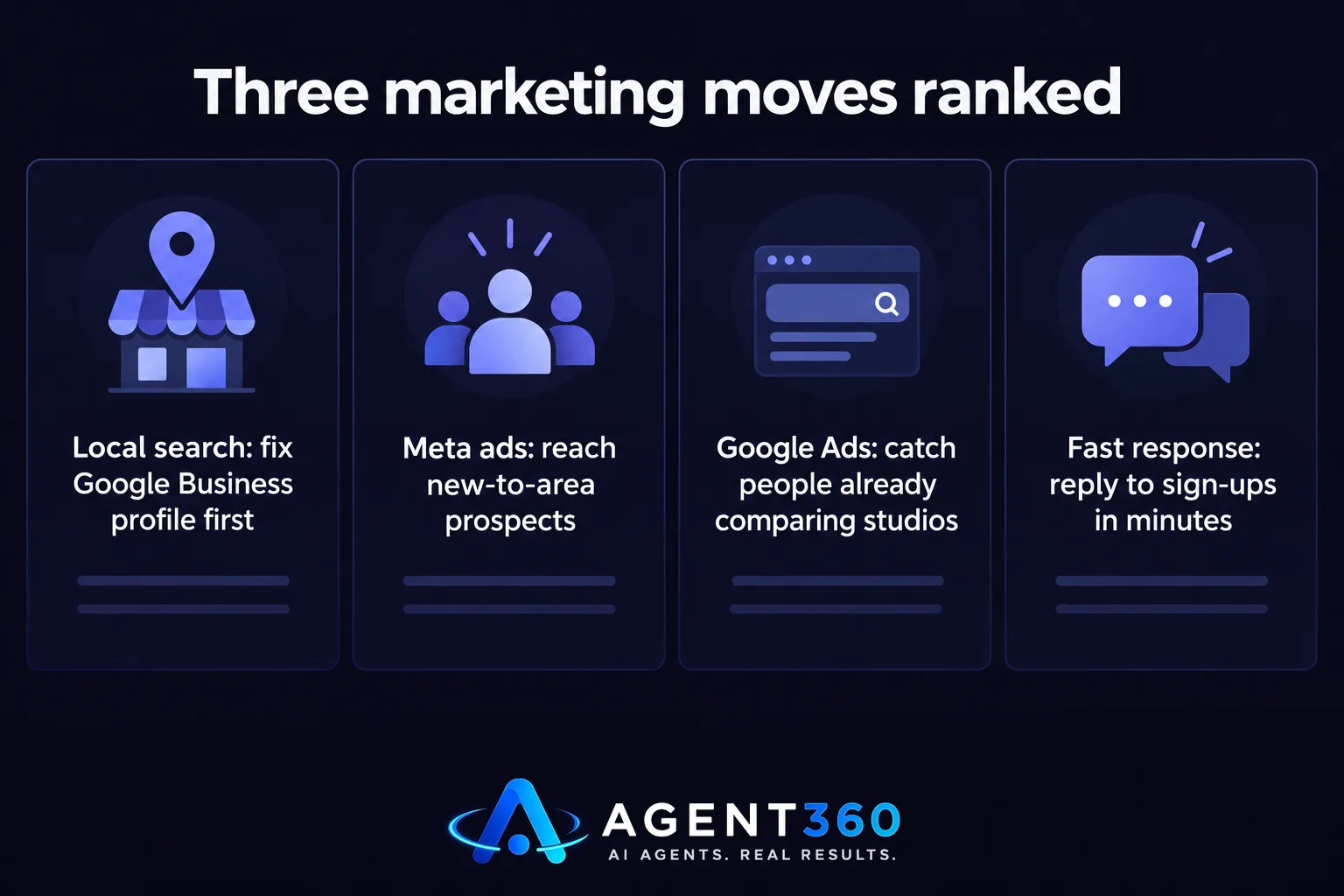
1. Fix local search before you touch paid ads
Someone who just moved to the area, or whose old gym closed, searches “gym near me” or “pilates studio [city]” before they ever see an ad. If your Google Business profile is thin, the hours are wrong, or the class photos are two years old, you lose that search before you've spent a dollar on Meta — the groundwork covered under getting found rather than getting clicked. It matters for AI answers too. When someone asks ChatGPT or Google's AI Overview to recommend a studio nearby, it pulls from the same signals that drive local search rankings.
2. Run trial offers through Meta, not Google, for new-to-area prospects
People rarely search for a studio before they have a reason to join — a New Year's resolution, a doctor's recommendation, a friend's invite. Instagram and Facebook ads reach them before they ever search, with a free class or a discounted first month. Google Ads just catch the smaller group already comparing studios by name.
3. Respond to every trial sign-up in minutes, not hours
A trial lead who fills out a form and doesn't hear back within the hour books somewhere else — or just forgets. Instant text or email confirmation, followed by the day-3 and day-10 check-ins above, is the fast, structured lead response that turns a free class into a signed membership.
What actually works for gym owners, beyond the obvious
Referral programs outperform almost every paid channel for studios, because a member who brings a friend to class is already sold on the format and the community — the hardest thing to sell a cold lead. Win-back campaigns to lapsed members are the second-best return. Someone who canceled six months ago already knows your studio, your instructors and your location, so bringing them back costs a fraction of acquiring someone new. The third thing that works, and gets skipped most often, is simply asking happy members for a Google review right after a strong class. Reviews compound into the local search ranking that drives the next round of trial sign-ups.

Where Booked fits into this
Running the day-3/10/30 follow-up, the review requests, the win-back texts and the trial-ad targeting by hand is a full job on its own — on top of actually teaching classes. Booked's Starter plan runs your Google Business profile, instant lead response, and Google, Instagram and Facebook ads from one dashboard. The fitness studio plan adds the SMS coupons and win-back campaigns that bring lapsed members back without you writing another text.
Questions
What is the 3-3-3 rule for marketing?
There's no standard 3-3-3 rule for marketing. The term comes from day trading, where a position gets reviewed after 3 minutes, 3 hours and 3 days. Some marketers borrow the shape of it loosely, but it isn't a recognized framework for lead generation or campaigns.
What is the 3-3-3 rule for fitness?
In fitness, 3-3-3 usually means a weekly workout split: 3 days of strength training, 3 days of cardio, 3 days of mobility or recovery. It's a training template for individuals, not a marketing or membership strategy for studios.
How profitable are fitness studios?
Margins are tight and highly sensitive to class occupancy, because rent, equipment and instructor pay stay fixed whether a class is half-empty or full. Profitability comes less from new leads and more from filling the class slots you already have, and keeping members past their first billing cycle — replacing a canceled member costs far more than keeping one.
How do I market my fitness business on a tight budget?
Start with your Google Business profile and review count — that's free, and it drives the searches people make before they ever see an ad. Then put a small, consistent budget behind Instagram and Facebook trial offers, and make sure every trial sign-up gets a personal follow-up within the hour. That single habit converts more trials than almost any amount of extra ad spend.
More articles
- Real Estate Agent Marketing: What Actually Gets You Clients
- Marketing for Auto Repair Shops That Keeps Bays Full
- Restaurant Marketing Ideas That Actually Fill Tables
- Law Firm Marketing: What Actually Brings In Cases
- Marketing for HVAC Companies: What Actually Books Jobs
- Marketing for Dentists: What Actually Fills the Schedule
- Google Business Profile Optimization: What Moves Rankings
- Local SEO Services: What They Should Actually Do
