How to Find LinkedIn Profiles Worth Outreach
Finding the right LinkedIn profiles for outreach means picking people who match your buyer criteria and show some sign they're open to a conversation right now, not just anyone with the right job title. Title alone tells you almost nothing about timing. A VP of Sales who just posted about a hiring freeze is a worse target this month than a Director who just took over a new territory.
Most outbound stalls because the list is wrong before the first message goes out. Fixing the list fixes the reply rate faster than rewriting the copy ever will.
Key Takeaways
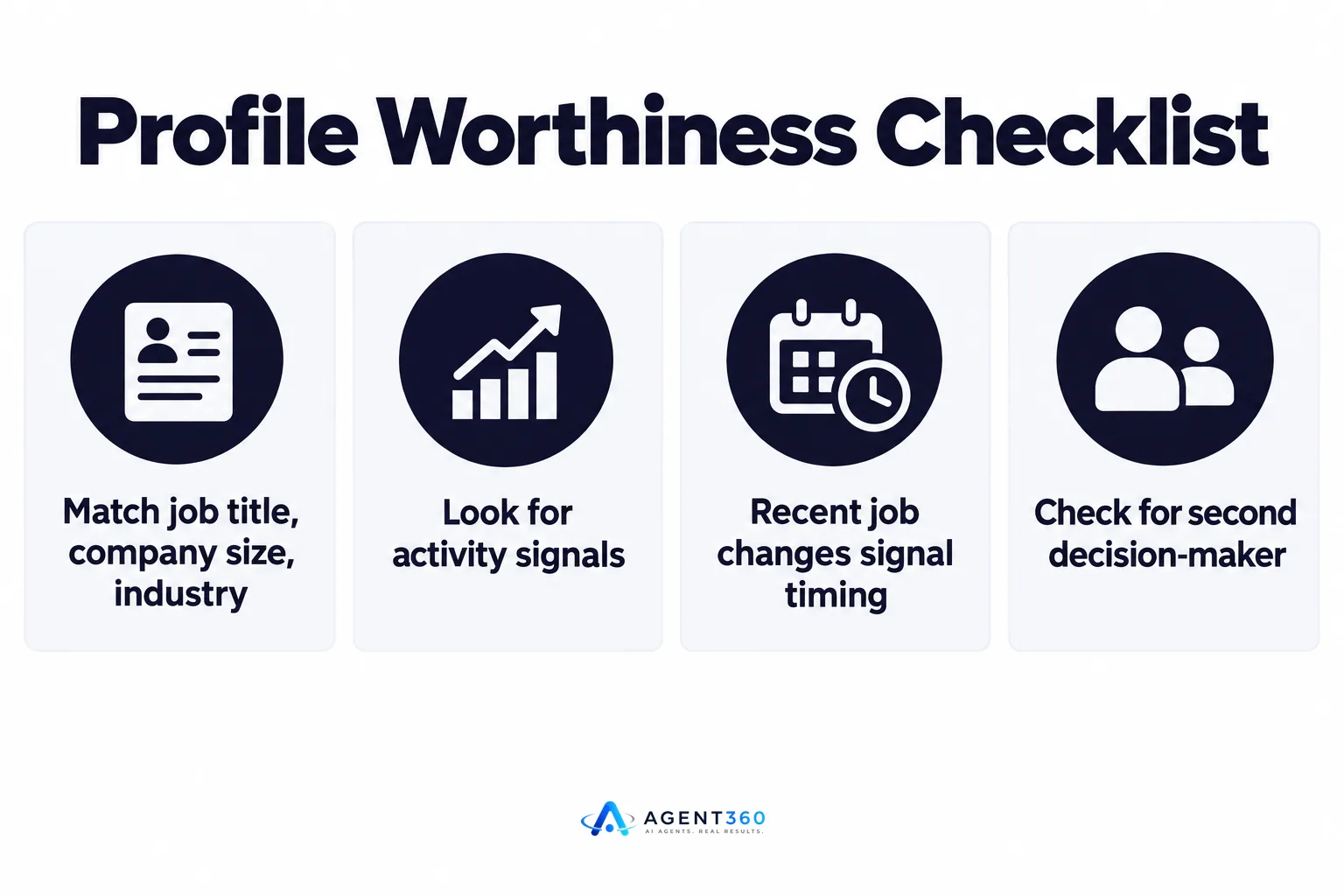
- Match job title, company size, and industry first, then layer in activity signals before you message anyone.
- Recent job changes, hiring posts, and content engagement are stronger timing signals than title alone.
- Check for a second decision-maker at the same account before you commit a sequence to one contact.
- Automated prospecting software can build and refine this list faster than manual search ever will.
- Cap your weekly list size to what your outreach channels can handle without tripping platform limits.
Table of Contents
What makes a LinkedIn profile worth adding to your outreach list?
A profile is worth outreach when it matches your ideal customer profile and shows a reason to act now. Fit and timing are two separate filters, and both have to pass. Fit covers role, seniority, company size, and industry. Timing covers anything that suggests the person is actively dealing with the problem you solve this month, not sometime next year.
What counts as a timing signal on LinkedIn?
A new job posting for a role connected to your product, a recent promotion, a company announcement about funding or expansion, or a post where the person is openly discussing the problem you solve all count. Job postings in particular are one of the clearest signals available, because they tell you a budget line already exists. Job postings as a buying signal are worth treating as a standing filter, not a one-off check.
Does company size matter more than title?
It depends on your product, but for most B2B sellers, company size sets the ceiling on deal size and title sets who can say yes. Screening both together narrows a list faster than screening either alone. A perfect title at a company too small to buy wastes the same amount of time as a perfect company with the wrong contact.
How do you find the right LinkedIn profiles without spending hours searching?
You combine a filtered search with a signal layer, then verify before you send anything. Manual search alone finds names. It doesn't tell you which of those names are ready to talk this week.

- Define the firmographic filter. Set industry, company size, and geography first so the search pool is the right shape before you add anything else.
- Set the title and seniority range. Include the economic buyer and at least one influencer role, since deals rarely close through a single contact.
- Layer in activity signals. Pull recent job postings, leadership changes, or funding news that point to active need, not just eligibility.
- Check for duplicate accounts. Remove contacts already in an open deal or a recent sequence so you're not messaging the same company twice in one month.
- Export and hand off to outreach. Move the finished list into your sequencing tool rather than messaging from the search results page directly.
Doing this by hand across dozens of searches a week is slow and easy to get wrong. Buying-signal detection built into a prospecting tool runs this filtering automatically, so the list that reaches your outreach channel has already passed the fit-and-timing check.
What should you check before you add a profile to a sequence?
Confirm the person is still in the role, still at the company, and not already in your pipeline. LinkedIn data goes stale fast. A title that was accurate three months ago can be wrong today, and messaging someone who left the role burns the account for a future attempt.
How do you avoid messaging someone already in your pipeline?
Cross-check the profile against your CRM before adding it to any sequence. If your pipeline tracking is scattered across spreadsheets or a tool nobody updates consistently, this check gets skipped and duplicate outreach slips through. A shared CRM view that both prospecting and outreach pull from closes that gap.
Should you message the same account more than once?
Yes, but through a second contact, not the same person twice in one cycle. Multi-threading an account protects the deal if your first contact goes quiet, and it's far less disruptive than re-sending to someone who already ignored you.
How many profiles should you target for outreach each week?
Size your list to what your channels can actually process without tripping platform limits. LinkedIn and email providers both impose practical ceilings on connection requests and messages, and those limits change the math on list size more than most people expect. LinkedIn outreach limits are worth checking before you build a list larger than your sending capacity can clear in a week.
A smaller, well-qualified list that clears your channel limits with room to spare outperforms a large list that gets throttled halfway through. Build for the volume you can actually send, not the volume that looks impressive in a spreadsheet.
Build Your Outreach List Without the Manual Search
Finding the right LinkedIn profiles for outreach is a filtering problem before it's a messaging problem. Agent360's AI prospecting finds buyers that match your target market and flags buying signals like job changes and hiring activity, so the list reaching your sequences is already narrowed to people worth a message. Multi-channel outreach then takes that list across LinkedIn, email, and phone without you managing each step by hand.
Pipeline tracking runs through the same system, so a contact already in a deal doesn't get added to a fresh sequence by mistake. See how the full process works before you decide whether to build your next list manually or let it run automatically.
Frequently Asked Questions
What's the difference between a LinkedIn connection request and outreach?
A connection request is just an invitation to link accounts; outreach is the message sequence that follows once the connection is accepted or in parallel through other channels. Treating a connection request as the whole outreach effort undercounts how many touches most deals actually need.
Should I only target people with a specific job title?
No. Title alone misses the timing half of the equation. Pairing title with a recent activity signal, like a job posting or leadership change, finds people who are actually ready to engage, not just people who technically qualify.
How often should I refresh my LinkedIn outreach list?
Weekly refreshes catch job changes and new signals before they go stale, since a title or company fit that was accurate a month ago may no longer hold. A list that sits untouched for months accumulates contacts who've left their roles.
Can I reuse a LinkedIn profile list across multiple campaigns?
Only after checking it against your current pipeline and recent outreach history. Reusing a list without that check risks messaging the same person twice in a short window, which tends to hurt reply rates rather than help them.
Is LinkedIn alone enough for outreach, or do I need other channels?
LinkedIn works best paired with email and phone rather than as a standalone channel, since not every prospect responds the same way on every platform. Running all three gives a contact more than one path to respond on their own terms.
More articles
- Skylead vs HeyReach: Which LinkedIn Tool Books More Meetings?
- A LinkedIn Outreach Tool That Books Meetings, Not Just Sends
- How to Choose a LinkedIn Lead Generation Tool That Books Meetings
- Export LinkedIn Post Commenters for Warm B2B Leads
- How to Export LinkedIn Post Comments for Warm Leads
- How to Export LinkedIn Post Likers for Warm Outbound Leads
- How to Turn Leads From LinkedIn Comments Into Meetings
- HeyReach vs Waalaxy: Which LinkedIn Tool Fits B2B Outbound?
