SEO for Local Businesses: Win the Map, the List, and the Answer
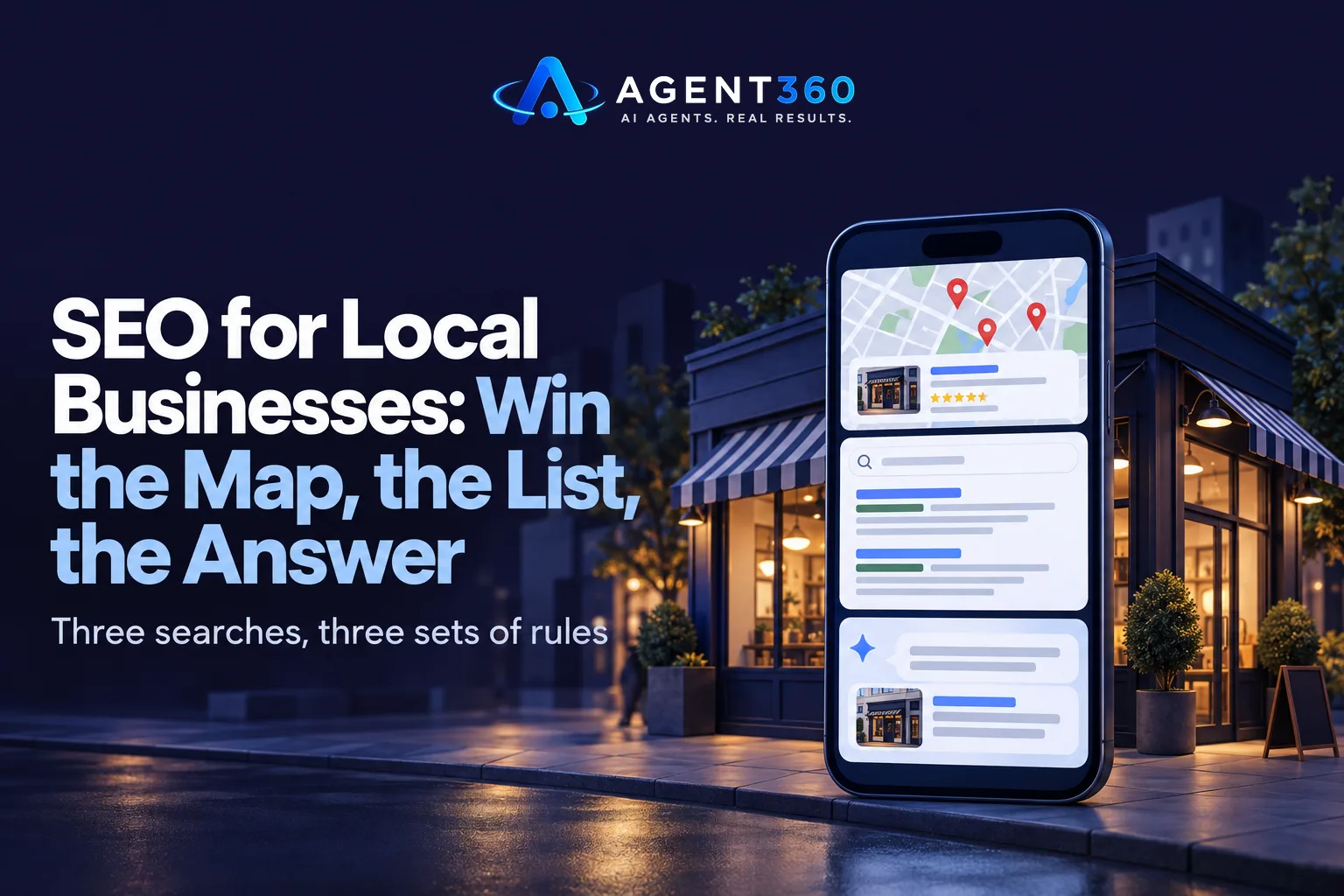
Local SEO isn't one fight, it's three. There's the map pack with its three pinned listings and star ratings, the organic results sitting below it, and now the answer an AI tool gives when someone asks it to recommend a business in your town. Win one and lose the others, and you still lose the customer — a different shopper hit a different surface and saw your competitor's name instead of yours.
Most owners only work the map pack, because it's the one they can see and touch: fill in the Google Business Profile, add some photos, call it done. That gets you into one race out of three. Here's what the other two actually require — and why skipping them costs you jobs.
The map pack and the organic list are scored by different rules
Google says the map pack runs on three factors: relevance, distance and prominence — how close the searcher is to you, how well your profile matches what they typed, and how well-known you are from reviews and citations. Notice what's missing: your website content. The organic results sitting below the map run on a completely different set of signals, the same ones that decide any search result — page quality and depth, internal linking, and whether the page actually answers what someone typed.
That's why a business with a thin, outdated website can still rank in the map pack on reviews and proximity alone — and why a site packed with good content can rank organically while its neglected profile loses the pack entirely. Both tracks need work. Neither covers for the other.
One page per service area beats one page that tries to cover all of them
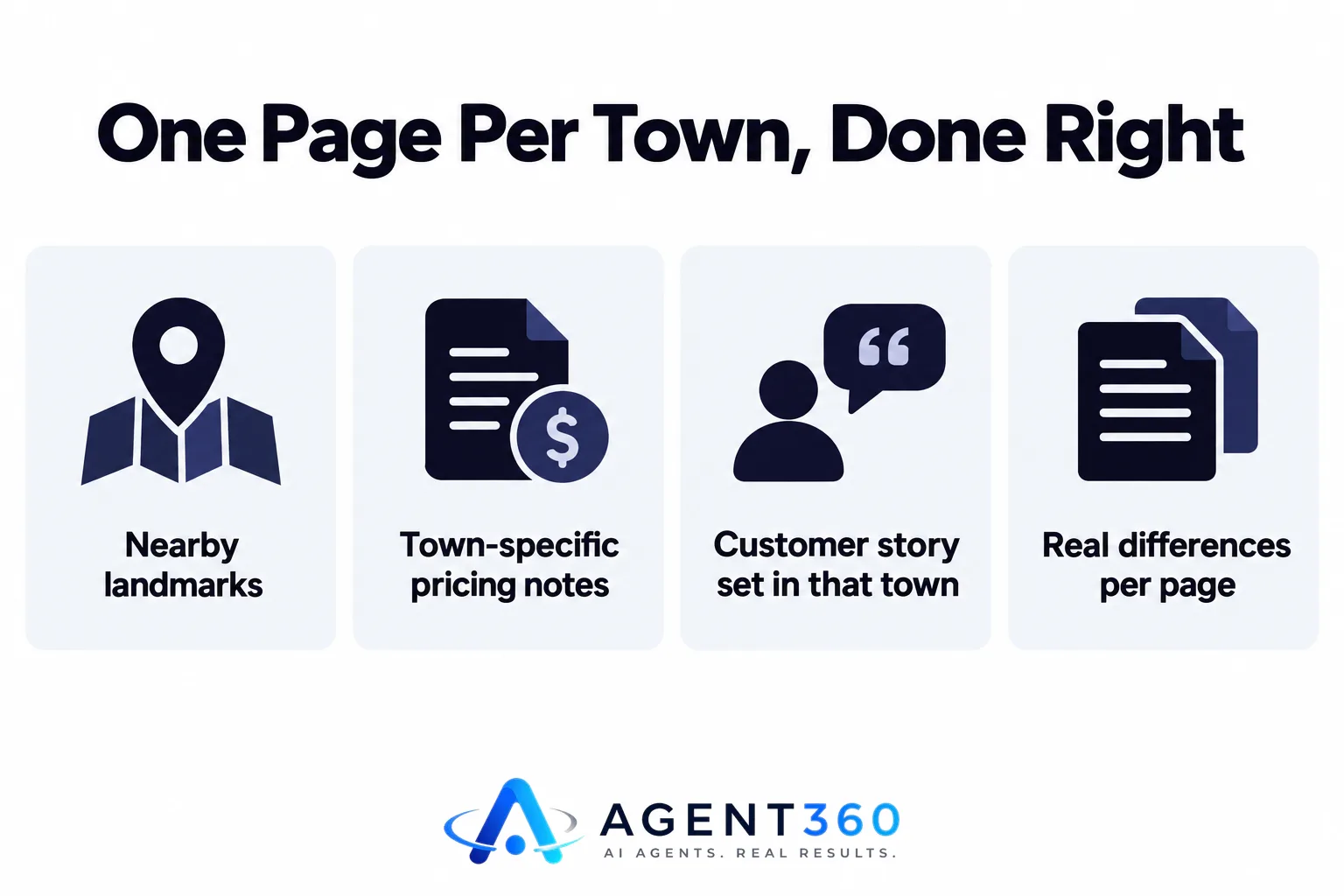
Say you serve six towns from one location. A single “service area” page listing all six in a bullet list will rarely beat a competitor running a dedicated page per town — each one carrying its own local detail: nearby landmarks, town-specific pricing notes, a customer story set in that town. The opposite mistake is just as common: six pages that are copies of each other with the town name swapped in. Google reads that as duplication and often ranks none of them. The fix is real differences per page, not a different headline pasted on the same content. And if you're not sure whether your existing pages are already splitting your own rankings against each other, check that before adding more — pages that compete for the same search usually show up as two mediocre rankings instead of one strong one.
Reviews move the map pack faster than almost anything else you control
Prominence leans heavily on review count, recency and your response rate — more than it leans on backlinks or domain age, which matter for a website but barely register for a local listing. A business adding a steady trickle of new reviews every week will usually outrank one sitting on a bigger total that stopped growing a year ago. Respond to every review, not just the bad ones. An unanswered three-star review sitting there for months reads as neglect next to a competitor who replies to everything within a day.

Your name, address and phone number have to match everywhere, exactly
Directories, your website footer, your Google Business Profile, your social pages — if the phone number or suite number is off on even two of these, it chips away at the “prominence” signal Google uses to judge how established and trustworthy you are. It's tedious, unglamorous work. It's also one of the few local ranking factors you can fix entirely yourself, without waiting on content or links. Audit it once a quarter and move on.
Check whether AI tools can even name your business
Someone typing “best electrician near me” into Google now often sees an AI Overview before they ever get to the map pack — and that overview either names a short list of businesses, or it doesn't. Ask ChatGPT the same question and you get a different kind of answer. It leans more on what's written about you across the web than on your live listing data, since it isn't pulling fresh map rankings the way Google's AI Overviews can. If your only web presence is a profile and a five-page site, there's often nothing for either engine to cite. Pages that answer the specific questions local buyers ask — not just “who are you” but “how much does X cost in my town” — give these engines something to actually quote.
Track the map, the organic list and the AI answer separately
Treat these as three separate dashboards, not one. Organic position, and the keywords actually bringing in visits, come from Search Console data — it's also what tells you whether a new service page is gaining ground or stuck. A tool built to read that nightly, like a rankings tracker pulling from Search Console, catches movement weeks before you'd spot it by eye. Map pack position has to be checked from a few different spots around your service area, since it shifts with the searcher's exact location. AI mentions need to be checked on a schedule, full stop — a single check on a single day tells you almost nothing, since the same question can return a different answer an hour later.
Where SearchAgent fits, if you want this run for you
SearchAgent tracks your Google rankings from Search Console every night, checks who holds the top ten for your local terms each week, and asks ChatGPT, Claude and Google AI Overviews the questions your buyers ask, on a schedule. Then it turns whatever gaps it finds into articles — written, checked and published for you. Plans start at $297 a month with no contract; see plans and what's included at each tier if you'd rather have the tracking and the writing handled together instead of juggling three dashboards yourself.
How long does local SEO take to show results?
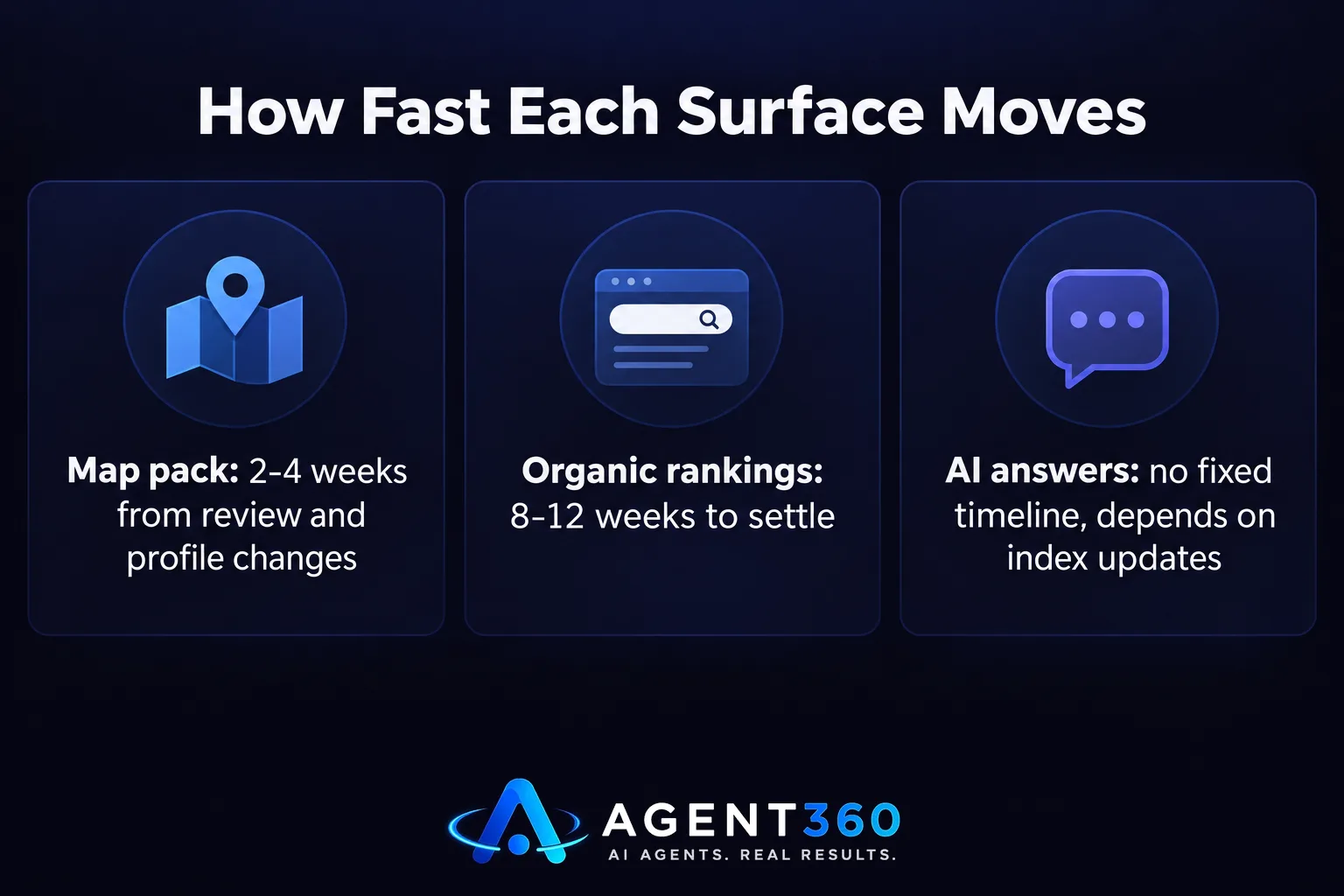
Map pack movement from review and profile changes can show up within two to four weeks. Organic ranking gains from new or improved pages typically take eight to twelve weeks to settle, longer still for competitive terms in a crowded town. AI answer changes have no fixed timeline — they depend on when each engine's index or model last updated.
Do I need a website if I already have a Google Business Profile?
Yes. The profile wins you map pack visibility, but not organic rankings or AI citations — both of those depend on content living on a site you control. A profile with no website behind it also leaves AI tools with nothing to cite when someone asks for a recommendation rather than runs a map search.
How many reviews do I need to rank in the map pack?
There's no published threshold, and anyone who gives you an exact number is guessing. What matters more than the total is recency and velocity: a steady stream of new reviews beats a big pile that stopped growing, and replying to each one does more for you than hitting any particular count ever will.
More articles
- Automated SEO for Small Business: What to Automate First
- An AI Blog Writer Won't Rank You. Here's What Will
- SEO Content Automation: What to Automate, What Not To
- What Is llms.txt and Do You Actually Need One?
- How to Appear in Google AI Overviews
- AI Visibility Tracking: What to Measure and How Often
- Track Brand Mentions in ChatGPT Without Fooling Yourself
- How to Get Mentioned by ChatGPT: A Practical Playbook
