SEO Agency Alternative: What Actually Replaces the Retainer
Stop looking for another agency. The honest answer to "seo agency alternative" is one of three things: someone on your own team doing the work with better tools, a platform that writes and publishes for you, or a hybrid where agents handle production and a person keeps it aimed at the right searches. Which one fits depends on how many pages you need written, how fast your rankings move, and whether you trust your team's drafts without a second set of eyes.
Are SEO agencies worth it?
For some businesses, yes. A competent agency running real technical audits, building real backlinks, and reporting honestly earns its retainer. The problem is structural, not moral. Agencies bill hours, and content is the easiest hour to bill. A $3,000-a-month retainer often buys two or three articles, a monthly call, and a report built from a tool you could rent yourself for a tenth of the price. You're paying for someone's time assembling the report, not for insight in it.
Here's a quick test. Ask your agency how many articles they publish a month and what each one actually costs you. Under five articles at more than $400 apiece, and you're paying agency margin on commodity writing. That gap is exactly what alternatives are built to close — see the full breakdown at SearchAgent vs an SEO agency.
What is SEO being replaced by?
Nothing is replacing SEO. The surface it's played on has split into three. A buyer researching your category now has three places to look: Google's ten blue links, the AI Overview Google writes above them, and a direct question typed into ChatGPT or Claude. Ranking well on the first no longer guarantees a mention in the second or third — those summaries pull from a different mix of sources and reward different signals, like being quoted cleanly and cited by name instead of just linked to.
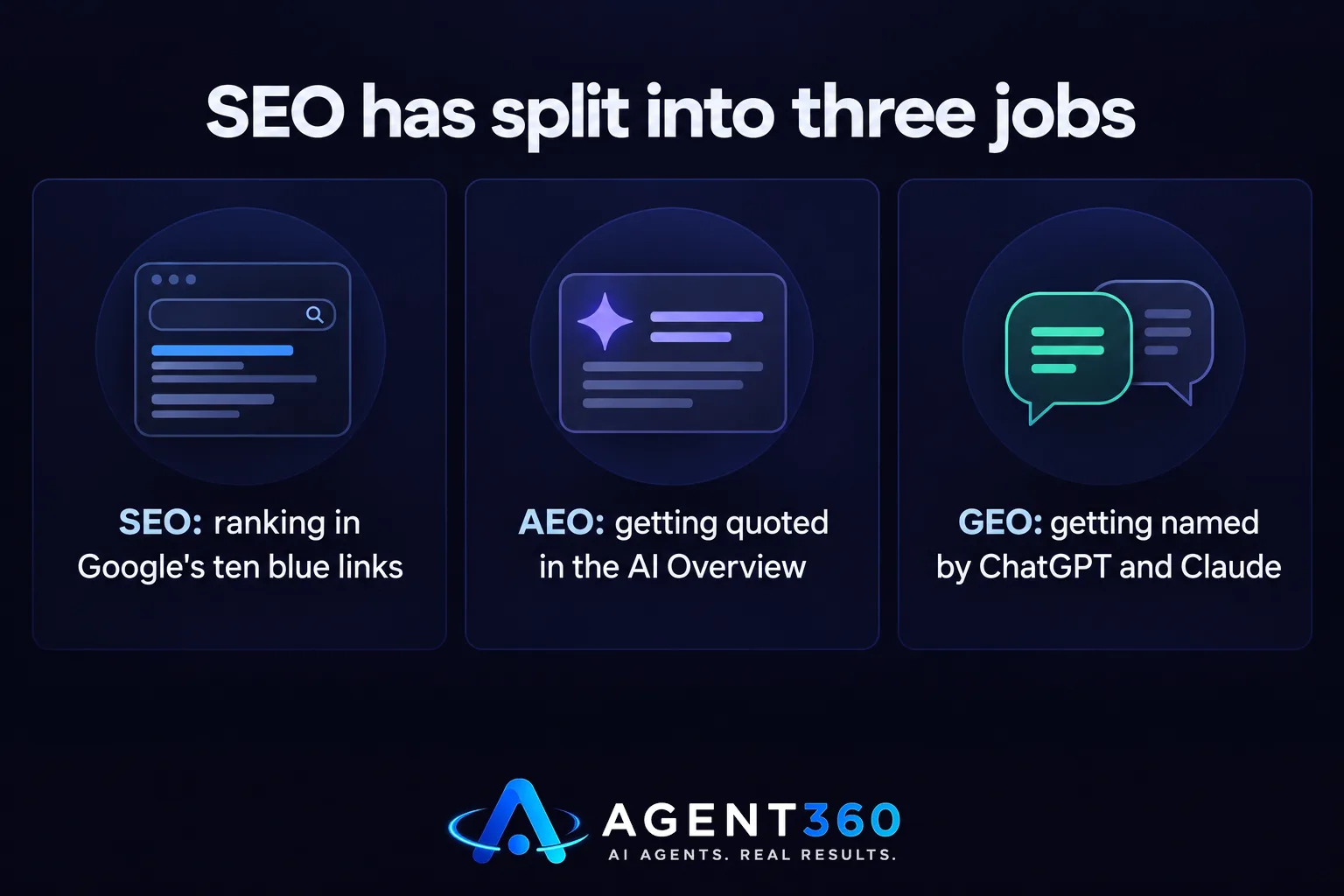
That's why "SEO" as one single service is getting harder to buy. The work has split into getting into the list (classic SEO), getting quoted in the summary (AEO), and getting named when an assistant makes a recommendation (GEO) — laid out in more detail in SEO vs AEO vs GEO. An agency built around link-building and on-page checklists may not touch the other two at all. That's a real gap, not a sales pitch.
Is SEO dead now with AI?
No. But the deliverable changed. Rankings on Google still drive most organic traffic for most businesses, and Search Console is still the ground truth for what's actually moving. What's dead is the idea that one blog post a month and a stray backlink add up to a strategy. If your buyers are asking ChatGPT "who's the best X for Y" before they ever open Google, and nobody checks whether you're named in that answer, you're optimizing for half the funnel. B2B buyers in particular now shortlist vendors through AI chat long before a demo call — a pattern covered in how B2B companies use AI visibility tracking.
What are some good alternatives, concretely
Three paths. Each has a real tradeoff.
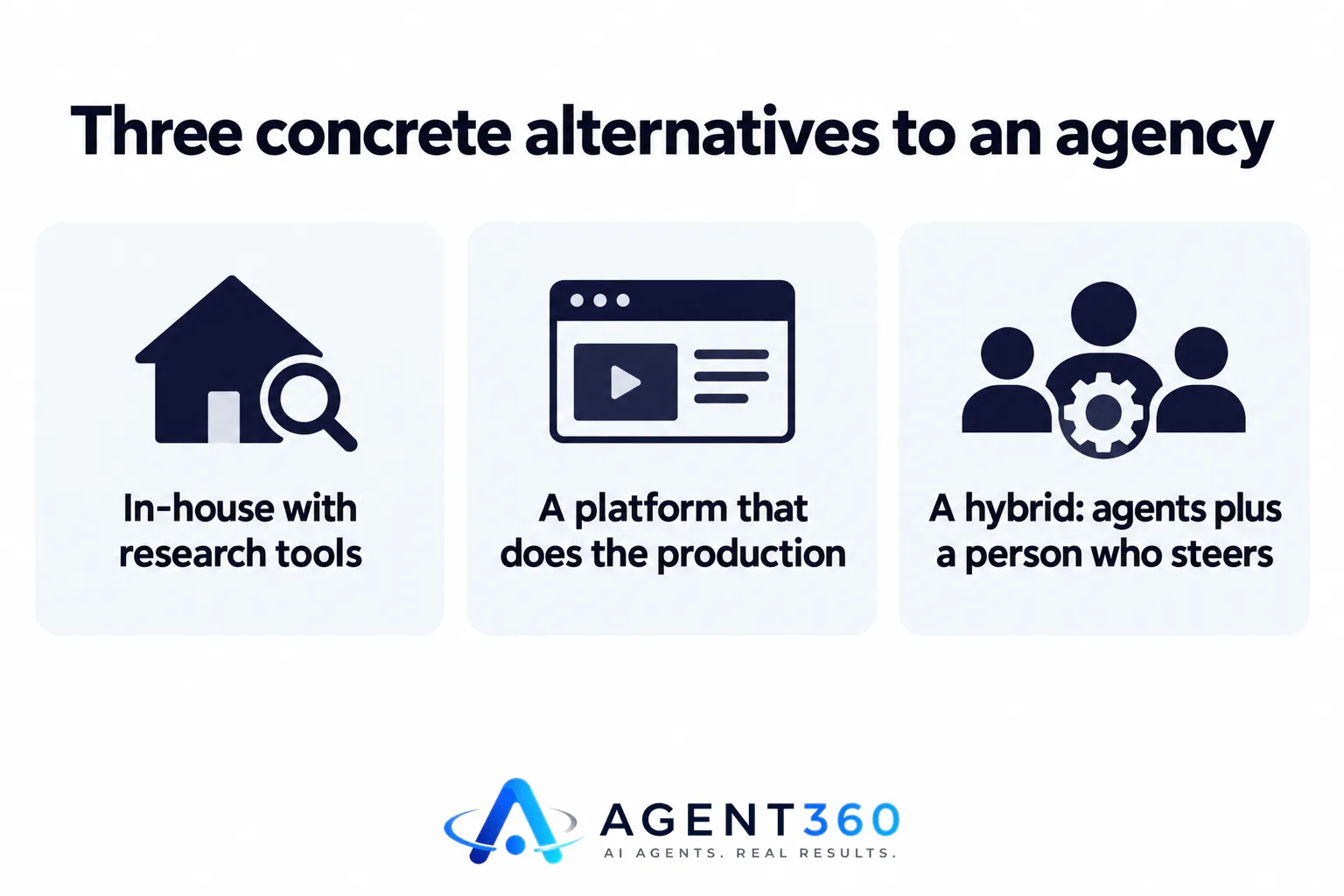
- In-house, with research tools. A marketer or two using a research suite like Ahrefs or Semrush for data, then writing and publishing by hand. Cheapest in software cost, most expensive in headcount hours. Works when you need under ten pages a month and someone on staff who writes well.
- A platform that does the production. Tools that research, write, and publish on a schedule, with a human approving before anything goes live. Removes the writing bottleneck but still needs someone deciding what to write about and watching whether it's working.
- A hybrid: agents plus a person who steers. Production runs on automation — research, drafting, publishing, refreshing stale pages — while a person on a kickoff call and a monthly review keeps the plan aimed at searches that actually convert, not just ones that are easy to rank for.
Most businesses outgrow option one around 15 to 20 articles a month. That's roughly where one person's writing capacity caps out without torching every other task on their plate.
Where a GA4-and-tools stack stops being enough
Here's a familiar pattern for teams trying to self-serve: they stitch together Google Analytics, Search Console, and a keyword research tool, then burn hours reconciling three dashboards that refuse to talk to each other. None of those tools can tell you whether ChatGPT named a competitor instead of you last week, because none of them ask ChatGPT anything. If your current stack can answer "are we ranking" but not "are we getting recommended," that's the actual gap an alternative needs to close — not a prettier dashboard for the data you already have.
This is the gap SearchAgent is built to close
SearchAgent runs as that hybrid option. It tracks your Google rankings from Search Console every night, asks your buyers' questions to ChatGPT, Claude and Google AI Overviews on a schedule, and its agents write, publish, and refresh the articles that close the gaps it finds — set up and run with a team, not left to a dashboard. Plans start at $297 a month on a month-to-month basis; full detail on what's included at each tier is at pricing.

How to decide this week, not this quarter
Pull your last three months of agency invoices and count actual published articles against total paid. Divide. Over $350 per article, with no backlinks or technical fixes thrown in that you couldn't do yourself, and you're paying for coordination, not output. Then ask ChatGPT and Claude the three questions your best customers would ask before buying from you, and note whether you're named. If you're not, that's not a content problem a bigger retainer fixes by default — it's a tracking gap most agencies never measure, covered in what AEO actually means.
Frequently asked questions
What are some good alternatives to SEO?
There's no alternative to SEO itself — buyers still search Google. The real choice is in how the work gets done: in-house with research tools, a platform that writes and publishes on a schedule, or a hybrid of automated production plus a person steering strategy.
What is SEO being replaced by?
Nothing replaces it outright; it's splitting into three jobs — ranking in Google's list, getting quoted in AI Overviews, and getting named by ChatGPT and Claude. A strategy built only for the first misses a growing share of how buyers now research.
Is SEO dead now with AI?
No. Google search still sends the bulk of organic traffic for most businesses. What changed is that AI answers are now a second channel worth tracking on their own, not a replacement for ranking well.
Are SEO agencies worth it?
For technical fixes and real link-building, often yes. For routine content production, the math rarely favors a retainer over automated writing plus a strategist checking the plan monthly. Run the per-article math on your own invoices before you renew.
More articles
- SEO for Local Businesses: Win the Map, the List, and the Answer
- Automated SEO for Small Business: What to Automate First
- An AI Blog Writer Won't Rank You. Here's What Will
- SEO Content Automation: What to Automate, What Not To
- What Is llms.txt and Do You Actually Need One?
- How to Appear in Google AI Overviews
- AI Visibility Tracking: What to Measure and How Often
- Track Brand Mentions in ChatGPT Without Fooling Yourself
