Repurpose Content for Social Media: The Rules That Work
One recorded sales call, cut right, can carry two weeks of posts. That's the whole idea behind repurposing content for social media: take something you already made — a webinar, a blog post, a sales call, a podcast — and cut it into the formats each platform actually rewards, instead of writing something new every single day. Done wrong, you post the same caption five times and wonder why engagement drops.
The difference is a system, not a mindset. Here are the two ratios worth using, what actually counts as a repurposed asset, and what it costs to automate the cutting.
The 5-5-5 rule turns one source into five formats across five days
The 5-5-5 rule puts a ceiling on how far you stretch one piece of source content before you need fresh material: five formats, from five minutes of recording, spread across five days. A customer call becomes a quote graphic on day one, a LinkedIn post on day two, a 30-second clip on day three, a carousel-style picture set on day four, a one-line X post on day five. It exists to stop two failure modes at once — recording once and never touching it again, or recording once and firing the identical clip at every platform the same morning.
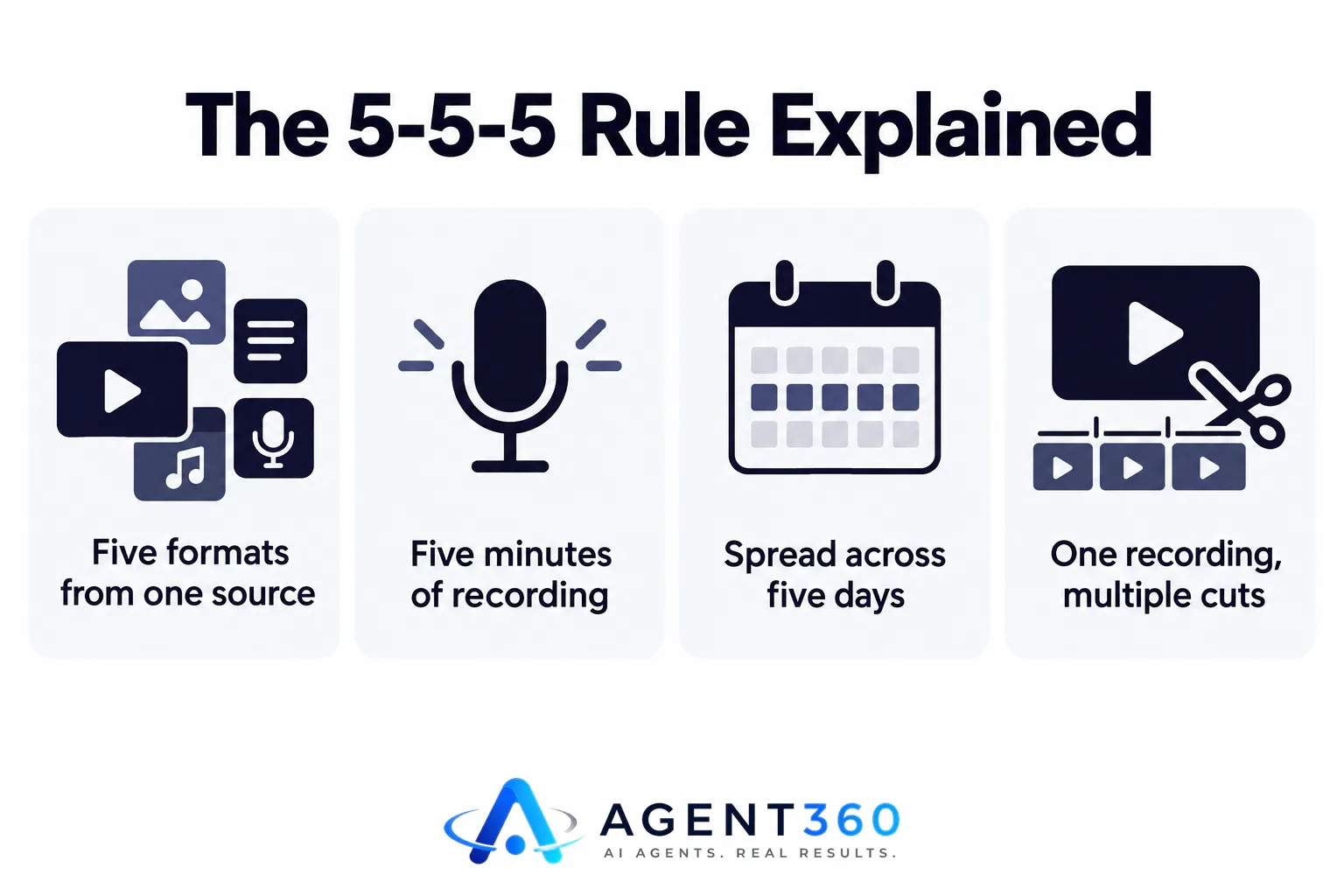
The number five isn't sacred. What matters is the shape — one recording, multiple cuts, staggered release. Get three usable formats out of a piece? Post three and move on. Force a fifth out of thin material and you get filler.
The 5:3:2 rule for social media posts balances teaching against selling
The 5:3:2 split applies to a batch of ten posts, not a single day: five teach something the reader can use without paying you a cent, three show opinion, behind-the-scenes or personality, and two pitch directly — a feature, an offer, a reason you're the right vendor. It's the same logic behind the old 80/20 rule, just split finer so founders stop lumping “value” and “personality” into one bucket.
Repurposing makes the ratio easy to hit, because one long piece of source material naturally produces all three types. A 40-minute webinar has a teaching segment, a few opinionated asides, and usually one moment where the speaker just describes what the product does. Cut those apart instead of publishing the whole thing as one post, and the ratio fills itself. The mechanics of that mix are covered in more detail in value vs pitch.
Examples of content repurposing that actually hold up
Not every reuse of old material counts as repurposing. Posting the same paragraph on three platforms is duplication, not repurposing — the format has to change to fit how people actually consume that platform. A few that hold up:
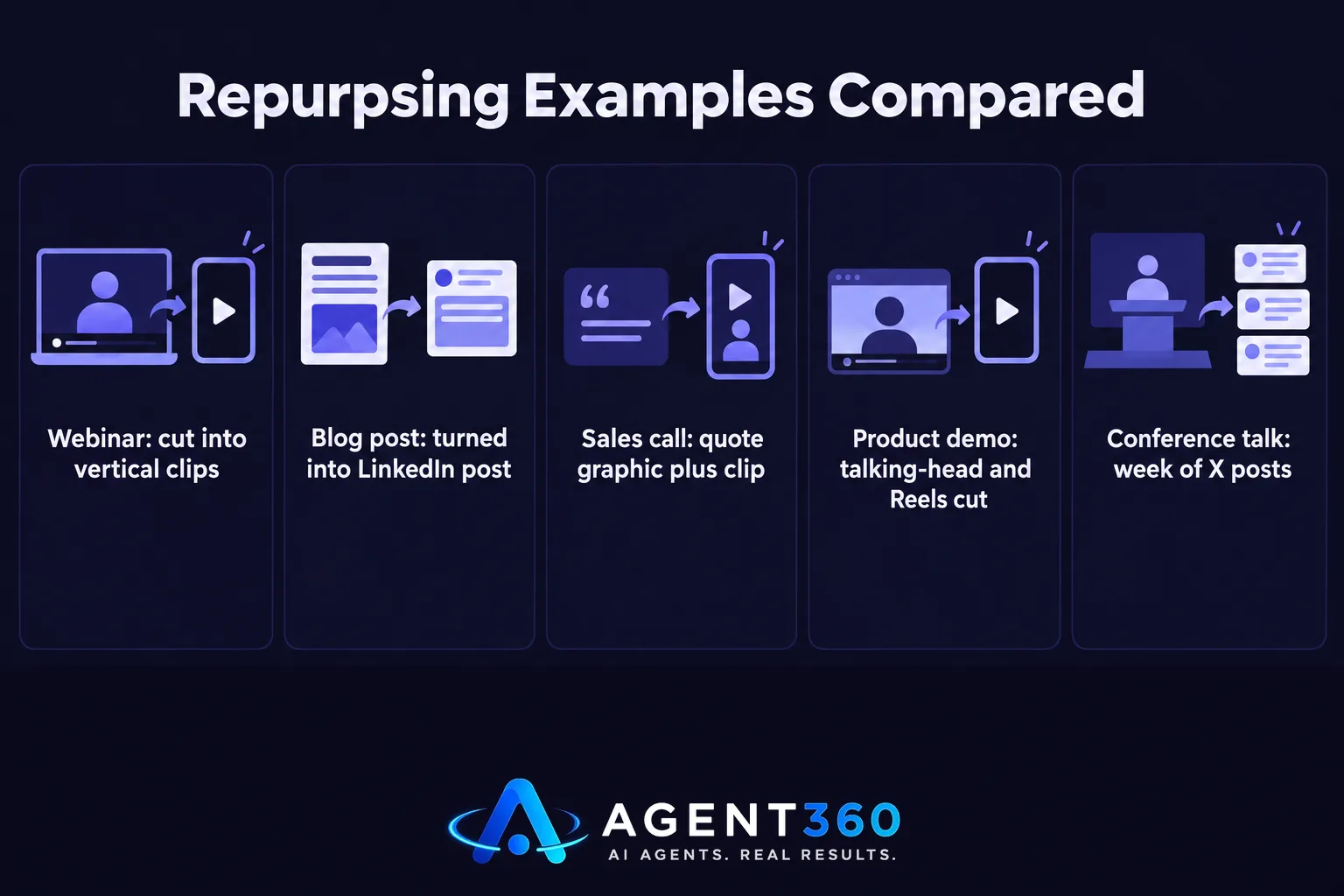
- A webinar recording cut into five to eight vertical clips, each built around one claim the speaker made, with its own caption and hook.
- A long blog post turned into a LinkedIn post that states the single strongest argument from the piece, with a picture pulled from its main point.
- A sales call or customer interview turned into a quote graphic plus a short clip of the moment the customer said it, rather than a paraphrase.
- A product demo recorded once and cut into a talking-head explainer for LinkedIn and a faster vertical cut for Reels and Shorts.
- A conference talk turned into a week of X posts, one per key point, instead of a single recap post nobody reads past the first line.
The pattern across all five: the source does the thinking, each platform just gets its own edit of the delivery. A single recording session genuinely holds more usable content than most teams publish in a month — the full breakdown is in one video, a month of clips.
How much does Repurpose.io cost per month?
Repurpose.io, like most third-party repurposing tools, prices on a tiered subscription based on how many pieces of source content and destination platforms you connect. The exact dollar figures change often enough that quoting one here would likely be wrong by the time you read it — check the vendor's current pricing page rather than trust a number in a blog post. What's worth knowing going in is the shape of that pricing, not the figure. Most tools in this category charge more as you add platforms or increase volume. And most of them move your finished clips and images to where you post them, but don't write the caption, draw the picture, or decide what to say — you still start from a script or a post you wrote yourself.
That's the gap worth checking before you commit to any tool, repurposing or scheduling: does it only move content, or does it also make it? A straight scheduler, compared on that basis, is covered in scheduling tools vs BrandAgent.
Where BrandAgent fits
BrandAgent's Clip Agent takes a webinar, podcast or interview and cuts captioned vertical clips from it automatically, writing a post to go with each one. Or it runs a guided interview that asks the questions out loud and turns every answer into its own clip — which solves the 5-5-5 rule's hardest part: having source material to cut in the first place. Clips, pictures and short videos are included from the Starter plan at $97 a month, and every clip still needs your approval before it goes live. Details on how the cutting works are at clips and interviews.

Questions worth answering before you start repurposing
Do I need a full studio setup to get five formats out of one recording? No. A phone recording of a sales call, a Zoom webinar, even a voice memo of you talking through an idea — all of it works. Repurposing is an editing job, not a re-shooting job, and the quality bar for the source is lower than people assume.
How long should the source content be? Fifteen minutes is usually enough for two or three usable clips. Forty-five minutes to an hour gets you a full week of mixed formats. Shorter sources just mean fewer formats, not worse ones.
Should every platform get the same message, repurposed? No. Repurposing means the same underlying idea delivered in whatever format that platform rewards — a 280-character point on X, a fuller argument on LinkedIn, a visual cut on Instagram. Paste the same paragraph everywhere and you haven't repurposed anything, you've just copied it.
More articles
- YouTube Shorts for Business: The Rules That Get Views
- How Often to Post on LinkedIn: The Rules That Actually Matter
- Social Media Content for Small Business: The Rules That Work
- Brand Voice AI: What It Means and What It Can’t Fake
- What an AI Short Video Maker Needs to Actually Work
- The Honest Guide to AI Video Generators for Social Media
- LinkedIn Ghostwriting: What It Really Costs and How It Works
- An AI Content Calendar Only Works With Rules Behind It
