Social Media and Website Management for Small Business

A busy social feed pointing at a stale website is the most common way small businesses spend money on marketing and book nothing. Social media and website management is two recurring jobs with one purpose: the website keeps your facts, speed and booking path correct, and social media sends people to it. Pay for them separately and that mismatch is what you buy. Treat them as one system, with posts feeding pages that take bookings, and the work gets smaller and the results become measurable.
Fix the website before you post anything
This will annoy anyone selling a posting package: if your site is slow, out of date or has no clear way to book, more posts just make the problem more expensive. Every post is an invitation to click. If the click lands on last year's hours, a contact form nobody checks, or a phone number buried in the footer, you paid to send people to a dead end.
A fair test takes five minutes. On your phone, on mobile data and not Wi-Fi, do the following:
- Open your site from a social post. Does the page load before you lose patience?
- Find your price, or at least a starting point, without scrolling past three screens of stock photos.
- Book, call or submit the form. Does anything happen within a minute, and do you get a reply?
If any of those fail, the site is the first job. Our piece on builder, cost or done-for-you websites covers how to choose the route that fits.
Website management is six recurring tasks, not a vague promise of maintenance
When a vendor says they will manage your website, ask them to name the tasks. A real answer looks like this:
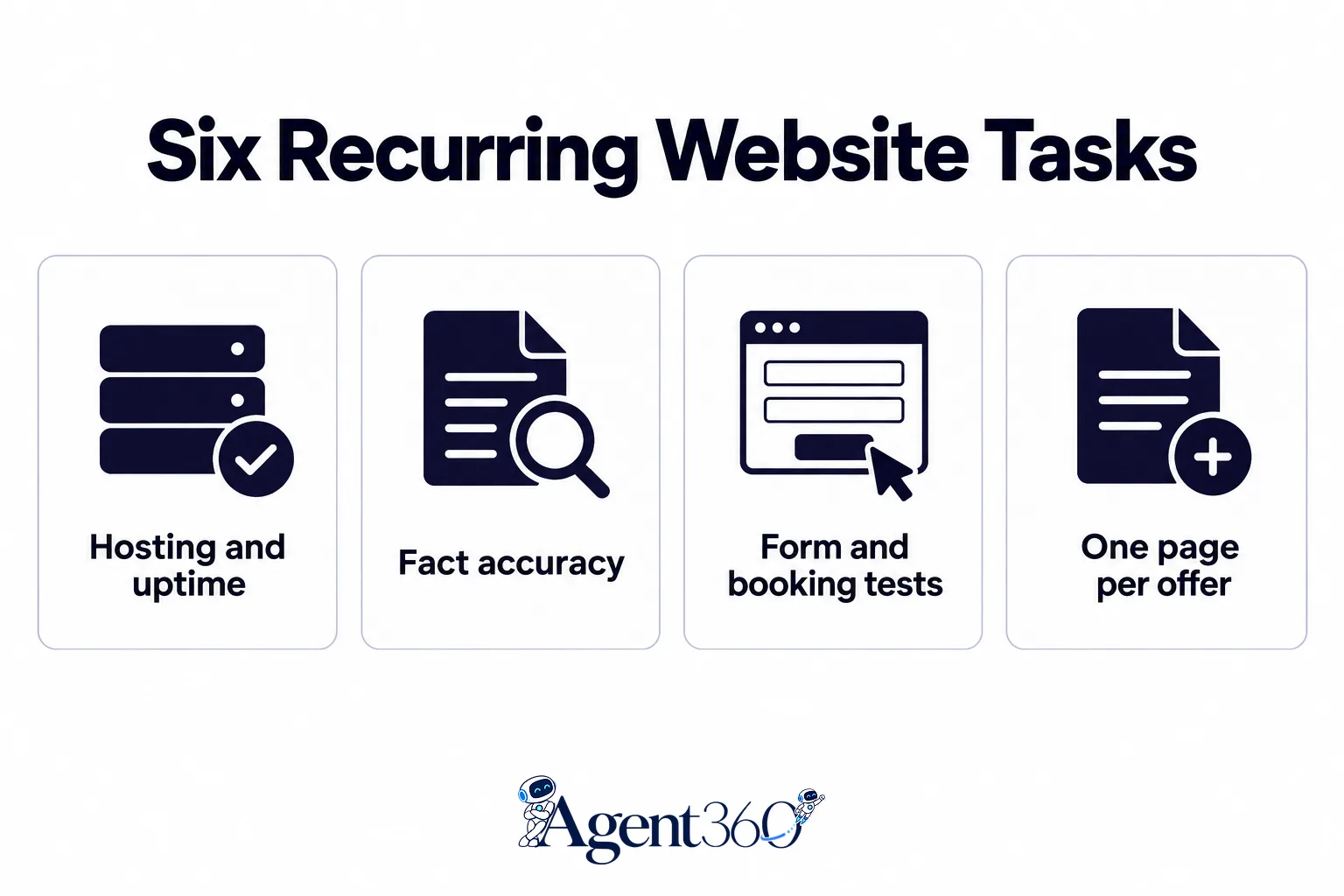
- Hosting and uptime. The site stays online and loads fast, and someone owns the problem when it does not.
- Fact accuracy. Hours, services, prices, staff, service areas and holiday closures change. The site, your Google Business Profile and your social bios must all say the same thing.
- Form and booking tests. Once a month, someone submits your own form and confirms it reaches a person and triggers a reply. Forms break quietly. You find out when a customer mentions it.
- One page per offer. A campaign or a seasonal promotion gets its own landing page with a single action, not a link to the homepage.
- Content that keeps ranking. New service pages and articles that answer what local customers actually search for, refreshed when they go stale.
- Changes made in days, not weeks. If swapping a price takes a support ticket and a fortnight, the site will drift out of date.
Notice what is missing: yearly redesigns and plugin updates you never see. Those are the vendor's housekeeping, not your outcome. Judge the work by the six items above.
Social media management is a weekly rhythm, and ten good posts beat thirty filler ones
Frequency advice is mostly folklore, and nobody can honestly hand you a universal number. Our view, which you are free to disagree with: for a local business, a small number of posts with a clear job each month beats a daily stream of filler. Your audience is a few thousand people within driving distance, not the internet.

Give each post one of three jobs:
- Proof. A finished job, a before and after, a happy regular, a team member at work. This is what a stranger checks before trusting you.
- Answer. A direct reply to a question you get every week: how long it takes, what it costs roughly, what to do before the appointment.
- Offer. A specific, time-boxed reason to act now, with one link to one page.
A simple month: four proof posts, four answer posts, two offer posts.
If you cannot fill the proof slots, that tells you something. You need a habit of capturing photos and permission on the job, and that is a front-desk or crew task, not a marketing one.
Every post needs a destination you can count
Likes and follower counts feel good and pay no rent. The number that matters is how many people who clicked a post then booked or called. That takes two things: a distinct page or tracked link for each offer, and a record of where each lead came from.
Without that, you will argue about whether social works based on gut feeling. With it, the pattern shows up fast. Perhaps answer posts bring bookings and offer posts bring only discount hunters. Perhaps Instagram brings enquiries but Facebook brings the people who actually show up. You can only shift effort toward what works if the lead record names the source.
Then there is what happens after the click. A visitor who fills in a form at 9 p.m. and hears nothing until noon has probably contacted someone else. We go through that in lead follow-up for small business, and it matters as much as the post that brought them.
Decide who does it by counting hours, not by hoping
There are four ways to run this, and each has a failure mode:
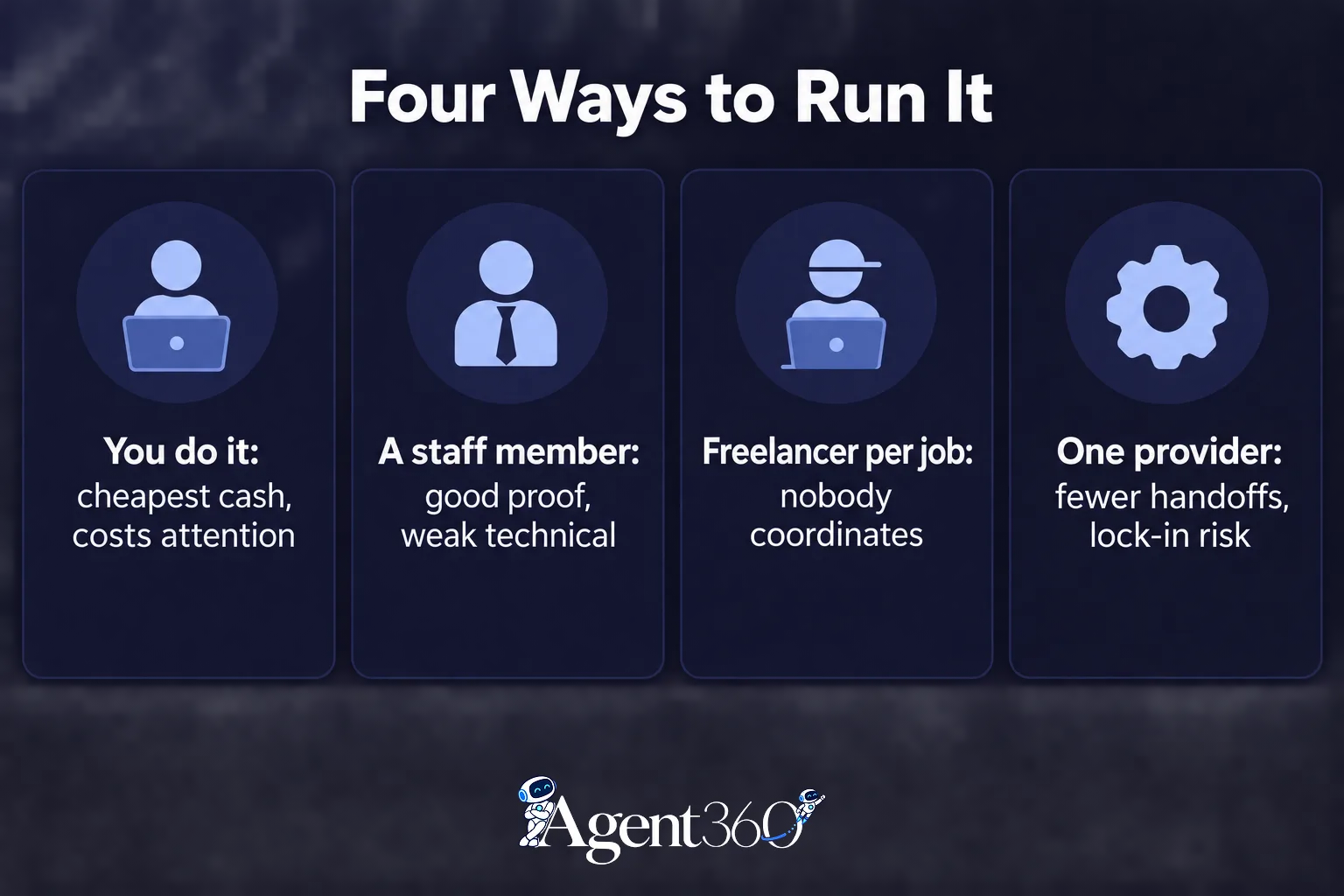
- You do it. Cheapest in cash, most expensive in attention. It works until a busy week hits, and then the feed goes quiet for a month. Choose this only if you will honestly protect a fixed weekly block.
- A staff member. Good for proof content, since they are on site. Weak on website changes and anything technical, and the knowledge walks out the door with them.
- A freelancer for each job. A web person and a social person who never speak. This is where the stale-site, busy-feed problem comes from, and someone, usually you, has to coordinate them.
- One provider for both. Fewer handoffs and one place to look when something breaks. The risk is lock-in, which is why the ownership rules below matter. We compare the tradeoffs in all-in-one agency vs. separate vendors.
A rough rule: if the owner is doing it and it is not their strength, price those hours at what you would bill for them. It usually comes to more than the retainer.
Four things to demand from whoever manages it
- Ownership. Your domain in your name, your site and your leads and customer list yours, including if you cancel. If a provider cannot say this plainly in writing, walk away.
- Approval you control. Posts written in your voice, with the choice to approve each one or review a monthly summary. Nobody should publish on your behalf without a way for you to see it.
- A report about leads. Reach and impressions are fine as context. The report has to show enquiries, bookings and cost per lead by source.
- No promised rankings or viral results. Nobody controls the algorithms. Commit to deliverables you can verify: posts published, pages updated, leads answered, a clear monthly report.
Our guide on what you still do when marketing is done for you spells out the owner's share. It is smaller than most people expect, but never zero.
Where Booked fits
Booked treats the website and the social feed as one job on a single monthly price. We build and host the site and keep it current. We publish your social posts every week in your voice, from a brand kit built on one kickoff call, and give each campaign its own landing page. A person on our team checks every post and ad before it goes out, and you can approve each one first or review the monthly report. Starter is $297 a month with 10 social posts, and Pro and Scale raise that to 20 and 40. Plans are month to month, with no setup fee, and you keep your domain, site, leads and customer list. See the pricing page for the full plan breakdown, or the Convert service for how the site and landing pages are built to take bookings.
Questions people ask
How much does website and social media management cost for a small business?
Price it by deliverables and hours, not by a headline number. Ask what is included each month: how many posts, how many site updates, whether hosting is covered, whether ads and landing pages are part of it, and whether you will get a report that ties leads to sources. Two separate retainers for site and social usually cost more and need more of your coordination than one bundled price. Still, compare line by line before assuming.
Should one company manage both my website and my social media?
Usually yes, for a local business. Posts need pages to land on, and pages need traffic, so splitting them creates a handoff where things get lost. The condition is ownership: you must keep your domain, site, accounts and leads, so switching providers never means starting over.
How often should a small business post on social media?
As often as you can make each post do a job: proof, an answer to a common question, or a specific offer with one link. For many local businesses that is a handful of posts a week at most, and a few good ones beat a daily stream of filler. Count the leads each source brings and let that set your pace, not a rule of thumb.
More articles
- Local Business Website and Marketing: What to Buy First
- Booked vs Outreach: a fair, side-by-side comparison
- Booked vs Clicksgeek: a fair, side-by-side comparison
- Booked vs Digitaldomination: a fair, side-by-side comparison
- Booked vs Businessallinone: a fair, side-by-side comparison
- Booked vs Scorpion: a fair, side-by-side comparison
- Booked vs Instantly: a fair, side-by-side comparison
- Booked vs BrightLocal: a fair, side-by-side comparison
