Local Business Website and Marketing: What to Buy First
Local business website and marketing is three jobs: get found by someone ready to buy, turn that visit into a call or booking, and reply before a competitor does. You pay for it in two places. One is a build and monthly work fee. The other is an ad budget that goes straight to Google or Meta. Most owners overspend on the first job and ignore the third, which is backwards.
The 3-3-3 rule for marketing is not a rule, so use a three-job check instead
People searching for the 3-3-3 rule for marketing land on several different things: formulas for content, for outreach cadence, for ad testing. None is an official standard, and no one owns the term. Be suspicious of anyone who presents it as settled. (The fitness-studio version is picked apart in Why the 3-3-3 Rule Falls Short.)
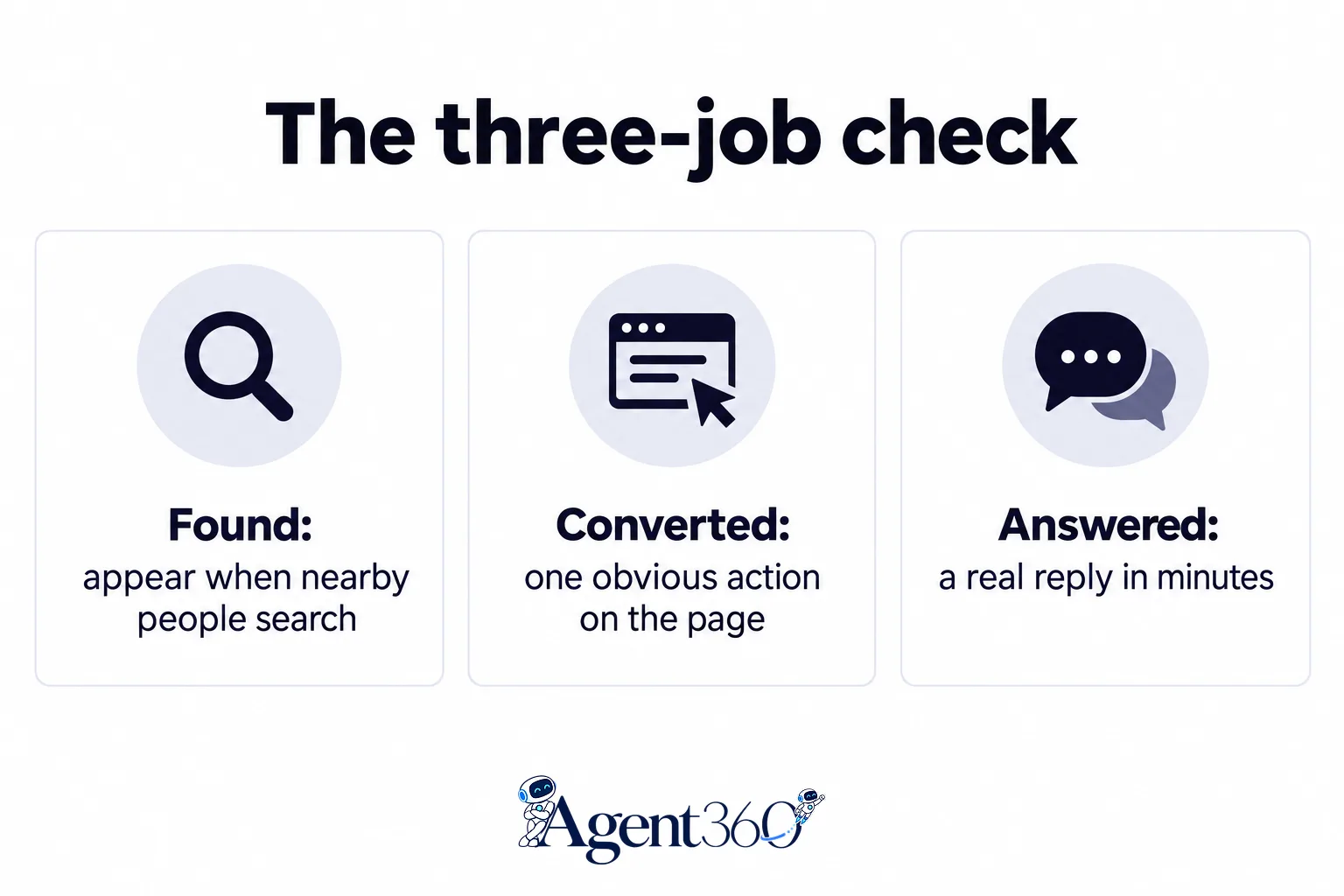
If you want a rule you can actually audit, use this one. Your marketing works only if all three of these hold:
- Found: when someone nearby searches for what you do, in Google, in Maps or by asking an AI assistant, you appear.
- Converted: the page they land on makes one action obvious: call, book or send the form. Not five actions.
- Answered: every inquiry gets a real reply in minutes, at night and on weekends too.
Test yourself this week. Search your own service and city on your phone. Tap into your site and time how long it takes to find the booking button. Then fill in your own contact form at 9 p.m. and see when you hear back.
Whichever step fails is where the next dollar goes. Not a new logo. Not more posts.
How much does website marketing cost? Price three separate things
The confusion about cost comes from vendors rolling three different expenses into one number.
- The build. A site, a Google Business Profile, tracking and a booking or contact path. Some agencies charge this as a large upfront fee, some fold it into the monthly price. Ask which.
- The ongoing work. Search optimization, content, ad management, reporting, and fixing things when they break. This is a monthly cost and it is where quality varies most.
- The media. The money paid to Google and Meta for clicks and impressions. It should come out of your own ad account, not through a vendor who marks it up, so you can see every dollar.
When you compare quotes, line them up on those three. A cheap monthly fee with a large setup fee and a 12-month contract is not cheap. A low fee that quietly includes no ad management is not a package. It is a hosting plan.
Four questions expose most bad deals. Do I own the domain and the site if I leave? Is there a contract? Is ad spend billed to me directly? Can I see which lead came from which ad? For a longer look at how much to set aside overall, read Small Business Marketing Budget: What to Actually Spend.
How do I advertise my business locally online? Go in this order
Most owners start with social posts because they are free and feel productive. But posts rarely close a customer who is searching today. Sequence your spending by buying intent instead.
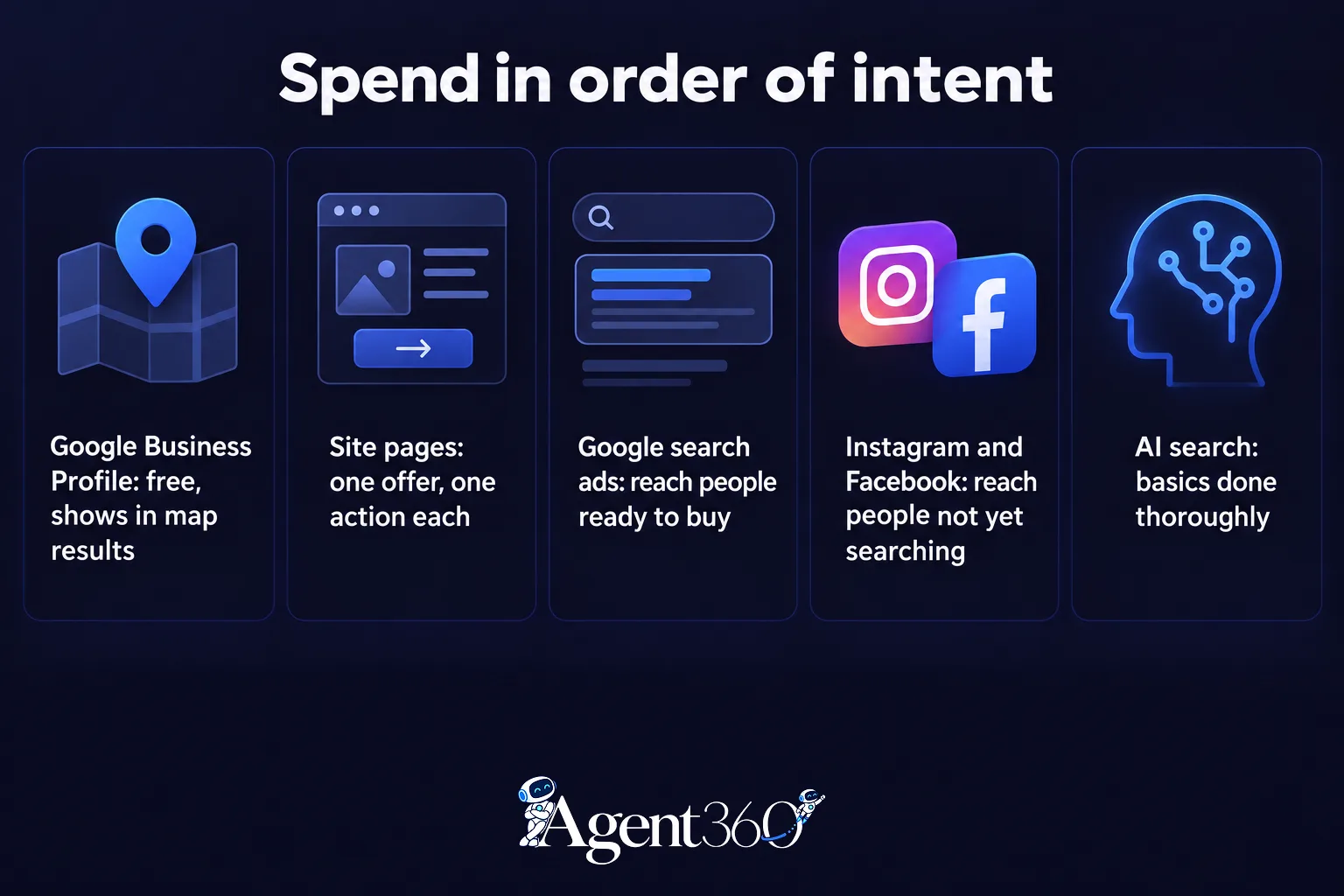
First: your Google Business Profile
Correct categories, hours, service area, photos and a steady flow of reviews. This is what shows in the map results, and it costs nothing but attention. How to Get Found on Google Maps, Not Just Listed covers what moves it.
Second: a site with one job per page
Your home page can be broad. Your ad landing pages should not be. One offer, one action, a phone number that can be tapped, a form with as few fields as you can get away with. Run an ad for emergency repairs that lands on your general home page, and you are paying twice for the same confusion.
Third: search ads for people ready to buy
Someone typing your service plus your city has already decided they need it. Google search ads reach them at that moment, and can start producing inquiries as soon as they run. Organic ranking, by contrast, builds over months. Start with a budget you can sustain long enough to learn from, and cap it. The mechanics are in Google Ads for Local Business: What a Real Budget Looks Like.
Fourth: Instagram and Facebook for people not yet searching
Meta ads reach local customers before they search. They suit services people buy on impulse or on a schedule, and they are the right tool for retargeting visitors who looked and left. Don't expect them to behave like search. Intent is lower, so the reply and follow-up matter more.
Fifth: AI search
People now ask ChatGPT and Google AI who to hire. The signals behind those answers are mostly the ones above: consistent business details, reviews, clear service pages and content that answers real questions. There is no separate trick. You just need the basics done thoroughly.
Fix the reply before you buy more traffic
Here is the claim some marketers will argue with: if you answer inquiries slowly, adding ad budget is a waste. A lead who filled in forms with three businesses will usually go with whoever responds first. Every dollar that sends a lead into an unanswered inbox is lost, and you will blame the ads.

The fix is not heroic. Send an instant text and email acknowledgement to every form fill. Text back anyone who hits voicemail. Put the booking link in that first message so the customer can finish without waiting for you. The reasoning behind the speed is laid out in Speed to Lead: Why the First Five Minutes Decide the Sale.
Where Booked fits
Booked is the done-for-you version of everything above, on one monthly price. Starter is $297 a month and includes your website, SEO, local SEO and Google Business, AEO and GEO for AI search, Google, Instagram and Facebook ads managed by us on up to $1,500 a month of ad spend, landing pages, retargeting, instant text and email replies to every lead, online booking with deposits, and a live dashboard that shows which ad or search produced which lead. Pro at $497 adds 24/7 AI phone answering and a dedicated Customer Success manager, and Scale at $597 covers up to 3 locations with no ad cap. There is no setup fee and no contract. Ad budget is paid to Google and Meta directly, and you keep your domain, site and customer list if you leave. See the pricing page, the Respond service for the reply side, or book a strategy call.
Questions people still ask
Does selling websites to local businesses actually work?
As a standalone product, a website rarely changes a local business by itself. A site with no traffic and no fast reply to its form produces nothing. It works when it is sold with the traffic and follow-up attached. If you are the owner being pitched a site alone, ask who sends the visitors and who answers the inquiries.
How long before local website marketing produces leads?
Paid ads can produce inquiries within days of launching, though they need a few weeks of tuning. Organic search and AI recommendations build over months and depend on competition in your area. Be wary of any vendor who guarantees a ranking or a lead count, since nobody controls Google.
Do I need a new website to start?
Not necessarily. If your current site loads fast, is easy to edit and already brings in inquiries, improve it in place. If it is slow, hard to update, or has no clear booking or call action, replacing it is usually cheaper than advertising to it.
More articles
- Social Media and Website Management for Small Business
- Booked vs Outreach: a fair, side-by-side comparison
- Booked vs Clicksgeek: a fair, side-by-side comparison
- Booked vs Digitaldomination: a fair, side-by-side comparison
- Booked vs Businessallinone: a fair, side-by-side comparison
- Booked vs Scorpion: a fair, side-by-side comparison
- Booked vs Instantly: a fair, side-by-side comparison
- Booked vs BrightLocal: a fair, side-by-side comparison
