Booked vs Hibu: a fair, side-by-side comparison
Put Booked and Hibu side by side and the service lists look almost identical, so the real comparison is in the terms. Both sell local marketing to small businesses. What differs is how long you are tied in, who owns the website and ad accounts, where the ad money goes, and whether you can see which dollar produced which booking. Below are the tests to run on any vendor, Hibu included.
One limit up front. We do not have Hibu's current price sheet or contract in front of us, and its packages change. So where this post compares, it tells you what to ask Hibu to put in writing. We state facts only about Booked.
Judge Hibu on its contract, not its reputation
“Is Hibu a reputable company?” is a fair question. It won't settle your decision, though. A well-known, long-established company can still sell you an agreement that is wrong for a business your size, and a small unknown one can be completely upfront. Reputation tells you whether they will show up. The contract tells you what happens when the results disappoint.
Do the reputation check properly, then move on:
- Read recent customer reviews on more than one site, and weigh complaints about billing and cancellation separately from complaints about results. Those are different problems.
- Ask for two references in your trade and your region. A sales rep who cannot produce them has told you something.
- Search the company name plus “cancel” and plus “website ownership”. The pattern of what people complain about shows you where the friction is.
Then ask for the full agreement, not the proposal, before you agree to anything.
Five terms decide whether a marketing deal is fair
Run any provider through these five. Good answers to all of them count for more than a long feature list.
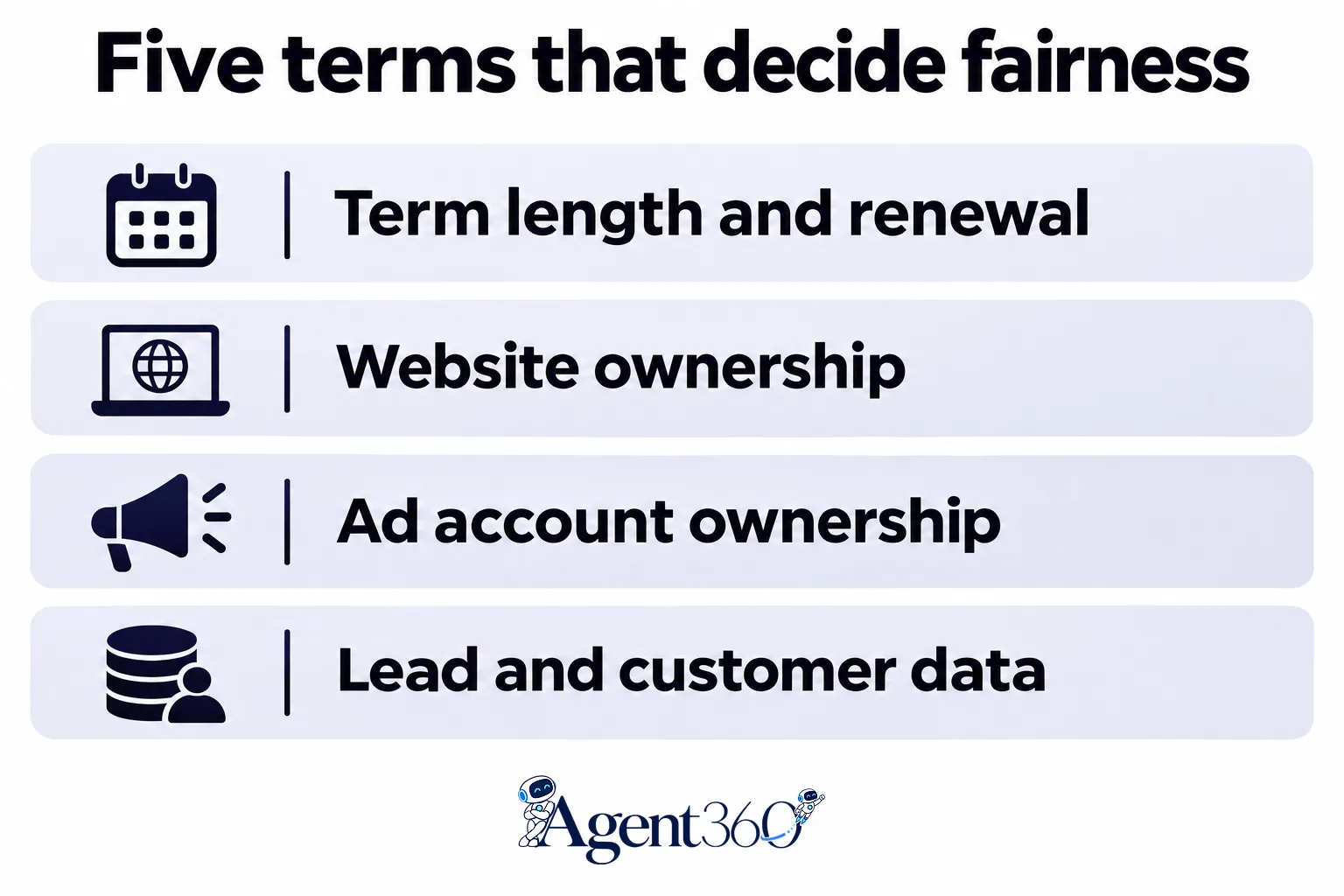
- Term length and renewal. Is it month to month, or a fixed term? Does it renew automatically, and how many days before renewal must you give notice?
- Website ownership. If you leave, do you keep the site, the domain and the content? Or does the site live on the vendor's platform and stay behind?
- Ad account ownership. Are the Google and Meta ad accounts in your name, with you paying the platforms directly? Or does the vendor bundle your ad budget into one invoice and hold the accounts?
- Lead and customer data. Do you get the leads, call recordings and customer list on exit?
- Reporting. Can you see each lead, the ad or search that produced it, what it cost and whether it turned into a booking? Or do you get a summary of impressions and clicks?
The third one is the quiet trap in this category. Fold your ad budget into the monthly fee and you can't easily tell how much reaches the ad platform and how much is the vendor's margin. Ask for the split in writing, and for admin access to the ad accounts.
Getting out of a Hibu contract starts with the paper you signed
We can't tell you your exit terms. They are in your agreement, and we have not read it. This is not legal advice, but the order of operations is the same for any marketing contract:

- Find the signed agreement and any renewal notice. Look for the term, the renewal clause and the notice period. Put the notice deadline in your calendar today.
- Check what you are actually paying for. Compare the invoice against the services listed. If something promised is not being delivered, note it with dates. That gives you something concrete to point to in a conversation, and it matters if there is a dispute.
- Give notice in writing, the way the contract says. Use the method it names, whether that is email, certified mail or a form. Keep proof of when you sent it. A phone call with a rep does not count as notice unless the contract says it does.
- Secure your assets before you cancel. Get your domain registered in your name, admin access to Google Business Profile and the ad accounts, a copy of your site content, and an export of your leads. Do this first, because access can get harder once you give notice.
- Line up the replacement before the old one ends. Gaps in your Google Business Profile and ads cost you calls.
If the agreement and the rep's version of events disagree, the agreement wins. If you think you were misled at signing, talk to a local attorney or your state's consumer protection office. A blog post is not the place to settle that.
Hibu competitors fall into three groups, and they are not interchangeable
Search “Who are Hibu competitors?” and you mostly get a flat list. Sorting by model is more useful, because each model fails in a different way.
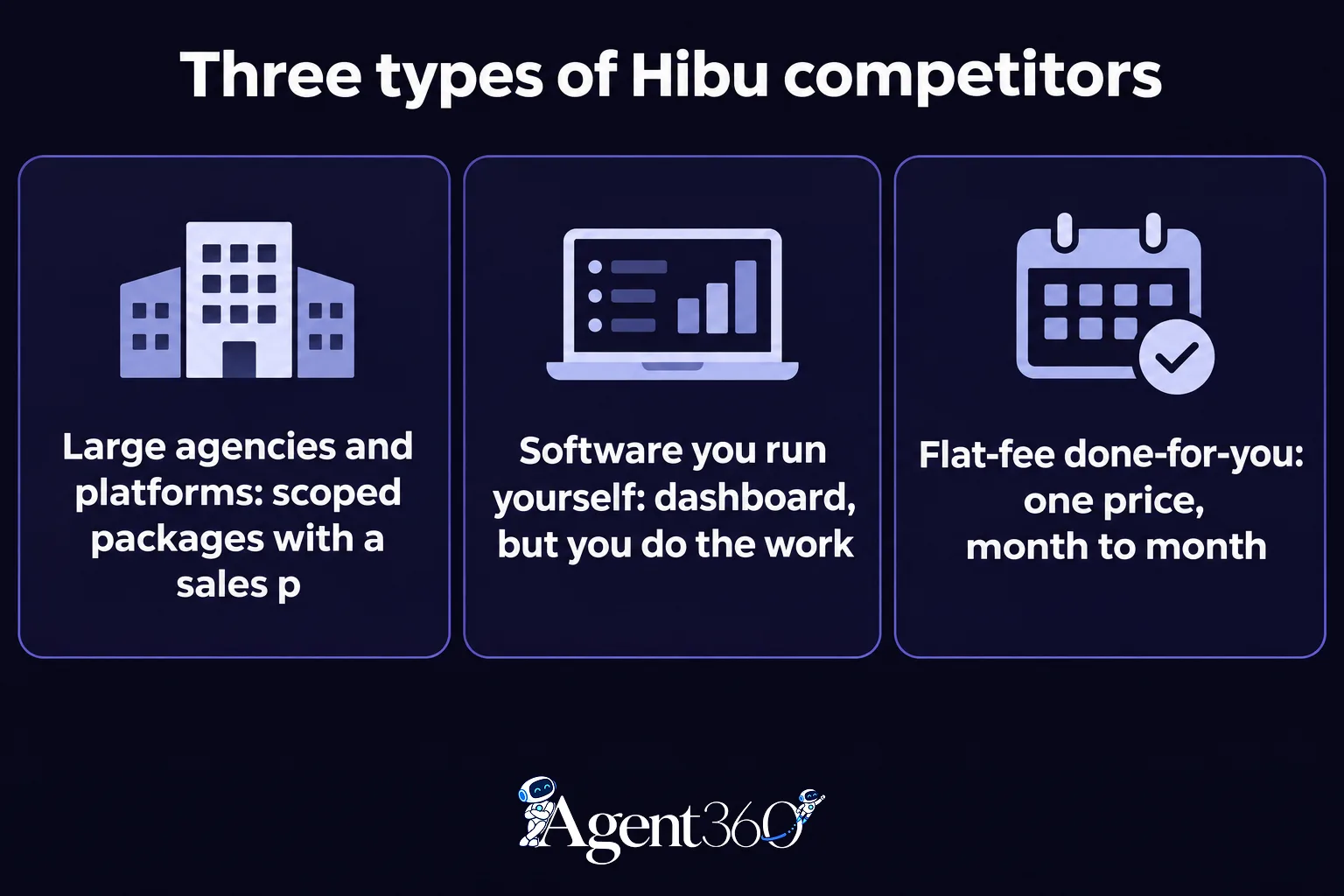
- Large agencies and local marketing platforms. Scorpion, Thryv and LOCALiQ sit here. They usually sell scoped packages with a sales process. See our side-by-sides for Scorpion and Thryv, and our post on cheaper alternatives to Thryv or LOCALiQ.
- Software you run yourself. Tools like BrightLocal or Vendasta's platform give you or your agency the dashboard, but someone still has to do the work. Fine if you have a marketer in-house. A poor fit if you are the marketer. See BrightLocal and Vendasta.
- Flat-fee, done-for-you services. One price, one team, month to month. This is where Booked sits.
Weighing one team against several vendors? All-in-one versus separate vendors covers the tradeoff.
The side-by-side to fill in before you sign anything
Copy these rows, fill in Booked's column from below, and make Hibu fill in theirs with documents, not answers on a call.
- Monthly price, all-in: what you pay for the work, separate from ad spend.
- Setup fee: yes or no, and how much.
- Term: month to month, or fixed.
- Who holds the ad accounts: you or the vendor.
- Who owns the site and domain on exit: you or the vendor.
- What happens to a new lead: how fast it gets a reply, and who sends it.
- Booking: can a customer book and pay a deposit, or only call or fill a form?
- Reporting: lead-level, or summary-level.
Any row where the answer is “it depends” and nobody will write it down? Be skeptical.
Where Booked fits, and where it does not
Booked is a done-for-you website and marketing service for local businesses, running on the Agent360 platform. Plans are $297, $497 and $597 a month. There is no setup fee and no contract, so you can cancel any time. Each plan includes the website, SEO, AEO and GEO for AI search, managed Google, Instagram and Facebook ads, landing pages, retargeting, an instant text and email reply to every lead, online booking with deposits, a waitlist, review requests, a CRM and a live dashboard.
Against the five terms above:
- Ad accounts: your ad budget is paid directly to Google or Meta from your own account. Our fee covers running the ads.
- Ownership: your domain stays in your name, and the website, leads and customer list are yours, including if you cancel.
- Reporting: your dashboard shows every lead, the ad, search or post it came from, what it cost and whether it booked.
- Guarantees: we do not guarantee rankings or results. We commit to the work: every lead answered in seconds, posts and ads going out weekly, and a monthly report.
Two honest limits. We do not connect to third-party booking platforms, so if your business is built around existing booking software, you would move to our booking page rather than keep both. And Starter manages ad spend up to $1,500 a month, so a larger ad program means a higher plan or a custom scope. To check the fit, book a strategy call.
FAQ
Is Hibu a reputable company?
Hibu is a long-running local marketing provider, but reputation alone should not decide it. Check recent reviews on several sites, ask for references in your trade, and read the full contract for term length, renewal and who owns your website and ad accounts before you sign.
Who are Hibu competitors?
They fall into three groups: large agencies and local platforms such as Scorpion, Thryv and LOCALiQ; software you run yourself such as BrightLocal and Vendasta; and flat-fee done-for-you services such as Booked. Choose by model, because the failure modes differ.
How do I get out of a Hibu contract?
Read your signed agreement for the term, renewal clause and notice period, then give written notice in the exact way it requires and keep proof. Before you do, secure your domain, ad account access and lead data. For disputes, consult a local attorney or your state's consumer protection office.
More articles
- Social Media and Website Management for Small Business
- Local Business Website and Marketing: What to Buy First
- Booked vs Outreach: a fair, side-by-side comparison
- Booked vs Clicksgeek: a fair, side-by-side comparison
- Booked vs Digitaldomination: a fair, side-by-side comparison
- Booked vs Businessallinone: a fair, side-by-side comparison
- Booked vs Scorpion: a fair, side-by-side comparison
- Booked vs Instantly: a fair, side-by-side comparison
