Who Can Get You Recommended by ChatGPT and Google AI

You cannot buy your way into a ChatGPT recommendation. There is no ad slot for it, no listing fee, no account rep who flips a switch. ChatGPT, Google AI Overviews and Perplexity build their answers from what is already public about your business: your website, your Google Business Profile, your reviews, and anywhere else your name and services get mentioned. Whoever can get you recommended is whoever controls and keeps consistent all three of those at once — which is usually not your web designer, not your ad agency, and not you working alone on a Saturday.
That is the real answer. The rest of this is what the work actually involves, what it costs, and whether it is worth doing before you hire anyone.
How can I get AI to recommend my business?
AI answer engines do not crawl the web live when you ask a question. They work from an index built ahead of time, weighted toward pages that are specific, cited elsewhere, and structured so a machine can pull a clean fact out of them — a price, an hours range, a service area, a direct answer to a direct question. A page that says “we pride ourselves on quality service” gives the model nothing to quote. A page that says “we replace water heaters in [city] same-day, typically $1,200–$1,800 installed” gives it something to cite.
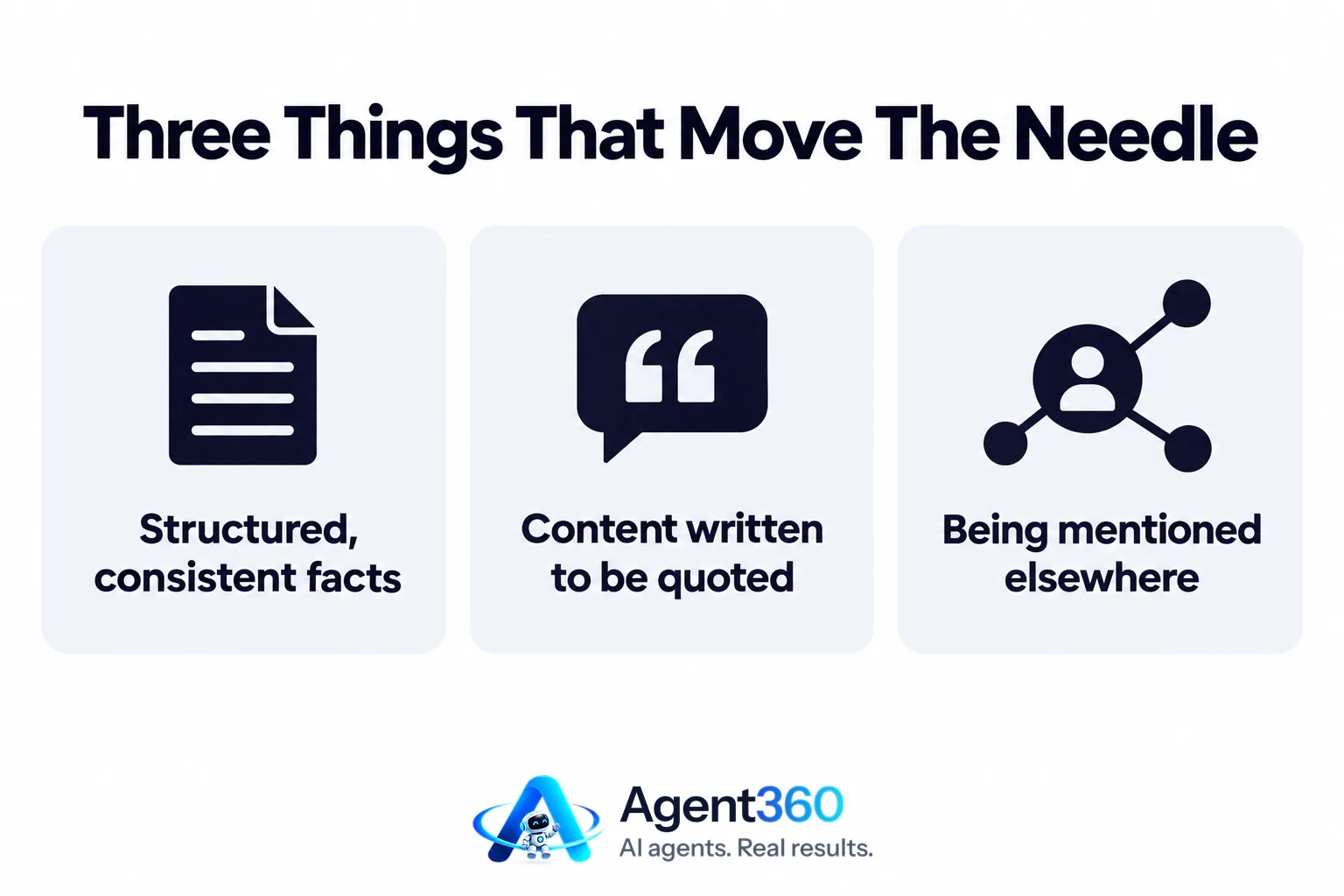
Three things move the needle in practice:
- Structured, consistent facts. Your name, address, phone, hours and services need to match exactly across your site, your Google Business Profile, and any directories that list you. Mismatches do not just confuse customers; they tell the model your data is unreliable.
- Content written to be quoted. Pages and FAQs that answer one specific question in one direct sentence get lifted into AI Overviews and chatbot answers far more often than long, scene-setting copy.
- Being mentioned elsewhere. Reviews, local press, directory listings and other sites referencing your business give the model outside confirmation. This is the part most businesses skip, and it is the part AEO and GEO work is built to address.
Google AI Overviews reward authority on page one, not just keywords
AI Overviews draw heavily from pages that already rank well organically, then restructure the information into a direct answer. So your AEO and your SEO are not two separate projects. They are the same work, viewed from two angles. A page that ranks on page one for “emergency plumber [city]” because it is fast, well-structured and genuinely answers the search is also the page Google is most likely to summarize at the top of the results. Chase the summary without the ranking underneath it, and there is nothing for Google to summarize.
How much does it cost to get to the top of Google Search?
It depends entirely on how competitive your market and service are, so be skeptical of anyone who quotes a flat number without asking first. A single-location business in a low-competition service, in a mid-size market, can move meaningfully with a modest monthly SEO and content budget. A business competing for “[service] near me” in a dense metro, against ten other companies doing the same thing, needs sustained content, review volume and link activity over months, not weeks. The cost rises with the competition, not with your ambition. The honest version: it is an ongoing monthly spend, not a one-time purchase, and anyone promising a guaranteed position for a fixed low fee is selling something other than SEO.
Is SEO worth it for a small business?
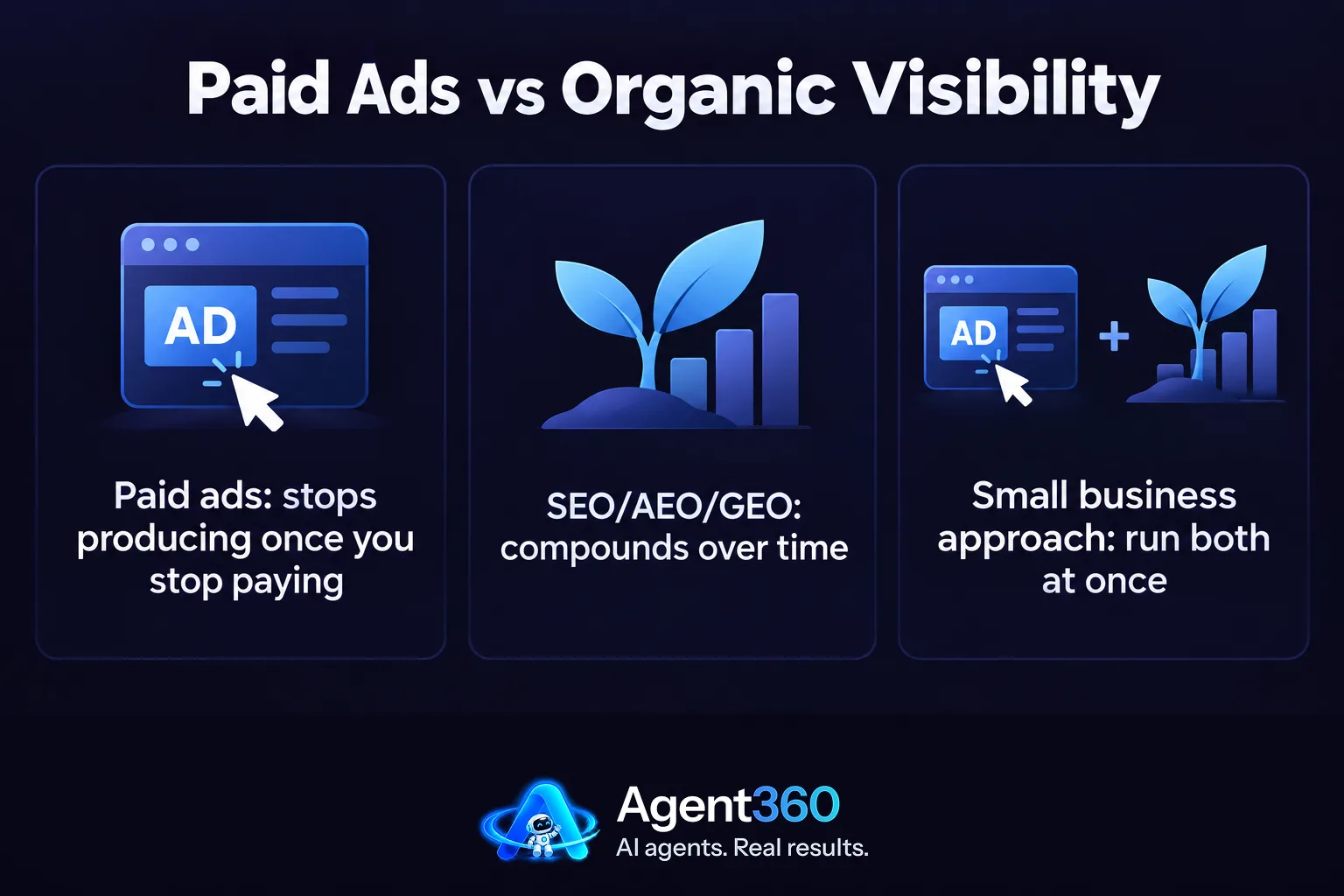
Worth it compared to what, exactly. Paid ads stop producing the moment you stop paying. SEO, AEO and GEO compound — an article or a review that ranks or gets cited in month three is still working in month eighteen without further spend. The tradeoff is time: nothing here moves in a week. For a small business with a tight monthly budget, the practical answer is to run both at once, ads for leads now, organic and AI visibility for the leads that keep arriving after the ad budget gets reallocated elsewhere. Treating them as one system, tracked on one dashboard, is the only way to know which dollars are actually compounding.
How do you get featured in AI search results?
Start with the gap between “listed” and “featured.” Being listed means your Google Business Profile exists and your website is indexed. Being featured means a model chose your business, by name, as the answer. Closing that gap takes specifics: service pages that name exact services and prices rather than vague categories, an FAQ section on every service page phrased the way customers actually ask the question, a steady stream of recent reviews mentioning specific services by name, and a Google Business Profile kept current with posts, hours and photos. None of this is exotic. It is unglamorous maintenance work, done consistently, across every channel at once, which is exactly why most small businesses do not get around to it, and most generalist agencies do not bundle it in.

Who actually does this work
Three kinds of providers can plausibly do this: a specialist SEO consultant who adds AEO as a sideline, a large agency that bills AEO and GEO as a separate add-on project, or a service that treats SEO, AEO, GEO, your Google Business Profile, your reviews and your website as one connected system from the start. The third approach matters because the inputs overlap — the review you collect after a job also feeds your AI visibility, and the FAQ you write for your service page also becomes the answer an AI reads out loud. Booked runs SEO, local SEO, Google Business, AEO and GEO together as one part of its plans from $297 a month, month to month, with no setup fee, rather than pricing AI visibility as a bolt-on after the fact. Compare that against whatever you are already paying for separate pieces on the pricing page before deciding who should own this.
Common questions
How long does it take to show up in AI answers?
There is no fixed timeline. It depends on how much reliable, structured information about your business already exists, and how competitive your service and area are. Expect early movement in Google Business Profile visibility within weeks, and broader AI-answer visibility to build over months as reviews, citations and content accumulate.
Can I do this myself instead of hiring anyone?
Yes, if you have the time to keep your listings consistent, write specific service pages, collect reviews after every job, and check every month how AI tools are answering questions about your industry. Most owners find the maintenance is the part that slips once the business gets busy, which is the usual reason this work gets handed off.
Does paying for Google or Meta ads help AI recommend me?
Not directly. Ads buy visibility while you are paying for it; AI Overviews and chatbot answers are built from organic signals — your reviews, your site, your listings. The two can run side by side under paid lead generation, but one is not a substitute for the other, and no amount of ad spend will get ChatGPT to say your name.
More articles
- Booked vs Businessallinone: a fair, side-by-side comparison
- Booked vs Scorpion: a fair, side-by-side comparison
- Booked vs Instantly: a fair, side-by-side comparison
- Booked vs BrightLocal: a fair, side-by-side comparison
- Booked vs Vendasta: a fair, side-by-side comparison
- Best Marketing Agency for Dental, HVAC or Auto Repair
- Is There a Cheaper Alternative to Thryv or LOCALiQ?
- Best Alternatives to Scorpion for Local Business Marketing
